
How NdFeB Disc Magnets Are Produced
NdFeB disc magnets are made from neodymium, iron, and boron, and are widely used in electronics, motors, sensors, and magnetic assemblies due to their strong magnetic properties. The production process involves precise material preparation, shaping, sintering, and finishing to ensure performance and durability.
Material Preparation
The first step in producing NdFeB disc magnets is selecting and preparing raw materials. Neodymium, iron, and boron powders are accurately measured and blended to form a homogeneous alloy. Additional elements, such as dysprosium or cobalt, may be added to improve thermal stability or corrosion resistance. The mixture is then milled into fine powders suitable for compacting and shaping.
Pressing and Forming
The powdered alloy is pressed into a disc shape using uniaxial or isostatic pressing methods. During pressing, a magnetic field is often applied to align the particles and enhance the magnet’s magnetic properties. The pressing process ensures the disc achieves the desired density and preliminary shape, which is critical for the next sintering step.
Sintering
Pressed discs are sintered at high temperatures in a controlled atmosphere. Sintering densifies the material while preserving the alignment of magnetic domains. Careful control of temperature and atmosphere prevents oxidation and maintains the magnetic performance of the discs.
Machining and Surface Treatment
After sintering, the discs are machined to precise dimensions, including grinding, cutting, or drilling as required. Surface coatings, such as nickel, zinc, or epoxy, are applied to improve corrosion resistance and protect the magnet in various operating environments.
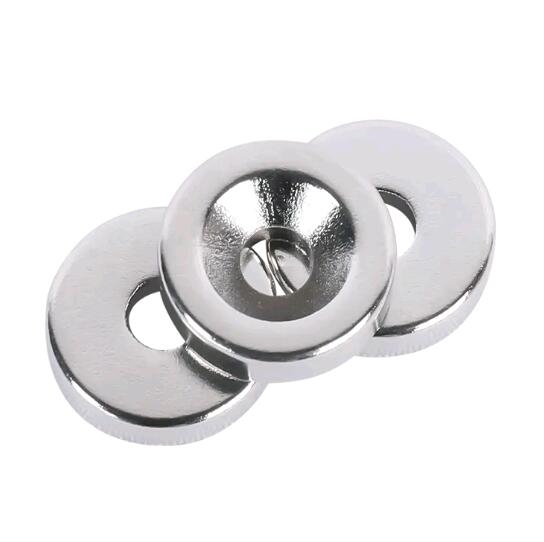
https://www.mlmagnet.com/product/ndfeb-ring-shape-magnet/ring-neodymium-magnets-with-hole.html
These are ring neodymium magnets with holes used in various applications where they can be stuck and repositioned with ease during use. Neodymium ring magnets are one of the strongest permanent magnetic materials available and have high resistance to demagnetization. They are ideal for applications such as jewelry, watch bands, security systems, calculators, and games.
 Spanish
 English
 Arabic
 French
 Portuguese
 Deutsch
 Turkish
 Dutch
Dutch
 Italiano
 Russian
 Romaian
 Portuguese (Brazil)
 Greek
Greek
