
Subpoena Service in California: A Practical Guide to Getting Business Records
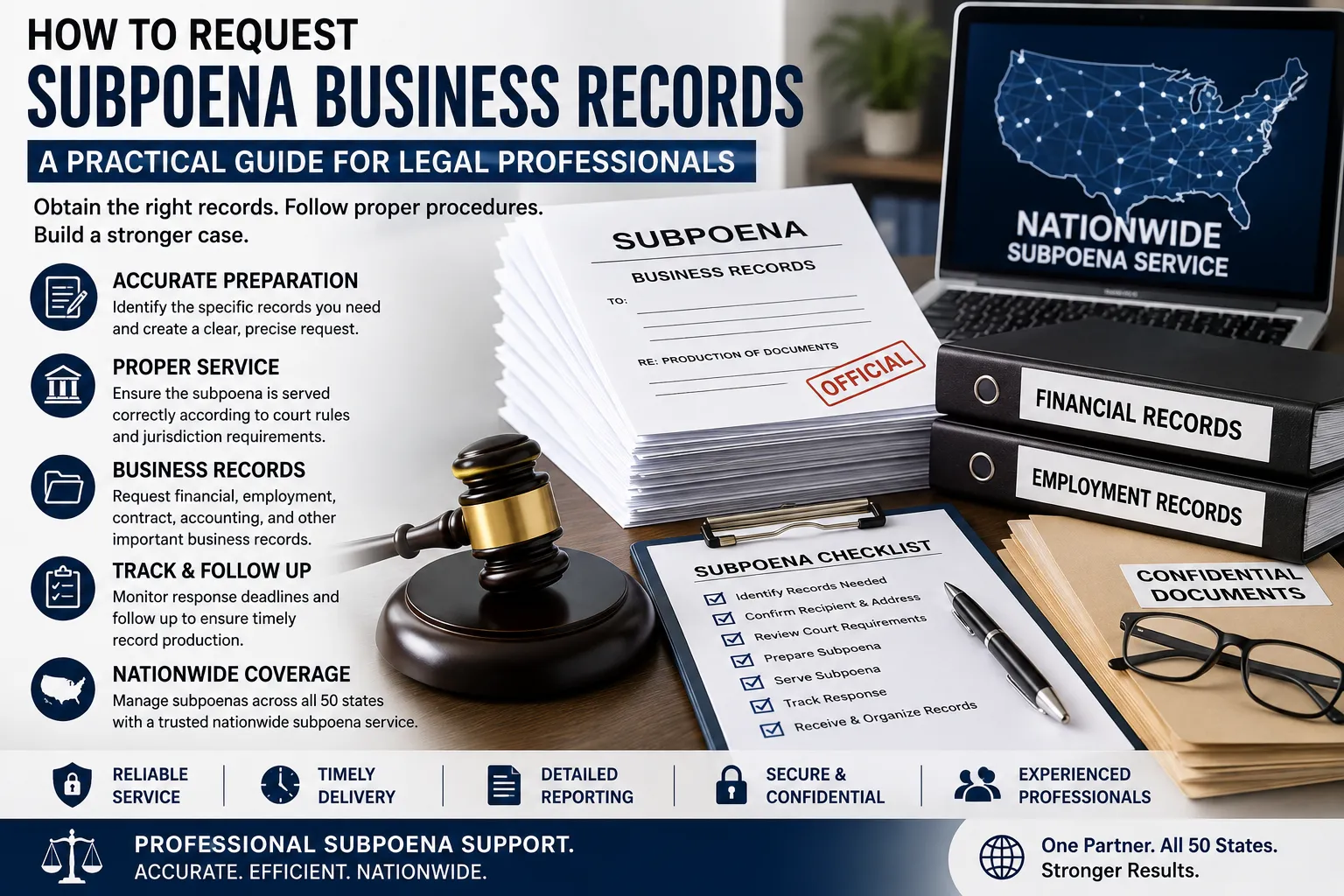
Legal cases often depend on information held by someone who is not directly involved in the dispute. A company may have financial records, contracts, employment documents, transaction histories, insurance files, or other information that could help establish important facts. When informal requests are not enough, a subpoena may provide a formal way to seek records when permitted under the applicable legal rules.
Handling a subpoena requires more than preparing a document and delivering it. The legal team must identify the appropriate records custodian, determine what information is relevant, follow applicable service procedures, monitor deadlines, and maintain documentation of the assignment.
This is where professional subpoena service in California can provide valuable administrative support. For law firms handling matters in multiple states, nationwide coordination can make the process even more efficient.
What Is a Business Records Subpoena?
A business records subpoena is a legal document used to request specific records from a business or other organization in connection with a legal proceeding. The records may belong to a company, employer, financial institution, healthcare organization, insurance provider, or another third-party custodian.
The type of information requested depends on the case. Examples can include:
- Financial records
- Business contracts
- Invoices and receipts
- Employment records
- Payroll information
- Insurance documents
- Corporate records
- Account statements
- Property documents
- Transaction histories
- Business communications
A carefully prepared request should identify the records with enough detail for the recipient to understand what is being requested.
Why California Subpoena Service Requires Attention to Detail
California legal proceedings can involve specific procedural requirements concerning subpoena preparation, notice, service, and document production. The appropriate process may also depend on the type of proceeding and the records being requested.
For example, a request for business records can involve different considerations from a subpoena requiring an individual to appear and testify.
This means legal professionals should avoid assuming that the same process applies to every subpoena assignment.
A mistake involving the recipient's information, service location, document description, or timing can create unnecessary delays.
Common Problems When Requesting Business Records
Law firms may encounter several challenges when trying to obtain records from a third party.
Incorrect Recipient Information
Large organizations may have multiple offices, departments, or records custodians. Sending a subpoena to the wrong location can delay the assignment.
Unclear Record Requests
A request that does not clearly identify the desired information can lead to confusion, incomplete production, or additional correspondence.
Tight Deadlines
Attorneys may need records before a deposition, hearing, mediation, or trial. Waiting too long to initiate the process can leave little time to resolve service or production issues.
Multiple Jurisdictions
A California case may involve businesses or records located outside California. Coordinating several service providers can quickly become an administrative burden.
Incomplete Documentation
Proof of service and assignment records are important for maintaining an organized litigation file. Missing documentation can create additional work later.
How Professional Subpoena Services Can Help
Professional subpoena support is designed to reduce the logistical workload associated with serving legal documents.
A provider may assist with:
- Subpoena service coordination
- Business record subpoena assignments
- Process server coordination
- Service status updates
- Proof of service documentation
- Multi-location assignments
- Record retrieval support
- Document reproduction
- Litigation support
The legal team remains responsible for determining the legal strategy and requirements of the case, while the service provider can handle the logistical side of the assignment.
7 Steps for Managing a California Business Records Request
1. Determine What Evidence Is Needed
Start by identifying the information that could reasonably assist with the case.
Consider the relevant:
- Documents
- Accounts
- Transactions
- Individuals
- Businesses
- Date ranges
- Events
A focused request can make the records process easier to manage.
2. Identify the Correct Record Custodian
Determine who actually maintains or controls the requested information.
For a large corporation, this may require additional research because records can be distributed across different offices or departments.
Accurate recipient information can help prevent unsuccessful service attempts.
3. Select the Appropriate Subpoena
The subpoena should correspond with the purpose of the request.
For example, a legal team seeking documents may use a records-production subpoena, while a matter requiring testimony may involve a different type of subpoena.
Attorneys should determine the appropriate document and procedure based on the circumstances of the case.
4. Review Applicable Requirements
Before service, review the procedural requirements applicable to the case.
Important considerations may include:
- Required forms
- Service method
- Notice requirements
- Production date
- Applicable fees
- Objection procedures
- Court-specific requirements
Because requirements can change and vary by situation, legal professionals should verify the current rules before proceeding.
5. Arrange Professional Service
Once the subpoena is ready, arranging reliable service is essential.
A professional process server can deliver the document according to the applicable requirements and provide information about the result of the assignment.
This can be particularly helpful when the recipient is located outside the law firm's normal service area.
6. Monitor the Assignment
A subpoena request should not disappear into a filing system after service.
Track important information such as:
- Service date
- Recipient
- Location
- Attempt history
- Production deadline
- Service outcome
- Follow-up requirements
Organized tracking becomes even more important when several subpoenas are active simultaneously.
7. Organize the Records After Production
Once records are received, they may require additional processing.
Large productions can be scanned, copied, indexed, Bates numbered, categorized, or converted into searchable digital files depending on the needs of the legal team.
Combining subpoena support with document management services can create a smoother litigation workflow.
When Is Nationwide Subpoena Service Useful?
Not every legal matter stays within one state.
A California lawsuit might involve:
- A corporation headquartered in another state
- A financial institution located elsewhere
- A vendor in another jurisdiction
- Records stored outside California
- Witnesses in different states
Managing each assignment independently can create unnecessary communication and coordination.
A nationwide subpoena service allows legal teams to work with a centralized provider for assignments across different locations. This can be particularly useful for large litigation matters and law firms with clients operating throughout the United States.
Benefits of Using One Nationwide Provider
Using a centralized provider can offer several practical advantages.
Consistent Communication
Instead of contacting multiple service providers, legal staff can communicate through one primary point of contact.
Easier Assignment Tracking
Multiple subpoena assignments can be monitored through a consistent reporting process.
Reduced Administrative Work
Legal assistants and paralegals spend less time coordinating individual service providers.
Broader Geographic Coverage
Nationwide support can be valuable when a case involves records or custodians outside California.
Organized Documentation
Service results and related records can be maintained in a more consistent manner.
How to Choose a Subpoena Service Provider
Before selecting a provider, consider the company's experience, geographic coverage, communication practices, and ability to handle time-sensitive assignments.
Useful questions include:
- Do you handle subpoena service throughout California?
- Can you coordinate assignments in other states?
- How are service attempts reported?
- Will proof of service be provided?
- How quickly are status updates delivered?
- Can you manage multiple subpoena assignments?
- Do you offer related litigation support?
- How are confidential documents handled?
A provider should offer clear communication from assignment acceptance through completion.
Mistakes That Can Cause Unnecessary Delays
Legal teams can reduce avoidable problems by planning ahead.
Common mistakes include:
- Waiting until the deadline is approaching
- Using outdated recipient information
- Sending requests to the wrong location
- Failing to identify records clearly
- Overlooking applicable notice requirements
- Not tracking service attempts
- Losing proof of service
- Assuming procedures are identical across states
A well-organized process gives the legal team more time to address unexpected issues.
Frequently Asked Questions
What records can be requested from a business?
Depending on the case and applicable law, a subpoena may seek financial records, contracts, employment documents, transaction information, insurance records, corporate documents, or other relevant business records.
Can a California subpoena involve a business located in another state?
Potentially, yes, but the applicable procedure depends on the circumstances and jurisdiction involved. Legal counsel should determine the appropriate process before proceeding.
Why use professional subpoena services?
Professional service providers can reduce administrative work by coordinating document delivery, tracking assignments, reporting service results, and maintaining service documentation.
Can one provider manage subpoenas nationwide?
Many legal support companies offer nationwide coordination. This can be especially useful for law firms handling multi-state litigation or large numbers of third-party record requests.
Final Thoughts
Obtaining business records can be an important part of discovery, but the process requires organization and attention to procedural details. Identifying the right records, preparing the appropriate subpoena, arranging proper service, tracking deadlines, and maintaining accurate documentation can help prevent unnecessary setbacks.
Professional subpoena service in California can provide law firms with practical assistance when legal documents need to be delivered efficiently and documented properly. When a case extends beyond California, a nationwide subpoena service can make multi-state assignments easier to coordinate through a centralized workflow.

 English
 Arabic
 French
 Spanish
 Portuguese
 Deutsch
 Turkish
 Dutch
Dutch
 Italiano
 Russian
 Portuguese (Brazil)
 Greek
Greek
