
Key Financial Metrics for Small Business Owners: How to Find Problems Before They Grow
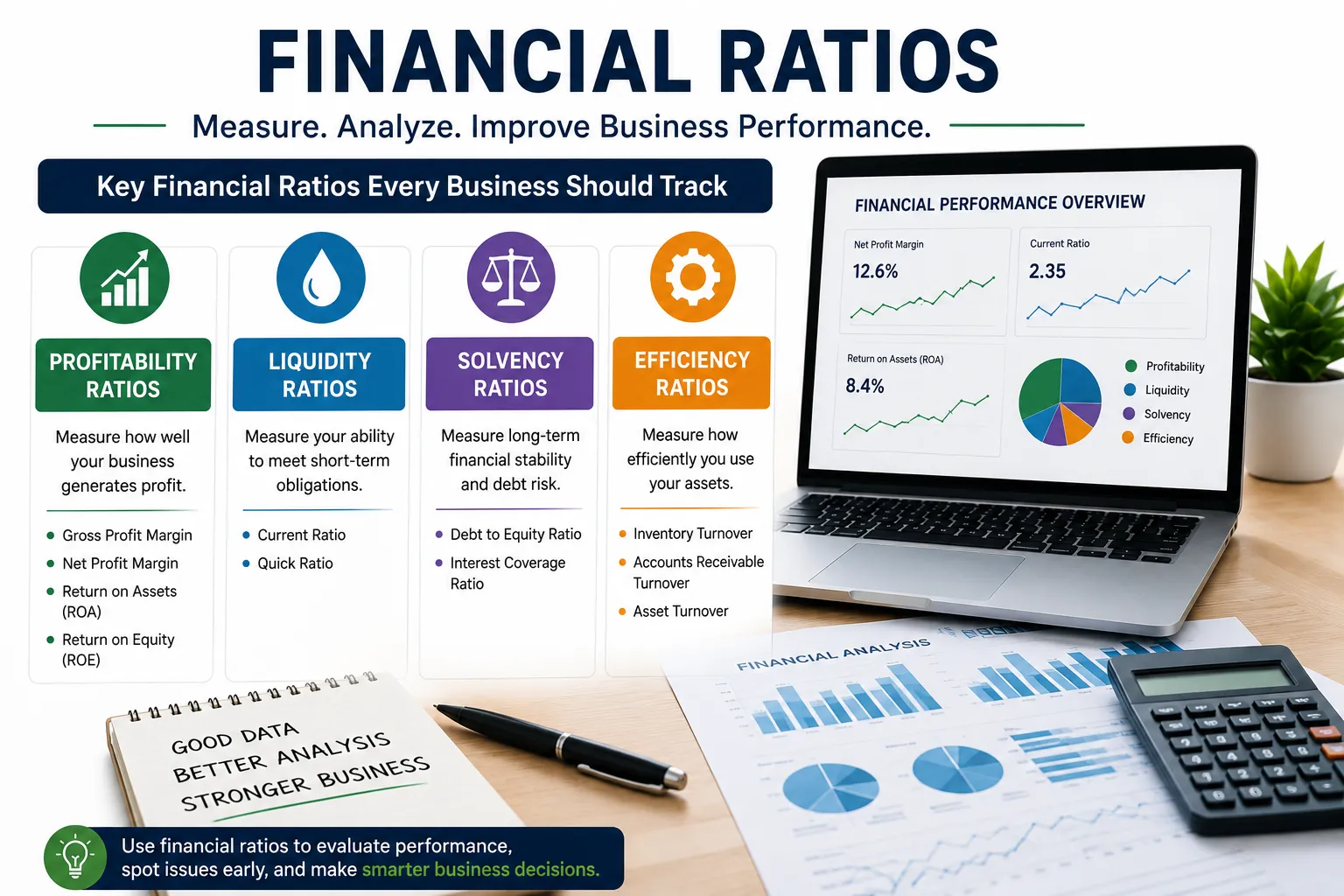
Running a small business requires more than generating sales. A company can have a growing customer base and increasing revenue while still experiencing financial problems behind the scenes. Rising expenses, slow customer payments, shrinking margins, or excessive debt can quietly reduce the strength of a business.
This is why understanding the key financial metrics for small business owners is essential. The right financial indicators help transform bookkeeping data into information that can support better decisions. Instead of waiting until the end of the year to discover a financial problem, business owners can monitor important numbers throughout the year and respond while there is still time to make changes.
The goal is not to track every number in an accounting system. A small business needs a practical set of measurements that explains profitability, cash flow, growth, costs, liquidity, and financial efficiency.
Why Financial Metrics Are Important for Small Businesses
Financial metrics provide a clearer picture of what is happening inside a company.
Revenue may tell you how much the business sold, but it does not tell you how much money remains after expenses. A bank balance shows available cash, but it does not necessarily show whether the company is profitable. Likewise, a profitable business can still experience cash shortages if customers pay slowly.
Financial analysis brings these pieces together.
Regularly reviewing financial performance can help owners:
- Detect declining profitability
- Monitor business growth
- Control unnecessary expenses
- Improve cash flow management
- Identify collection problems
- Evaluate pricing decisions
- Prepare realistic budgets
- Manage debt more effectively
- Compare actual results with goals
- Make informed decisions about future investments
Financial metrics become especially valuable when they are reviewed consistently rather than occasionally.
1. Revenue Growth
Revenue growth is one of the first measurements business owners should monitor. It shows whether income from sales is increasing, decreasing, or remaining relatively stable.
However, looking at revenue for only one month can be misleading. Small businesses often experience seasonal changes, unusual sales periods, or temporary fluctuations.
Compare revenue across different periods, such as:
- Month over month
- Quarter over quarter
- Year over year
- Actual revenue versus budget
- Current sales versus the same season last year
Consistent revenue growth can indicate increasing demand, but it should always be analyzed alongside expenses and profitability.
A business that increases sales by 20% while expenses increase by 30% may actually be moving in the wrong financial direction.
2. Gross Profit Margin
Gross profit margin measures how much revenue remains after deducting the direct costs associated with products or services.
The basic calculation is:
Gross Profit Margin = (Revenue − Cost of Goods Sold) ÷ Revenue × 100
For example, if a company generates $80,000 in revenue and has $48,000 in direct costs, its gross profit is $32,000 and its gross profit margin is 40%.
Tracking this percentage can help identify changes in supplier prices, production costs, labor expenses, or service delivery costs.
A declining gross margin may indicate that prices need to be reviewed or that direct costs are increasing too quickly.
3. Net Profit Margin
Net profit margin gives business owners a broader view of profitability because it considers the expenses remaining after revenue and direct costs.
The formula is:
Net Profit Margin = Net Profit ÷ Revenue × 100
This metric helps answer a simple but important question: How much of the company's revenue is actually becoming profit?
A company can have strong sales but a weak net profit margin if operating expenses are too high.
Reviewing this metric over time can help identify whether the business is becoming more efficient or whether expenses are consuming an increasing share of revenue.
4. Operating Expense Ratio
Operating expenses include the ongoing costs required to operate a business. These can include rent, payroll, insurance, marketing, software, utilities, professional fees, office expenses, and other overhead.
The operating expense ratio helps show how much of the company's revenue is being used to cover these costs.
Monitoring this ratio can help business owners identify expense categories that are growing faster than expected.
For example, if revenue remains stable but software subscriptions, advertising, and administrative expenses continue increasing, the owner may need to review whether those expenses are generating sufficient value.
Effective small business expense management does not mean eliminating every cost. It means understanding which expenses support the company's goals and which ones may be unnecessarily reducing profitability.
5. Cash Flow
Cash flow is one of the most important financial indicators because a business needs available cash to pay its obligations.
Cash flow tracks money entering and leaving the company. Cash inflows may come from customer payments, while outflows can include payroll, rent, supplier payments, taxes, loan payments, and operating expenses.
A business can be profitable but still experience a cash shortage if too much money is tied up in unpaid invoices or inventory.
Monitoring operating cash flow can help owners anticipate financial pressure and plan for upcoming obligations.
A simple cash flow forecast can also show when cash is expected to increase or decrease, giving management more time to respond.
6. Accounts Receivable Collection Period
Accounts receivable represents money customers owe to the business.
The longer customers take to pay, the longer the company has to operate without receiving cash from completed sales.
Tracking the average collection period can reveal whether customers are paying within expected terms.
If collection times are increasing, review:
- Invoice accuracy
- Payment terms
- Customer reminders
- Follow-up procedures
- Outstanding balances
- Credit policies
Improving collections can strengthen cash flow without requiring additional sales.
7. Accounts Payable
Accounts payable represents money the business owes to suppliers and other vendors.
Monitoring outstanding bills helps owners understand upcoming financial obligations and avoid unexpected cash pressure.
A business should know which invoices are due, when payments are required, and whether enough cash will be available to meet those obligations.
Good accounts payable management can also help maintain strong vendor relationships and reduce unnecessary late fees.
8. Current Ratio
The current ratio is a liquidity measurement that compares current assets with current liabilities.
Current Ratio = Current Assets ÷ Current Liabilities
Current assets may include cash and accounts receivable, while current liabilities can include short-term bills and other obligations due within the near term.
The ratio provides insight into the company's ability to meet short-term financial commitments.
However, business owners should not evaluate the current ratio without context. Different industries have different working capital requirements, and a healthy level for one business may not be appropriate for another.
9. Break-Even Point
The break-even point tells you how much the business needs to sell before total revenue covers total costs.
At break-even, the business is not making a profit or a loss.
Understanding this number can help with pricing, budgeting, sales planning, and expansion decisions.
For example, if a company needs $25,000 in monthly sales to cover its costs, management knows that sales below that level may create a loss unless expenses change.
Break-even analysis is particularly useful when a business is considering a new location, employee, product line, or other significant fixed expense.
10. Debt-to-Equity Ratio
Debt-to-equity ratio helps business owners understand how much of the company's financing comes from debt compared with owner's equity.
Debt can be useful when it funds productive investments, but excessive borrowing can increase monthly obligations and financial risk.
Monitoring debt levels helps owners evaluate whether the company has a manageable financial structure before taking on additional financing.
Debt should always be considered alongside cash flow, interest costs, repayment terms, and expected business performance.
11. Return on Investment
Return on investment, commonly called ROI, helps determine whether a business investment is generating sufficient value.
For example, a company might invest in advertising, new equipment, employee training, or software.
The investment should be evaluated against the financial benefit it produces.
A strong ROI can indicate that an investment is contributing to business performance. A weak ROI may suggest that the strategy needs to be adjusted.
This metric can prevent owners from continuing to spend money simply because a particular investment has always been part of the business.
Look at Metrics Together, Not Separately
One financial metric rarely tells the complete story.
Imagine a business reports strong revenue growth, but its net profit margin is falling and accounts receivable collection time is increasing.
Looking only at revenue would suggest that the company is performing well. Looking at the complete financial picture tells a different story.
The business may be growing sales but struggling to collect cash and control expenses.
This is why financial performance should be evaluated using multiple related indicators.
Use Financial Trends to Identify Problems Early
Financial metrics become more useful when business owners compare them over time.
A single month with higher expenses may not be concerning. However, if expenses increase for six consecutive months, the trend deserves investigation.
Similarly, a small decline in profit margin may not seem significant at first. If the decline continues, it could eventually have a major effect on annual profitability.
Trend analysis helps business owners move from reactive financial management to proactive planning.
Accurate Bookkeeping Makes Financial Metrics Reliable
Financial metrics depend on accurate accounting information.
If transactions are missing, expenses are categorized incorrectly, or bank accounts have not been reconciled, financial reports may not provide an accurate picture of business performance.
Regular bookkeeping, account reconciliation, accurate expense categorization, and timely financial reporting create a reliable foundation for financial analysis.
This is why bookkeeping and financial reporting should be treated as ongoing business processes rather than tasks completed only before tax filing.
How Often Should You Review Financial Metrics?
For many small businesses, a monthly financial review provides a useful balance between consistency and practicality.
Some information, such as cash balances and major outstanding invoices, may require more frequent monitoring. Other measurements can be reviewed monthly or quarterly.
The most important factor is consistency.
A business that reviews its financial performance every month can identify trends much earlier than one that waits until year-end.
Build a Simple Financial Dashboard
A small business does not need an overly complicated financial system.
A simple dashboard can include:
- Revenue growth
- Gross profit margin
- Net profit margin
- Operating expenses
- Operating cash flow
- Accounts receivable
- Accounts payable
- Current ratio
- Break-even point
- Debt-to-equity ratio
- Return on investment
Compare these results with previous periods and the company's budget.
If a metric changes significantly, investigate the reason rather than simply recording the result.
Final Thoughts
Understanding the key financial metrics for small business owners can provide valuable insight into profitability, liquidity, growth, and financial efficiency. Revenue growth can show whether sales are moving in the right direction, while profit margins reveal whether those sales are producing sufficient returns. Cash flow, receivables, expenses, debt, and liquidity measurements provide additional information about the company's financial stability.
The objective is not to become overwhelmed by financial terminology. Choose the metrics that matter most to your business, maintain accurate accounting records, and review the results consistently.

 English
 Arabic
 French
 Spanish
 Portuguese
 Deutsch
 Turkish
 Dutch
Dutch
 Russian
 Romaian
 Portuguese (Brazil)
 Greek
Greek
