
Automotive In-Vehicle Payment Market: Impact of Digital Wallet Integration 2032
Global Automotive In-Vehicle Payment Market Outlook 2025-2032
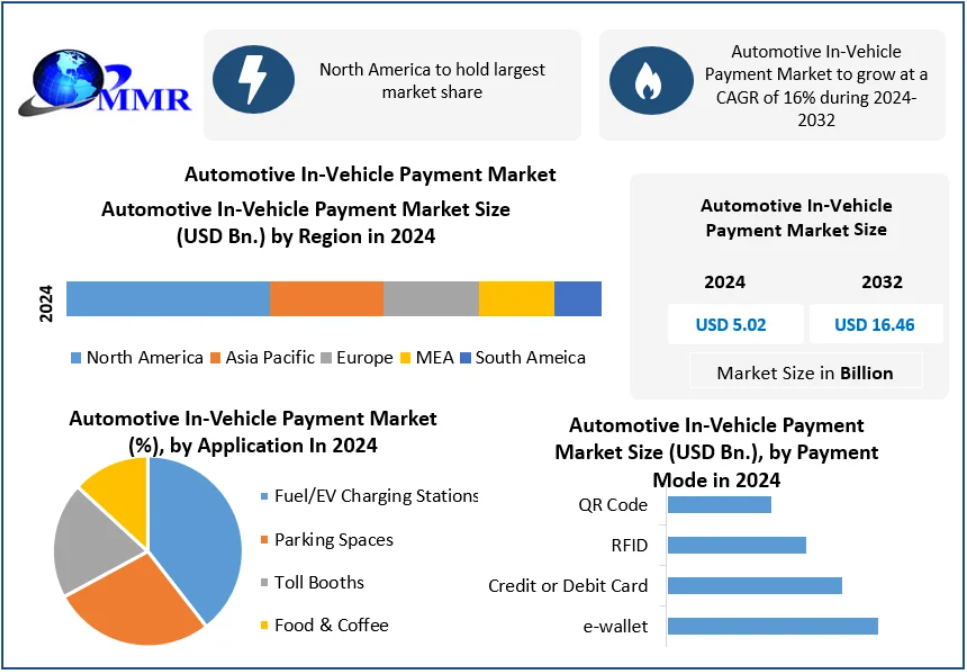
The Global Automotive In-Vehicle Payment Market was valued at USD 5.02 billion in 2024 and is projected to reach approximately USD 16.46 billion by 2032, growing at a CAGR of 16% during the forecast period. This rapid growth is fueled by the rising adoption of connected vehicles, increasing demand for digital and contactless payment solutions, and the integration of payment platforms into vehicle infotainment systems.
Market Overview
Automotive in-vehicle payment technology enables drivers to make real-time transactions directly from their vehicles, including payments for fuel, tolls, parking, and food. These systems leverage integrated payment gateways, e-wallets, and connected platforms, offering convenience and efficiency for both private consumers and commercial fleets.
The adoption of connected and electric vehicles is accelerating, prompting collaborations between automakers and fintech companies. Leading players such as General Motors, Tesla, Mastercard, Visa, and BMW are actively shaping the market through technological innovations and strategic partnerships.
To know the most attractive segments, click here for a free sample of the report:https://www.maximizemarketresearch.com/request-sample/81174/
Market Dynamics
Drivers:
- Rising demand for contactless payments: COVID-19 accelerated the preference for digital transactions, with millions of digital payments recorded worldwide. Consumers and fleets increasingly prefer in-vehicle systems for seamless transactions at fuel stations, tolls, and parking lots.
- Technological advancements in connected vehicles: Integration of the Internet of Things (IoT) allows vehicles to communicate with digital payment systems, enhancing convenience and operational efficiency.
- Collaborations with fintech companies: Partnerships with firms like Mastercard, Visa, and PayPal enable automakers to provide secure, tokenized, and real-time payment capabilities.
Restraints:
- Data security concerns: Centralized payment systems are susceptible to hacking, and consumers are cautious about sharing telematics and payment data. Robust cybersecurity measures increase system costs, which may hinder adoption in emerging markets.
- High implementation costs: The integration of secure in-vehicle payment infrastructure adds to vehicle cost, affecting affordability for some users.
Market Segmentation
By Application:
- Fuel/EV Charging Stations – Largest segment, driven by growing EV adoption and online payment integration.
- Parking Spaces – Increasing demand for seamless parking transactions.
- Toll Booths – Streamlined payments reduce traffic congestion.
- Food & Coffee – Fastest-growing segment, as consumers increasingly use in-car payment systems for quick service.
By Payment Mode:
- E-wallets: Dominant due to ease of integration with connected car systems and strong security features like tokenization and biometric authentication.
- RFID
- QR Code
- Credit or Debit Card
By Component Type:
- ECU (Electronic Control Unit)
- Code Scanner
- Camera
By Technology:
- Long Range Radio Frequency Identification (RFID)
- Bluetooth
- Low Energy Communication
To know the most attractive segments, click here for a free sample of the report:https://www.maximizemarketresearch.com/request-sample/81174/
Regional Insights
- North America dominates the market, supported by advanced automotive infrastructure, strong fintech ecosystems, and the presence of major players such as Visa, Mastercard, General Motors, Tesla, and IBM.
- Asia-Pacific is expected to be the fastest-growing region due to the rise of connected vehicles in China, India, Japan, and South Korea, heavy traffic conditions, and a growing preference for contactless payments.
- Europe maintains steady growth, driven by increasing EV adoption and fintech collaborations.
- Middle East & Africa and South America show moderate growth, with gradual digital infrastructure development.
Competitive Landscape
The market is highly competitive, with key players leveraging technological innovation and strategic partnerships:
- General Motors (USA): Enhancing vehicle intelligence through NVIDIA partnerships and expanding hands-free driving and payment features.
- Tesla (USA): Offers a fully integrated ecosystem with in-app vehicle payments, financing, and subscription services.
- Mastercard (USA): Provides virtual cards and embedded payment solutions through automaker collaborations.
- Visa (USA): Enables fintechs and automakers to integrate real-time payment systems via advanced APIs.
- Toyota Motor (Japan), BMW (Germany), Mercedes-Benz (Germany): Actively integrating connected and autonomous vehicle payment systems.
Other notable companies include Ford, Honda, Hyundai, Nissan, Alibaba, SAIC Motor, Shell, Gilbarco Veeder-Root, and EmbraerX, all contributing to innovation and regional expansion.
Key Trends
- Digital Wallet Integration: Apple Pay, Google Pay, Samsung Pay, and others are increasingly supported by in-car systems.
- Embedded Payment Platforms: OEMs are developing proprietary ecosystems like FordPay and Mercedes Pay for seamless transactions.
- Fintech Partnerships: Collaboration with payment providers ensures secure, tokenized, and real-time in-vehicle payments.
Recent Developments
- General Motors & NVIDIA (March 2025): Enhanced AI-driven vehicle experiences and digital twin simulations.
- GM Middle East (May 2025): Launched Super Cruise hands-free driving system in Oman, Kuwait, and Bahrain.
- Mastercard (April 2025): Invested $300 million in Corpay, expanding virtual card and B2B payment services.
- Visa (May 2025): Launched Visa Commercial Integrated Partners program for fintech-vehicle integration.
- Toyota Motor (January 2025): Collaborated with Continental and Aurora to power AI-based connected and autonomous vehicle systems.
Conclusion
The Automotive In-Vehicle Payment Market is poised for exponential growth through 2032, driven by digital payment adoption, connected vehicles, and fintech-automaker partnerships. While data security and high implementation costs remain challenges, advancements in IoT, AI, and secure payment platforms are expected to unlock new opportunities. North America continues to lead in market size, while Asia-Pacific emerges as the fastest-growing region, reflecting the global shift toward seamless, contactless automotive commerce.

 English
 Arabic
 French
 Spanish
 Portuguese
 Deutsch
 Turkish
 Dutch
Dutch
 Italiano
 Romaian
 Portuguese (Brazil)
 Greek
Greek
