
Railway Management System Market Trends & Future Forecast, 2030 | UnivDatos
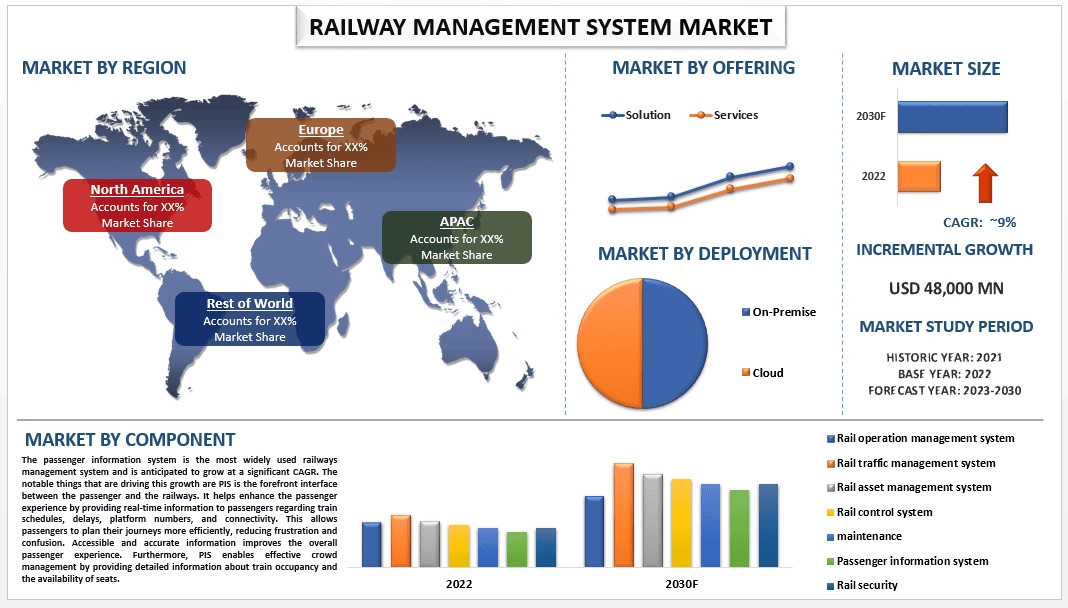
The railway management systems market was valued at approximately USD 48 billion in 2022 and is projected to grow at a compound annual growth rate (CAGR) of around 9% between 2023 and 2030. A railway management system refers to an integrated, software-driven platform designed to automate and optimize the various operational, administrative, and safety-related processes involved in managing a railway network. These systems enable railway operators and authorities to efficiently oversee train scheduling, ticketing and reservations, track and asset maintenance, inventory management, passenger communication, and performance reporting.
Modern railway management systems typically consist of multiple interconnected modules, including train and traffic management, passenger information systems, maintenance and asset management tools, and analytical dashboards. By leveraging real-time data, automation, and decision-support capabilities, these solutions significantly enhance operational efficiency, service reliability, safety standards, and overall passenger satisfaction. The growing demand for railway management systems is largely driven by expanding railway infrastructure, increasing rolling stock deployment, and a rising number of commuters opting for rail as a preferred mode of transportation.
In addition, the global push toward sustainable transportation has brought railways into sharper focus. Rail transport is widely recognized as one of the most energy-efficient and low-emission modes of mass transit, with a high degree of electrification compared to other transport systems. According to a report published by the International Energy Agency (IEA), railways account for nearly 8% of global passenger movement and about 7% of freight transportation, while consuming only 2% of the total energy used by the transport sector. The report further highlights that shifting current rail operations entirely to road transport would result in a 15% increase in global oil consumption and an additional 1.2 gigatonnes of greenhouse gas emissions, underscoring the critical role of railways in achieving climate goals.
Access sample report (including graphs, charts, and figures): https://univdatos.com/reports/railway-management-system-market?popup=report-enquiry
The railway management systems market features several prominent global players that continue to invest in innovation and digital transformation. Key companies operating in this space include Siemens Mobility, Alstom, Hitachi Ltd., Cisco Systems Inc., Wabtec Corporation, ABB, IBM, Indra, Honeywell International Inc., and Fujitsu. These organizations focus on developing advanced, intelligent solutions to improve rail network performance, safety, and sustainability.
Insights Presented in the Report
“Among offerings, both solutions and services are expected to register strong CAGR growth during the forecast period.”
Based on offerings, the market is segmented into solutions and services, both of which are expected to experience robust growth over the forecast period. These two segments work in close coordination to ensure uninterrupted and efficient railway operations. Solution providers focus on delivering advanced, energy-efficient technologies for rail infrastructure and rolling stock across intercity, urban, and high-speed rail networks. High-demand solutions include electrification systems, traction equipment, ventilation solutions, and integrated control systems for trains and infrastructure.
Click here to view the Report Description & TOC: https://univdatos.com/reports/railway-management-system-market
On the other hand, services such as IT and telecommunications support, system integration, maintenance services, and facility management are equally critical. These services ensure operational continuity, real-time connectivity, cybersecurity, and system reliability while also enhancing passenger convenience and experience. Together, solutions and services form the backbone of modern railway ecosystems.
“Among components, the passenger information system segment is expected to witness strong growth during the forecast period.”
The increasing adoption of PIS is driven by its direct impact on passenger experience and operational efficiency. As the primary interface between passengers and railway operators, PIS provides real-time updates on train schedules, delays, platform assignments, and service connectivity. Access to accurate and timely information enables passengers to plan journeys more effectively, reducing uncertainty and improving satisfaction.
Additionally, passenger information systems play a vital role in crowd management by displaying data related to train occupancy and seat availability. This allows operators to distribute passenger loads more evenly, optimize resource utilization, and minimize congestion during peak hours. Beyond operational benefits, PIS also opens new revenue-generation opportunities through targeted digital advertising. By leveraging passenger insights and travel patterns, railway operators can deliver relevant advertisements and promotional content, effectively monetizing their digital communication platforms.
Contact Us:
UnivDatos
Contact Number - +1 978 733 0253
Email - contact@univdatos.com
Website - www.univdatos.com
Linkedin- https://www.linkedin.com/company/univ-datos-market-insight/mycompany/

 English
 Arabic
 French
 Spanish
 Portuguese
 Deutsch
 Turkish
 Dutch
Dutch
 Italiano
 Russian
 Romaian
 Greek
Greek
