
How to Check AI-Generated Citations Before Submitting Your Research Paper
Writing centers and university librarians have increasingly started flagging a specific, recurring problem in student submissions: reference lists containing citations that look completely legitimate — proper formatting, plausible author names, real-sounding journal titles — but that don't actually exist anywhere. The sources were never published, because they were generated, not found.
This is the risk behind AI-generated citations, and it's becoming one of the more consequential pitfalls in modern academic writing. AI writing tools are genuinely useful for brainstorming, outlining, and clarifying ideas, but they are not reliable citation databases. When asked to produce a reference, some AI tools will generate one that follows the correct format and sounds academically plausible, without any guarantee that the source is real, accurate, or says what it's cited as saying.
This guide explains why this happens, how to catch it before submission, and how to build a verification habit that protects both the accuracy of your paper and your academic integrity standing.
What You'll Learn
-
Why AI tools sometimes generate citations for sources that don't exist
-
A step-by-step process for verifying every citation before submission
-
The difference between responsible AI use and citation risk
-
Warning signs that a reference list needs a closer look
-
Practical tools and habits for staying accurate under deadline pressure
Why AI Tools Sometimes Invent Citations
AI language models generate text by predicting plausible patterns based on their training, not by searching a live, verified database in real time. When asked for a citation on a specific topic, some tools will produce something that matches the statistical pattern of a real academic reference — a named author, a journal-sounding title, a page range, a year — without that specific combination actually existing anywhere.
This is often called "hallucination" in AI research contexts, and it's a well-documented limitation, not a rare glitch. It can also happen in subtler ways: a real author's name attached to a study they didn't write, or a real journal cited with a fabricated article title. The reference looks legitimate at a glance, which is exactly what makes it risky.
Academic best practices are clear on this point: an AI tool can help you find language to describe a source, understand a concept, or organize your citations, but it cannot substitute for verifying that a source is real and accurately represented.
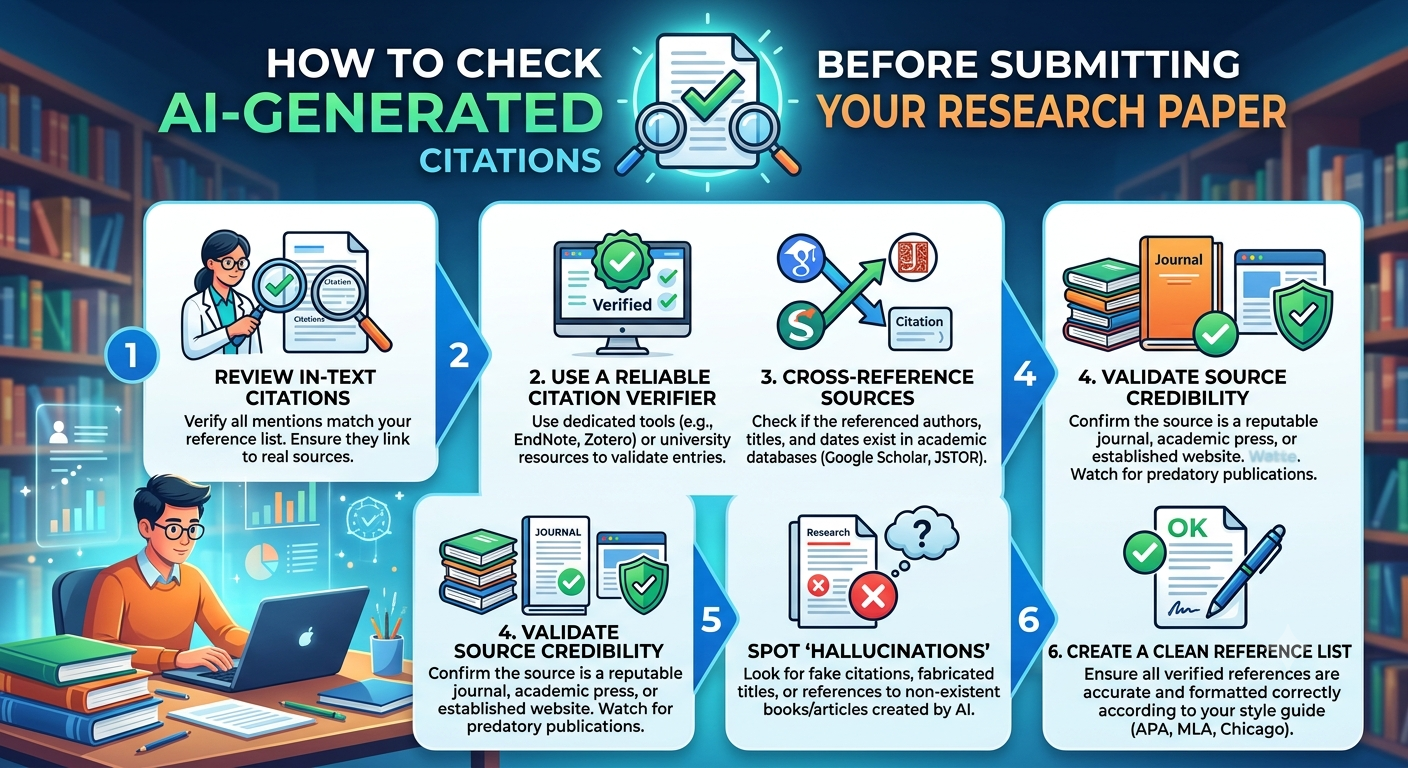
Step-by-Step: Verifying Every Citation Before Submission
Step 1: Search for the Source Directly
For every citation in your reference list, search the exact title in Google Scholar or your university library database. A real peer-reviewed source will typically appear with a matching author, journal, and publication year. If nothing matches, or if a similar but not identical source appears, that's a serious red flag.
Step 2: Confirm the DOI or Direct Link Resolves
Many academic sources include a DOI (Digital Object Identifier). Paste it into a DOI resolver or search it directly — a valid DOI should lead to the actual publication. A DOI that leads nowhere, or leads to a completely unrelated article, indicates the citation likely isn't accurate.
Step 3: Check That the Source Actually Says What You're Citing It For
Even when a source is real, AI tools can sometimes misattribute a claim to it — citing a legitimate study but describing a finding it didn't actually report. Skim the abstract or relevant section yourself to confirm the claim matches what the source actually says.
Step 4: Verify Author Names and Credentials
If an author's name seems unfamiliar for the field, a quick search of their name alongside their claimed institution can confirm whether they're a real, active researcher in that area.
Step 5: Cross-Check Formatting Against Your Required Citation Style
Once you've confirmed a source is real, double-check that its formatting matches your required style — APA, MLA, Chicago, Harvard, or IEEE — since AI tools can also make small formatting errors even for legitimate sources.
Actionable Takeaway: Before submission, go through your reference list one entry at a time and search each title independently. Treat this as a non-negotiable step, the same way you'd proofread for grammar — budget real time for it rather than treating it as optional.
Responsible AI Use vs. Citation Risk
|
Feature |
Responsible AI Use |
Citation Risk Zone |
|
Role of AI |
Brainstorming, clarifying, outlining |
Generating final citations directly |
|
Verification |
Every source checked against the original |
Citations accepted without checking |
|
Attribution |
Claims matched to what the source actually says |
Claims assumed accurate based on formatting alone |
|
Academic integrity |
Transparent, source-backed work |
Risk of fabricated or misrepresented references |
|
Outcome |
AI supports the research process |
AI output substitutes for real research |
Real Student Example
A master's student under deadline pressure used an AI tool to help generate a reference list for a literature review, given the volume of sources the assignment required. The formatting looked correct, and the citations seemed to match her topic closely. She submitted the paper without independently verifying each entry.
During grading, her instructor was unable to locate two of the cited studies in any database and flagged the paper for review. On investigation, it became clear the citations had been generated rather than found — a case of unverified AI use rather than intentional fabrication, but one with serious consequences for the assignment. After this experience, she adopted a strict verification habit: every AI-suggested source gets checked against Google Scholar or the university library database before it's added to any reference list. This kind of situation is avoidable, though outcomes and consequences vary by institution, and prevention is always easier than resolution after the fact.
Where This Connects to Academic Integrity
Submitting fabricated or misrepresented citations — even unintentionally — can raise serious academic integrity concerns, since a reference list is understood as a claim that the writer engaged with real, verifiable sources. Many institutions are actively updating their academic integrity policies to address AI-related citation issues specifically, and policies vary meaningfully between schools and departments.
Because of this variation, the safest approach is always the same: verify every source independently, and if you're ever unsure whether a specific use of AI tools is permitted for a given assignment, ask your instructor directly rather than assuming.
Warning Signs Your Reference List Needs a Closer Look
-
A citation you don't specifically remember finding yourself, especially if AI tools were used anywhere in your research process
-
A source that doesn't appear in Google Scholar, your library database, or a general search, even after multiple search attempts
-
A DOI that doesn't resolve, or resolves to an unrelated source
-
An author whose name doesn't turn up any other published work in the relevant field
-
A claim that seems slightly too convenient for your argument, without a clear, checkable basis in the source
-
A reference list assembled quickly, close to a deadline, without a dedicated verification pass
Academic consequences for submitting unverified or fabricated citations vary by institution and by whether the issue is judged intentional, but they can range from required revisions and grade penalties to formal academic integrity review. Given that range, treating citation verification as a mandatory step — not an optional one — is the safest standard to hold yourself to.
Expert Tips for Staying Accurate Under Deadline Pressure
-
Verify citations as you go, not all at once at the end. Checking a source the moment you add it to your notes is faster than auditing a full reference list the night before submission.
-
Use a citation manager (Zotero, Mendeley, EndNote) that pulls metadata directly from verified databases, reducing the chance of manually introduced errors.
-
Keep a research log noting where each source was actually found — this makes verification faster and creates a paper trail if a citation is ever questioned.
-
Treat AI-suggested sources as leads, not final citations — always locate and confirm the original independently.
-
Build in a dedicated "citation audit" step in your submission checklist, separate from grammar and formatting proofreading.
-
When in doubt about a source, don't include it. A slightly shorter, fully verified reference list is safer than a longer one with unconfirmed entries.
Frequently Asked Questions
1. Can AI tools ever be trusted to generate accurate citations?
Not reliably. Even well-designed AI tools can generate citations that look correct but reference sources that don't exist or misrepresent real ones. Every AI-suggested citation should be independently verified before use.
2. How can I quickly check if a citation is real?
Search the exact title in Google Scholar or your university library database, and check whether the author, journal, and year match. A valid DOI that resolves to the correct article is also a strong confirmation.
3. Is it my fault if an AI tool gives me a fake citation?
Academic integrity standards generally hold the writer responsible for verifying their own sources, regardless of how a citation was generated. This is why independent verification matters, even when using AI tools for research support.
4. What should I do if I already submitted a paper with an unverified AI-generated citation?
Policies vary by institution, but proactively contacting your instructor to correct the error is generally viewed more favorably than waiting for it to be discovered. Check your specific institution's academic integrity guidance for the appropriate next step.
5. Are citation managers like Zotero safer than AI-generated references?
Generally, yes, because citation managers typically pull metadata directly from verified databases rather than generating text predictively. They still require a manual accuracy check, but the underlying source data is far more reliable.
Final Thoughts
AI tools can genuinely support the research process, but citation accuracy is one area where verification can't be skipped or assumed. A reference list represents a direct claim that real, checkable sources back up your argument, and that claim needs to hold up under scrutiny. Building a habit of confirming every source — checking titles, DOIs, and claims against the original material — protects both the credibility of your paper and your academic integrity standing, and it takes far less time than resolving a flagged citation after submission.

 English
 Arabic
 French
 Spanish
 Deutsch
 Turkish
 Dutch
Dutch
 Italiano
 Russian
 Romaian
 Portuguese (Brazil)
 Greek
Greek
