
How Usage-Based Billing Benefits SaaS Companies
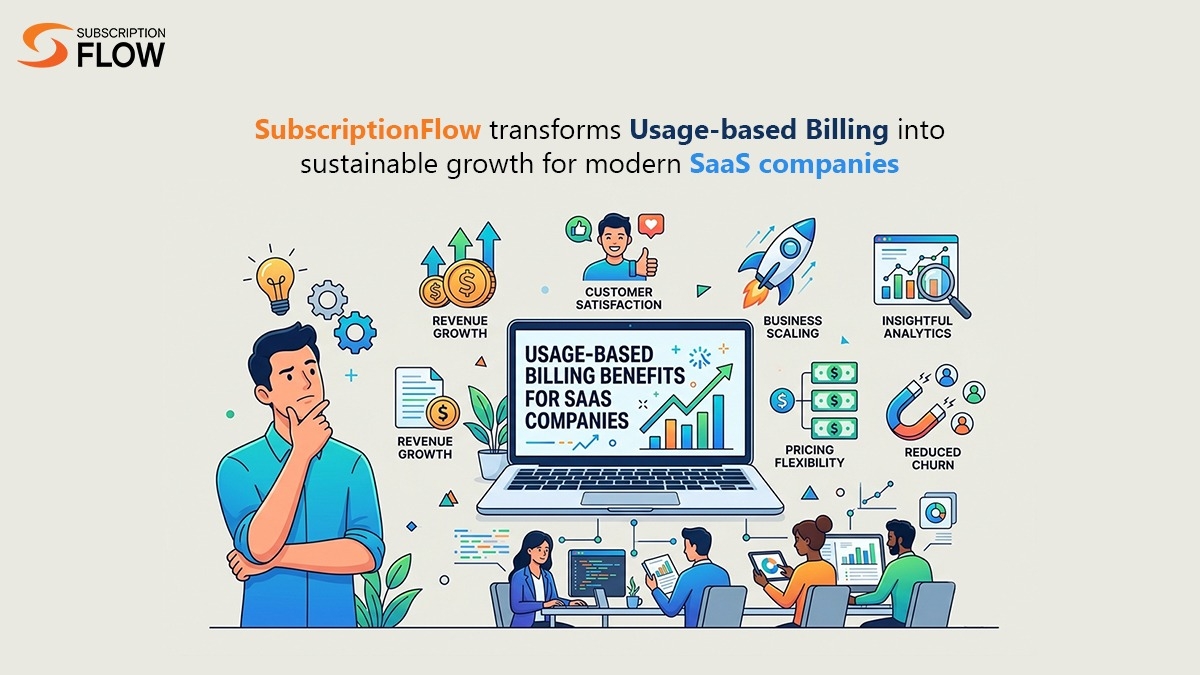
Software-as-a-Service (SaaS) businesses have traditionally relied on seat-based subscription pricing to generate recurring revenue. While this model has worked well for years, today's SaaS products increasingly deliver value through APIs, automation, AI capabilities, cloud computing, and data processing rather than simply the number of users. As businesses consume more platform resources without necessarily adding more users, traditional pricing models fail to capture the true value delivered. This is why usage-based billing has become one of the fastest-growing monetization strategies in the SaaS industry. By charging customers based on actual consumption, SaaS companies can align pricing with customer value while creating a scalable and sustainable revenue model.
Understanding Usage-Based Billing
Usage-based billing is a pricing approach where customers pay according to measurable product usage instead of a fixed subscription fee alone. Common billing metrics include API requests, data processed, storage consumed, compute time, transactions completed, messages sent, AI tokens, or other product-specific activities. Unlike flat-rate subscriptions, usage-based billing ensures customers only pay for the services they actually consume, creating a fairer relationship between cost and value.
Common Usage-Based Pricing Models
SaaS companies implement usage-based billing in several ways depending on their products and customer base. Some businesses offer pure pay-as-you-go pricing where every unit of usage is billed independently. Others adopt tiered pricing, allowing customers to receive lower per-unit costs as consumption increases. Volume pricing rewards high-usage customers with discounted rates across all usage, while prepaid credit systems require customers to purchase credits in advance and deduct usage from their balance. Many enterprise SaaS providers also combine fixed subscriptions with metered overages through hybrid pricing models, balancing predictable recurring revenue with flexible usage expansion.
Revenue Grows Alongside Customer Success
One of the greatest advantages of usage-based billing is that revenue naturally expands as customers increase product usage. Unlike traditional subscription models that require sales teams to negotiate plan upgrades, usage-based pricing automatically captures expansion revenue whenever customers process more transactions, store additional data, or consume more platform resources. This creates stronger net revenue retention while reducing sales friction and supporting long-term business growth.
Lower Customer Acquisition Barriers
High subscription fees often discourage prospective customers from trying new software solutions. Usage-based billing lowers this barrier by allowing customers to start with minimal investment and gradually increase spending as they realize value from the product. This approach is particularly effective for product-led growth (PLG) businesses, API-first platforms, and developer-focused SaaS products, where customers prefer paying according to actual usage rather than committing to expensive subscription tiers from the outset.
Aligning Pricing with Customer Value
Traditional seat-based pricing can unintentionally discourage product adoption by making customers hesitant to expand usage due to higher subscription costs. Usage-based billing removes these artificial limitations by allowing customers to consume resources according to their business needs while paying proportionately. As customers receive greater value from the platform, SaaS providers generate higher revenue without forcing unnecessary contract upgrades, creating a mutually beneficial pricing relationship.
Supporting Businesses of Every Size
One of the biggest pricing challenges for SaaS companies is serving startups and enterprise customers under the same pricing framework. Usage-based billing solves this issue by scaling naturally with customer demand. Smaller businesses can begin with low usage and affordable costs, while larger organizations consume significantly more resources and contribute proportionately higher revenue. This flexibility enables SaaS companies to serve a broader market without maintaining overly complex pricing structures.
Improving Customer Retention
Customers are more likely to remain loyal when pricing reflects actual usage. During periods of lower activity, their bills automatically decrease instead of forcing them to pay for unused capacity. This flexibility reduces cancellation rates because customers can temporarily reduce spending without abandoning the platform altogether. As business activity increases again, usage and revenue naturally recover without requiring customers to re-subscribe or renegotiate contracts.
Leveraging Usage Data for Better Business Decisions
Usage-based billing generates valuable operational insights beyond invoicing. Real-time consumption data allows SaaS companies to identify customers approaching usage limits, detect declining engagement that may indicate churn risk, monitor unusual activity, and discover opportunities for upselling. These insights enable product teams, customer success managers, and sales departments to make informed decisions based on actual customer behavior rather than assumptions.
Building a Reliable Billing Infrastructure
Successfully implementing usage-based billing requires accurate metering, flexible pricing engines, automated invoicing, payment processing, and revenue recognition. Every customer interaction must be measured in real time, converted into billable charges according to pricing rules, and presented through transparent invoices. Without reliable billing infrastructure, SaaS companies risk inaccurate invoices, customer disputes, and revenue leakage that can undermine trust and profitability.
How SubscriptionFlow Simplifies Usage-Based Billing
SubscriptionFlow enables SaaS businesses to implement sophisticated usage-based, tiered, volume-based, prepaid, and hybrid billing models without extensive engineering effort. The platform captures real-time usage events, applies customized pricing logic, automates invoicing, integrates payment gateways, and supports revenue recognition while providing customers with detailed billing transparency. This allows SaaS companies to focus on product innovation while SubscriptionFlow manages the operational complexity of modern billing.
Conclusion
As SaaS products continue evolving toward API-driven services, AI-powered automation, and cloud-native platforms, usage-based billing has become a strategic advantage rather than simply an alternative pricing model. By aligning pricing with actual customer consumption, businesses can improve customer satisfaction, increase revenue retention, expand market reach, and achieve sustainable long-term growth. Combined with robust billing automation through SubscriptionFlow, usage-based billing empowers SaaS companies to transform billing from an operational necessity into a powerful revenue growth engine.

 English
 Arabic
 French
 Spanish
 Portuguese
 Deutsch
 Turkish
 Dutch
Dutch
 Italiano
 Russian
 Portuguese (Brazil)
 Greek
Greek
