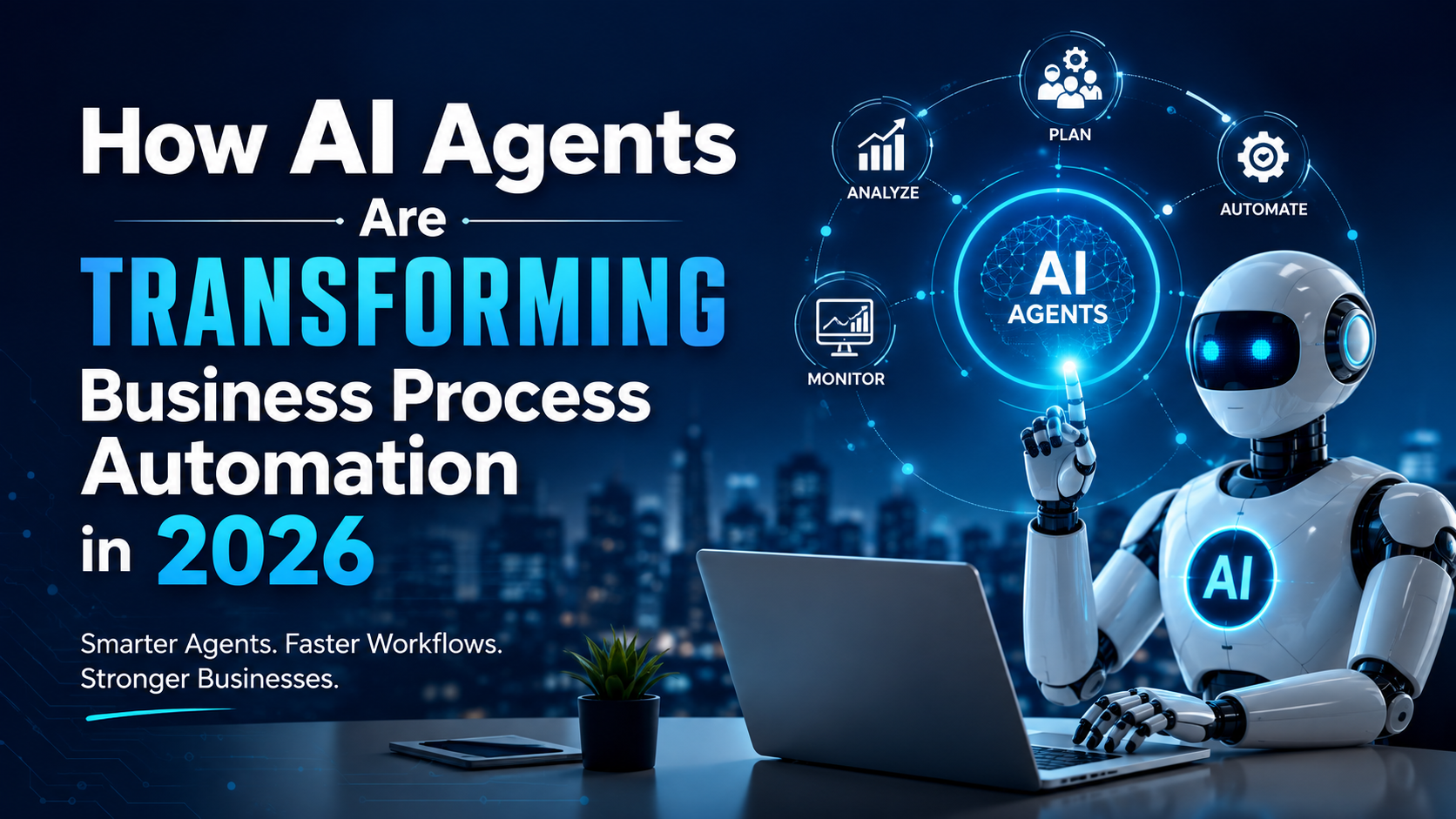
AI agents are becoming one of the most important developments in business automation in 2026. Unlike traditional automation systems that follow fixed rules and predefined workflows, AI agents can understand goals, process information, interact with business systems, and perform multiple tasks with limited human intervention.
Businesses are using AI agents to automate customer service, sales, finance, HR, IT operations, procurement, and other repetitive or complex processes. This shift is helping organizations reduce manual work, improve operational efficiency, and create more responsive business workflows.
What Are AI Agents?
AI agents are intelligent software systems designed to perform tasks or achieve specific goals by using artificial intelligence, business data, tools, APIs, and workflows.
A traditional automation might follow:
Trigger → Rule → Action
An AI agent can work more dynamically:
Goal → Understand → Plan → Use Tools → Execute → Evaluate → Continue or Escalate
For example, instead of simply sending an automated response to a customer, an AI customer service agent can understand the customer's request, review relevant information, check an order status, prepare a response, update the CRM, and escalate the issue when human assistance is required.
How AI Agents Differ From Traditional Automation
Traditional business automation is highly effective when processes are predictable. However, many business workflows involve emails, documents, conversations, exceptions, and changing circumstances.
Traditional Automation
AI Agent Automation
Rule-based
Goal-oriented
Fixed workflows
Dynamic workflows
Structured data
Structured + unstructured data
Predefined actions
Context-aware actions
Limited adaptability
More adaptable
Handles known scenarios
Can handle variable scenarios
Often task-focused
Can coordinate multiple tasks
This does not mean traditional automation is becoming obsolete. Instead, businesses can combine RPA, APIs, workflow automation, and AI agents to create more intelligent end-to-end processes.
Why AI Agents Matter for Business Automation in 2026
Businesses are under continuous pressure to improve productivity while controlling operational costs. AI agents provide a way to automate activities that previously required employees to interpret information and make routine decisions.
Some of the major benefits include:
Reduced manual effort
Faster workflow execution
Improved operational efficiency
24/7 task execution
Faster customer responses
Better data processing
Automated decision support
Reduced repetitive work
Improved employee productivity
Greater workflow scalability
The biggest opportunity is not simply automating individual tasks. AI agents can connect multiple tasks together and help automate complete business processes.
1. AI Agents Are Automating End-to-End Workflows
Traditional automation often focuses on individual tasks.
This allows organizations to automate a larger portion of the business process rather than only one step.
2. AI Agents Are Transforming Customer Service
Customer service is one of the most common applications of AI agents.
AI customer service agents can:
Understand customer questions
Search knowledge bases
Retrieve order information
Check account details
Generate responses
Create support tickets
Update CRM records
Escalate complex issues
For example, if a customer asks about a delayed order, an AI agent can check the order management system, identify the current status, explain the issue, and provide the appropriate response.
This can reduce the workload of customer support teams while enabling faster responses.
3. AI Agents Are Improving Sales Automation
Sales teams spend significant amounts of time on administrative tasks.
AI agents can automate activities such as:
Lead qualification
Prospect research
CRM updates
Follow-up emails
Meeting scheduling
Lead scoring
Customer segmentation
Sales reporting
For example, an AI sales agent can analyze an incoming lead, determine whether the prospect matches the company's ideal customer profile, update the CRM, draft a personalized message, and notify a sales representative.
This allows sales teams to spend more time on conversations and relationship building.
4. AI Agents Are Changing Finance Automation
Finance departments deal with large volumes of repetitive transactions and documents.
AI agents can assist with:
Invoice processing
Accounts payable
Expense management
Payment workflows
Reconciliation
Financial document analysis
Fraud or anomaly detection
Reporting
Consider an accounts payable workflow.
An AI agent can receive an invoice, extract relevant information, compare it against purchase orders, identify discrepancies, route the invoice for approval, and update the accounting system.
Human approval can remain part of the process for high-value or sensitive transactions.
5. AI Agents Are Automating HR Processes
Human resources departments also contain many repetitive workflows.
AI agents can assist with:
Resume screening
Candidate communication
Interview scheduling
Employee onboarding
Document collection
Policy questions
HR ticket management
Employee information requests
For example, an AI onboarding agent can provide new employees with required information, collect documents, create system requests, and notify HR when additional action is required.
6. AI Agents Are Improving IT Operations
IT departments manage large volumes of alerts, tickets, incidents, and repetitive support requests.
AI agents can help:
Analyze system alerts
Categorize tickets
Troubleshoot common issues
Retrieve technical documentation
Create incident records
Execute approved remediation actions
Escalate critical incidents
This creates an opportunity for AI-powered IT operations where agents assist employees and IT teams with routine operational tasks.
7. AI Agents Are Enhancing Marketing Automation
Marketing automation is moving beyond scheduled campaigns and basic workflows.
AI agents can support:
Content workflows
Audience segmentation
Lead nurturing
Campaign analysis
Customer research
Personalization
Email optimization
Marketing reporting
For example, an AI marketing agent could analyze campaign performance, identify underperforming segments, summarize customer behavior, and prepare recommendations for the marketing team.
8. AI Agents Can Connect Multiple Business Systems
One of the biggest advantages of AI agents is their ability to work with different tools and systems.
An AI agent can potentially interact with:
CRM platforms
ERP systems
Databases
Accounting software
Helpdesk platforms
Email systems
Communication tools
Internal applications
APIs
Cloud services
This allows businesses to build workflows that cross departmental and application boundaries.
For example:
CRM → AI Agent → ERP → Email → Support System
Instead of employees manually transferring information between these systems, automation can coordinate the workflow.
AI Agents and RPA: Better Together
Businesses do not necessarily need to choose between AI agents and RPA.
The two technologies can complement each other.
AI Agents
AI agents are useful for:
Understanding context
Processing natural language
Interpreting documents
Making bounded decisions
Planning tasks
Handling exceptions
RPA
RPA is useful for:
Repetitive data entry
Structured workflows
Legacy application interaction
Copying information between systems
Rule-based processes
A combined workflow might look like:
Customer Email → AI Agent → Understand Request → Decision → RPA Bot → Update Legacy System → Customer Notification
This hybrid approach can help organizations modernize automation without completely replacing existing systems.
AI Agents and Intelligent Workflow Orchestration
AI workflow orchestration is another important part of modern business automation.
Instead of one system performing every action, different AI agents and automation tools can handle specialized responsibilities.
An orchestration layer can coordinate these systems and determine which agent or application should handle each step.
This creates a more flexible automation architecture that can support complex business processes.
Human-in-the-Loop AI Automation
AI agents can automate many tasks, but businesses should not give unrestricted autonomy to every AI system.
Human oversight remains important for high-impact decisions.
A practical workflow could be:
AI Agent → Analyze → Recommend Action → Human Approval → Execute
Human approval can be required for:
Large financial transactions
Refunds
Legal decisions
Contract changes
Sensitive customer communications
Security actions
High-value procurement
This approach allows organizations to benefit from automation while maintaining control.
Key Challenges of AI Agent Automation
Despite their potential, AI agents introduce new challenges.
Security
AI agents may interact with sensitive business information and systems. Organizations need strong authentication, authorization, and access controls.
Accuracy
AI agents can make incorrect interpretations or recommendations. Critical workflows require validation and appropriate human oversight.
Integration
Connecting AI agents with CRM, ERP, databases, legacy applications, and APIs can require significant engineering work.
Governance
Businesses need clear rules around what AI agents can access, what actions they can perform, and when they must request human approval.
Monitoring
AI-powered workflows should be monitored for errors, unexpected behavior, performance issues, and business impact.
How Businesses Can Implement AI Agents in 2026
Businesses should avoid trying to automate every process at once. A phased approach can produce better results.
Step 1: Identify Repetitive Processes
Find workflows that consume significant employee time.
Step 2: Measure Current Performance
Record metrics such as processing time, cost, error rate, and employee effort.
Step 3: Select a Suitable Use Case
Start with a process where AI can provide measurable value without creating unnecessary risk.
Step 4: Integrate Business Systems
Connect the AI agent with the relevant CRM, ERP, database, API, or other applications.
Step 5: Define Permissions
Determine what the AI agent can read, modify, approve, or execute.
Step 6: Add Human Approval
Use human checkpoints for sensitive or high-impact decisions.
Step 7: Monitor and Optimize
Track automation performance and continuously improve the workflow.
Choosing an AI Automation Partner
Implementing AI agents requires more than selecting an AI model. Businesses need expertise in software development, automation, APIs, data, security, and workflow design.
Businesses looking for customized solutions can also work with an AI development company in USA that can build AI agents around their existing technology infrastructure and business requirements.
Organizations requiring broader application development, integrations, or enterprise software engineering may also benefit from working with a Software Development Company in Dallas or another experienced technology partner.
Future of AI Agents in Business Automation
AI agents are likely to become increasingly integrated into everyday business operations.
Future automation environments may combine:
AI Agents + RPA + APIs + Generative AI + Workflow Orchestration + Human Employees
Instead of isolated automation tools, businesses will increasingly build connected intelligent workflows that span departments and applications.
AI agents may become digital workers that assist teams with research, analysis, communication, documentation, administration, and operational execution.
However, successful adoption will depend on more than AI capabilities. Businesses will also need strong governance, secure integrations, reliable data, clear permissions, and measurable performance goals.
Conclusion
AI agents are transforming business process automation in 2026 by moving organizations beyond fixed, rule-based workflows toward more intelligent and adaptable automation.
From customer service and sales to finance, HR, marketing, and IT operations, AI agents can understand information, coordinate tasks, interact with business systems, and automate multi-step processes.
The most effective strategy is not to replace every existing automation technology. Instead, businesses should combine AI agents, RPA, APIs, workflow orchestration, and human oversight to create intelligent and controlled business processes.
Organizations that strategically adopt AI agents can reduce repetitive work, improve response times, increase employee productivity, and create scalable operations that are better prepared for the future.
Frequently Asked Questions
What are AI agents in business automation?
AI agents are intelligent software systems that can understand goals, process information, use business tools, and perform multiple actions to complete defined tasks or workflows.
How are AI agents different from RPA?
RPA primarily follows predefined rules and workflows, while AI agents can interpret context, process unstructured information, make bounded decisions, and coordinate multiple actions.
What business processes can AI agents automate?
AI agents can automate customer service, sales, finance, HR, marketing, IT support, procurement, document processing, reporting, and many other business workflows.
Can AI agents work with existing business software?
Yes. AI agents can be integrated with CRM, ERP, accounting, databases, helpdesk platforms, internal applications, and other systems through APIs, connectors, RPA, and workflow platforms.
Are AI agents safe for business automation?
AI agents can be used safely when organizations implement appropriate access controls, monitoring, governance, data protection, and human approval mechanisms for sensitive activities.
Should businesses replace RPA with AI agents?
Not necessarily. RPA remains valuable for predictable, rule-based tasks. Combining RPA with AI agents can create more flexible and powerful end-to-end automation.
How can a business start using AI agents?
Start with a repetitive, measurable workflow, define the desired outcome, connect the necessary systems, establish permissions and human approval rules, and measure the results before expanding to additional processes.


 English
 Arabic
 French
 Spanish
 Portuguese
 Deutsch
 Turkish
 Dutch
Dutch
 Italiano
 Russian
 Romaian
 Portuguese (Brazil)
