
IELTS vs PTE for UK Universities: Which Test Should You Take?
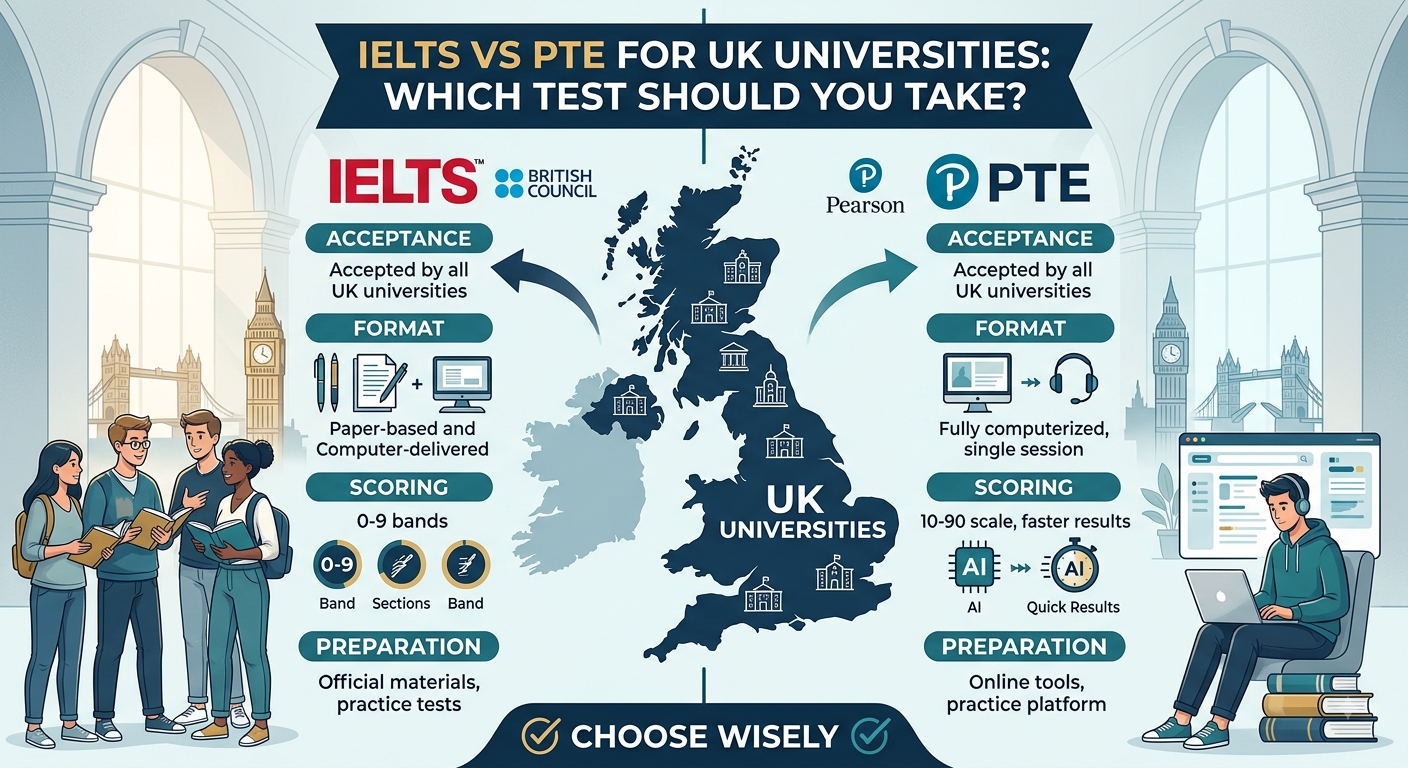
Every week, some student walks into our office and asks that same question , like it’s always the first day. They’ve basically narrowed the UK university shortlist, done the whole entry requirements check, and now it’s the language test that is blocking them. So, should they go for IELTS, or PTE? Their friends can not agree, not really, and their relatives have conflicting views too. And of course, the internet is full of advice that contradicts itself , over and over.
Let me clear this up for you. Both tests work. Both are accepted by UK universities. The difference lies in how you perform under specific conditions, and that's what most students overlook when making their choice.
The Fundamentals: What Each Test Actually Measures
IELTS and PTE are both English proficiency tests. They both assess reading, writing, speaking, and listening. But they do it differently, and those differences matter.
IELTS uses a 9-band scoring system. You get an overall score and individual scores for each skill. Most UK universities ask for 6.5 overall with no band less than 6.0. Some competitive programmes ask for 7.0 or 7.5.
PTE uses a scoring scale from 10 to 90. UK universities typically ask for scores between 58 and 65 overall, with minimums in each skill. The scoring is automated, which means no human examiner evaluates your speaking or writing responses.
The fundamental difference is the test format. IELTS offers a paper-based option in many locations, which some students prefer because they're comfortable with handwriting. PTE is entirely computer-based. You speak into a microphone, you type your responses, and an algorithm scores everything.
Speaking and Writing: The Real Decider
Here's where most students make their decision, often without realising it.
In IELTS, the speaking test is face-to-face with a human examiner. You have a conversation. There's back-and-forth interaction. If you're someone who thrives on human connection, who speaks better when there's someone listening and responding, this works in your favour.
But if you get nervous speaking to strangers, if you freeze when someone is watching you, IELTS can be a nightmare. We've seen brilliant students score 6.5 in listening and reading but crash to 5.5 in speaking because they couldn't relax in front of the examiner.
PTE eliminates this problem. You speak into a computer. There's no human watching, no judge mentally assessing your every word. For students who struggle with anxiety, this can be a game-changer. You just talk to the screen, knowing that an algorithm is evaluating your pronunciation, fluency, and content.
The writing section follows a similar pattern. In IELTS, human examiners read your essays and look for coherence, lexical resource, and grammatical range. They appreciate variety and nuance. In PTE, an algorithm checks your responses against a predefined template. It's looking for specific keywords and structures.
What this means is that PTE rewards students who can memorise templates and reproduce them accurately. IELTS rewards students who can think on their feet and express themselves naturally. Choose based on your strengths.
The Time Factor: Which Is Faster?
This matters more than you'd think, especially for students targeting specific intake deadlines.
IELTS results take 13 calendar days to release for the paper-based test. Computer-based IELTS results come in 3 to 5 days. PTE results are faster—typically available within 48 hours.
If you're rushing to meet a January intake deadline, those extra days can make the difference between securing your place and missing out. We've had students who took PTE specifically because they needed results quickly, and it worked in their favour.
Booking availability also varies. PTE test slots are generally more available because the testing system is fully computerised and runs more frequently. IELTS, especially the paper-based version, can be harder to book during peak application seasons.
The India Experience: Availability and Centres
Both tests are widely available across India. But there are differences.
IELTS has been in India for decades. Test centres are everywhere—metro cities, tier-2 cities, even smaller towns. The British Council and IDP both administer the test, so you have multiple options.
PTE is still newer, but its growing fast. Like, the larger cities have a few test centres around. The whole booking process feels pretty streamlined, and it’s all online mostly. So for students in places like Jaipur, the two tests are easy to get to pretty much right away.
Speaking of Jaipur, we've seen students benefit from local preparation options. IELTS Coaching in Jaipur tends to focus heavily on the speaking component because that's where Indian students traditionally struggle. Good coaching centres run mock interviews, help you build confidence, and teach you strategies for structuring your responses.
PTE Coaching in Jaipur takes a different approach. Because the test is computer-based, coaching focuses on mastering the algorithm. You learn templates for the writing section. You practise speaking clearly into a microphone. You understand how the scoring system works and what it penalises.
The coaching landscape has evolved. Students now choose their test partly based on which coaching centre they trust. If you have access to excellent IELTS coaching, that might tip your decision. If the PTE coaching in your city has a strong track record, that could be your answer.
UK University Acceptance: Does It Matter?
Here's the straightforward truth: UK universities accept both tests equally.
Some universities have a bit different requirements per each test, for instance they may want IELTS 6.5, or instead PTE 58 , yet once you satisfy the posted score threshold they generally dont really care which test it was that you took.
The same applies to the UK visa process. The Home Office accepts both IELTS and PTE for student visa applications. There's no advantage to choosing one over the other from a visa perspective.
The only exception is if you're applying to a specific course with a human interaction requirement—nursing, teaching, social work. Some of these courses prefer IELTS because the speaking test involves human interaction, which they feel better prepares students for client-facing roles. But even this is a preference, not a requirement.
The Retake Scenario
Nobody wants to think about this, but it happens. You take the test, you don't hit the score, and you need to retake.
IELTS allows you to retake individual sections if you're happy with your overall score but need to improve one area. This is a newer feature and not everyone knows about it. You can retake just the speaking or writing component without resitting the entire test.
PTE doesn't offer this option yet. If you need to improve your score, you retake the entire test. However, PTE tests are shorter and cheaper, so the inconvenience is somewhat balanced.
We generally tell students: if you're consistently scoring higher in some sections and lower in others, IELTS might be better because you can retake only the weak area. If your scores are balanced but need improvement across the board, PTE's lower test fee makes the retake less painful.
The Consultant's Role in This Decision
This is where a study abroad consultant actually earns their fee.
We don't just tell you which test to take. We assess your specific profile. We look at your history with English exams, your comfort with technology, your anxiety levels, and your target university requirements.
We've had students who wanted to take PTE because it seemed easier, but after assessing their English level, we realised they'd perform better on IELTS. We've had others who were convinced IELTS was the only option, but we showed them PTE data and they scored higher.
A good consultant also connects you with the right coaching. We know which centres in your city produce consistent results. We know which trainers specialise in the specific challenges Indian students face—intonation problems, hesitation in speaking, vocabulary gaps in writing.
Students who work with us don't waste time. They take the right test the first time, prepare effectively, and submit their scores early. This is especially critical for students from places like Jaipur, where coaching options are plentiful but not all are equally effective.
The Practical Takeaway
Here's my honest advice. If you're comfortable speaking to people and can handle a face-to-face interview, IELTS is a solid choice. The test is well-established, the materials are widely available, and you know exactly what to expect.
If you get nervous around strangers, if you're good at following structured templates, and if you want results quickly, PTE is worth considering. The computer-based format removes the human anxiety factor.
But don't decide in isolation. Take a practice test for both. See which one gives you a higher score. That's the test you should take.
And if you're still unsure, talk to someone who does this for a living. The money you spend on consultation is nothing compared to the time and stress you'll save by making the right choice from the start.

 English
 Arabic
 Spanish
 Portuguese
 Deutsch
 Turkish
 Dutch
Dutch
 Italiano
 Russian
 Romaian
 Portuguese (Brazil)
 Greek
Greek
