
How AWS Certification Exams Can Help You Build an AI Career
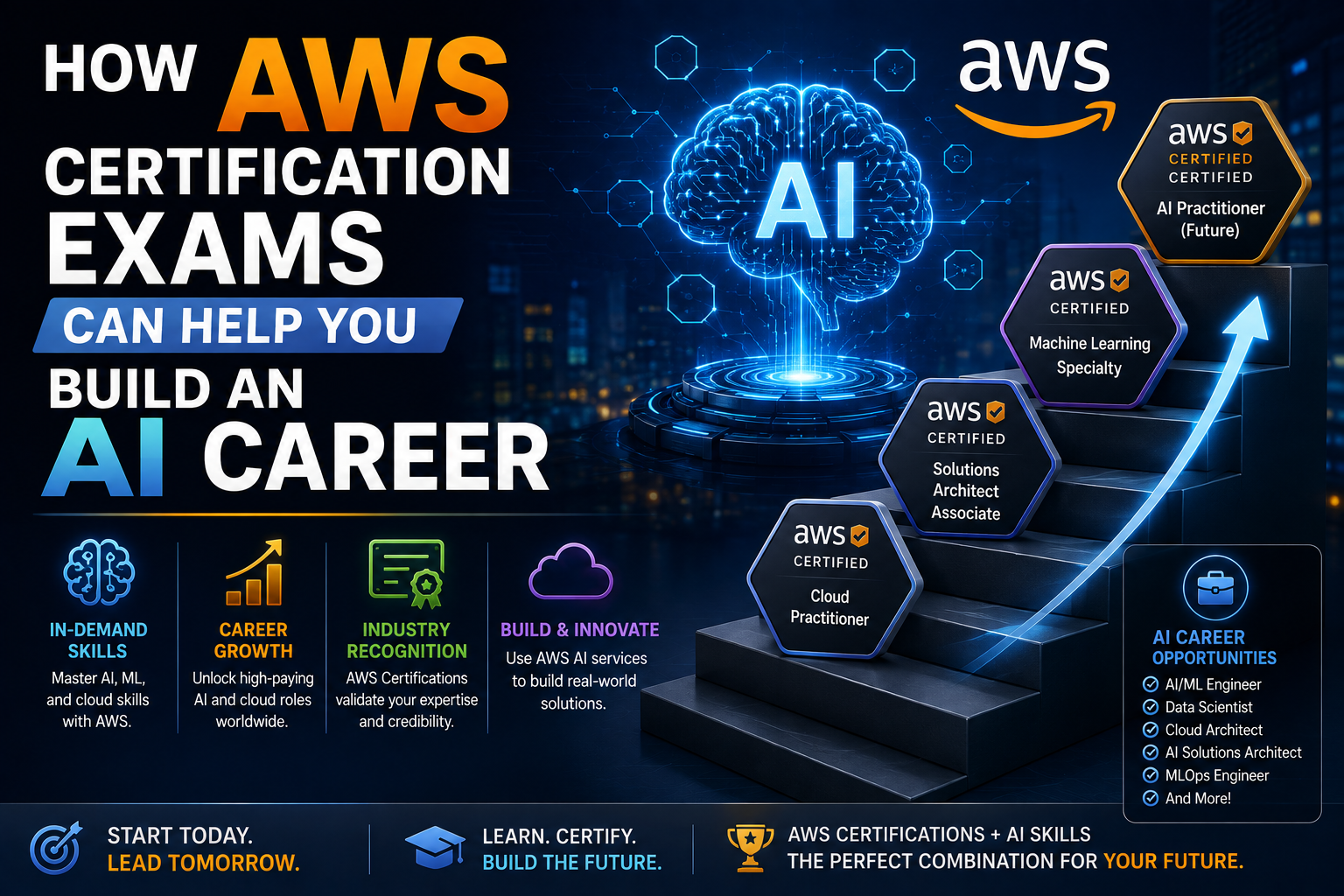
AWS Certification Artificial intelligence careers increasingly require a combination of machine learning knowledge, cloud infrastructure skills, data experience, and the ability to deploy AI systems into production. AWS certification exams can provide a structured way to develop and validate these skills while building familiarity with cloud-based AI services.
In 2026, AWS offers certification paths for learners at different stages. AWS Certified AI Practitioner focuses on foundational AI knowledge, Machine Learning Engineer – Associate targets production ML workloads, and Generative AI Developer – Professional validates advanced skills for building production-ready generative AI applications.
Why AWS Certifications Matter for AI Careers
Learning AI is not only about understanding algorithms. Modern AI professionals often work with cloud infrastructure, model deployment, APIs, data pipelines, security controls, monitoring, and scalable production systems.
AWS certification preparation can help candidates organize these skills around defined job responsibilities.
Potential benefits include:
- Building structured AI and ML knowledge
- Learning AWS AI services
- Developing cloud fundamentals
- Understanding production ML workflows
- Improving familiarity with generative AI
- Learning deployment and monitoring concepts
- Validating skills through a recognized assessment
Certification alone does not create an AI career, but it can provide direction for practical learning.
AWS AI Certification Paths in 2026
The main AWS certifications relevant to AI careers now target different experience levels.
| Certification | Level | Main Focus | Best For |
| AWS Certified AI Practitioner | Foundational | AI, ML and generative AI concepts | Beginners and business/technical professionals |
| Machine Learning Engineer – Associate | Associate | Building and operationalizing ML workloads | ML engineers and cloud practitioners |
| Generative AI Developer – Professional | Professional | Production generative AI applications | Experienced developers and AI engineers |
AWS retired the older Machine Learning – Specialty exam on March 31, 2026. Existing holders retain the certification until its normal expiration date, but new candidates now have more role-specific AI and ML options.
Start With AWS Certified AI Practitioner
AWS Certified AI Practitioner is the most accessible starting point for someone who wants to understand artificial intelligence without immediately entering advanced model engineering.
AWS states that the certification validates knowledge of AI, machine learning, generative AI concepts, and related use cases.
Who Should Consider AI Practitioner?
It can suit:
- IT professionals entering AI
- Cloud beginners
- Business analysts
- Project managers working with AI teams
- Developers beginning generative AI learning
- Professionals evaluating AI use cases
The certification is particularly useful if you need to understand how AI solutions fit into business and cloud environments before learning deeper implementation skills.
Move Into Machine Learning Engineering
AWS Certified Machine Learning Engineer – Associate is more technical.
AWS describes it as validating the ability to implement machine learning workloads in production and operationalize them using AWS. The current MLA-C01 exam specifically covers building, deploying, maintaining, and operationalizing machine learning solutions and pipelines.
Skills This Path Can Develop
Preparation can strengthen knowledge involving:
- ML data pipelines
- Model development
- Model deployment
- Production ML systems
- Monitoring
- Operationalization
- AWS ML services
- Cloud-based ML infrastructure
This makes the certification more directly aligned with machine learning engineer and MLOps-style responsibilities.
Important MLA-C02 Change in 2026
AWS is updating Machine Learning Engineer – Associate.
Registration for the updated MLA-C02 beta begins September 1, 2026, while the final date for the current English MLA-C01 exam is September 28, 2026.
The new version expands beyond traditional ML and includes:
- Generative AI
- Agentic AI
- Foundation models
- Large language models
- Modern AI operationalization
AWS explained that the update reflects how ML engineers increasingly work with generative AI and agent-based workflows in addition to traditional machine learning.
For someone beginning preparation in late 2026, MLA-C02 may therefore provide the more forward-looking study path.
Build Advanced Skills With Generative AI Developer – Professional
AWS Certified Generative AI Developer – Professional is designed for experienced professionals building production generative AI systems.
AWS states that the certification validates advanced technical expertise in developing and deploying production-ready generative AI solutions using services such as Amazon Bedrock.
The associated AIP-C01 exam is intended for professionals performing a generative AI developer role and validates the ability to integrate foundation models into applications and business workflows.
Who Should Consider It?
This path is suitable for professionals working toward roles such as:
- Generative AI developer
- AI application engineer
- Cloud AI engineer
- AI solutions developer
- Senior machine learning engineer
- AI platform engineer
AWS positions the credential particularly toward developers with substantial cloud experience who want to build production AI applications.
How AWS Certification Skills Translate Into AI Jobs
Certification preparation becomes more valuable when each topic is connected to practical work.
For example, an AI engineer may need to move from an experimental model to a secure production application. That requires more than model theory.
You may need to understand:
- Cloud compute
- Storage
- Data processing
- Model endpoints
- APIs
- Identity and permissions
- Monitoring
- Scaling
- Cost management
- Security
AWS certification paths can expose candidates to these surrounding skills, helping them understand AI as part of a complete production system.
Which AWS Certification Should You Start With?
Your current experience should determine your entry point.
- Start with AI Practitioner if you are new to AI concepts.
- Learn Python, statistics, data handling, and basic ML separately.
- Build practical AI projects on AWS.
- Move to Machine Learning Engineer – Associate when you can work with ML pipelines and deployments.
- Study generative AI, foundation models, and application integration.
- Consider Generative AI Developer – Professional when you have stronger cloud and development experience.
You do not need to earn every certification. Choose the credential that develops skills relevant to your intended job.
Build Projects Alongside Certification Study
AI certifications become much more valuable when paired with real projects.
Useful project ideas include:
- Training and deploying a simple ML model
- Building a classification API
- Creating a document question-answering application
- Testing a retrieval-augmented generation workflow
- Creating an AI chatbot
- Monitoring model performance
- Building an automated ML pipeline
- Deploying a generative AI application with Amazon Bedrock
AWS also provides hands-on learning through AWS Skill Builder and AI/ML learning programs, which can supplement certification study.
Practice Questions Should Support Practical Learning
Practice exams can help identify weaknesses, but they should not become the entire preparation strategy.
If you miss a question about model deployment, reproduce the process in a lab. If permissions are confusing, build a small IAM example. If you struggle with foundation-model concepts, test a simple application.
Candidates using Cert Empire for supplementary exam-style question practice can map incorrect answers back to the AWS exam guide and then reinforce those topics through practical cloud exercises.
Common Mistakes When Building an AI Certification Path
Several mistakes can reduce the career value of certification.
Avoid:
- Collecting certifications without building projects
- Skipping Python and data fundamentals
- Learning only AWS service names
- Ignoring model deployment
- Avoiding cloud security
- Using outdated exam guides
- Memorizing questions instead of understanding concepts
- Applying directly to advanced AI roles without practical evidence
Employers typically need evidence that you can solve technical problems, not simply pass exams.
How AWS Certifications Can Support Different AI Careers
Different credentials can support different career directions.
AI Practitioner can help professionals understand AI concepts and communicate with technical teams.
Machine Learning Engineer – Associate can support roles involving model development, deployment, ML pipelines, and production operations.
Generative AI Developer – Professional is more relevant to advanced application development involving foundation models and generative AI systems.
The strongest career path combines certification with programming, mathematics, data engineering, cloud knowledge, and practical project experience.
Conclusion
AWS certification exams can help build an AI career by providing a structured progression from foundational AI knowledge to production machine learning and advanced generative AI development.
Beginners can start with AWS Certified AI Practitioner. More technical candidates can progress toward Machine Learning Engineer – Associate, while experienced developers building generative AI applications can target Generative AI Developer – Professional.
The greatest value comes from treating certification as a roadmap for skills rather than the final goal. Combine exam preparation with Python, data skills, machine learning fundamentals, cloud labs, and portfolio projects. That combination can make AWS certification much more useful when pursuing real AI roles.
FAQs
Which AWS certification is best for an AI beginner?
AWS Certified AI Practitioner is the most beginner-friendly AI-focused certification because it validates foundational AI, ML, and generative AI concepts rather than advanced implementation skills.
Is AWS Machine Learning Specialty still available?
No. AWS retired Machine Learning – Specialty on March 31, 2026. Candidates can now pursue newer role-based credentials such as AI Practitioner and Machine Learning Engineer – Associate.
What is changing in MLA-C02?
MLA-C02 adds stronger coverage of generative AI, foundation models, LLMs, and agentic AI while retaining traditional machine learning engineering topics.
Is AWS certification enough to get an AI job?
Not by itself. Certification can validate knowledge, but AI roles usually also require programming ability, practical projects, data skills, ML understanding, and experience deploying technical solutions.
Which AWS certification is best for generative AI developers?
AWS Certified Generative AI Developer – Professional is the most directly aligned AWS certification for experienced developers building and deploying production-ready generative AI applications.
Read More: CompTIA A+ vs Network+: Which Certification Should You Take First?

 English
 French
 Spanish
 Portuguese
 Deutsch
 Turkish
 Dutch
Dutch
 Italiano
 Russian
 Romaian
 Portuguese (Brazil)
 Greek
Greek
