
How Businesses Can Simplify Subscription Payments With a Smarter Automated Payment System
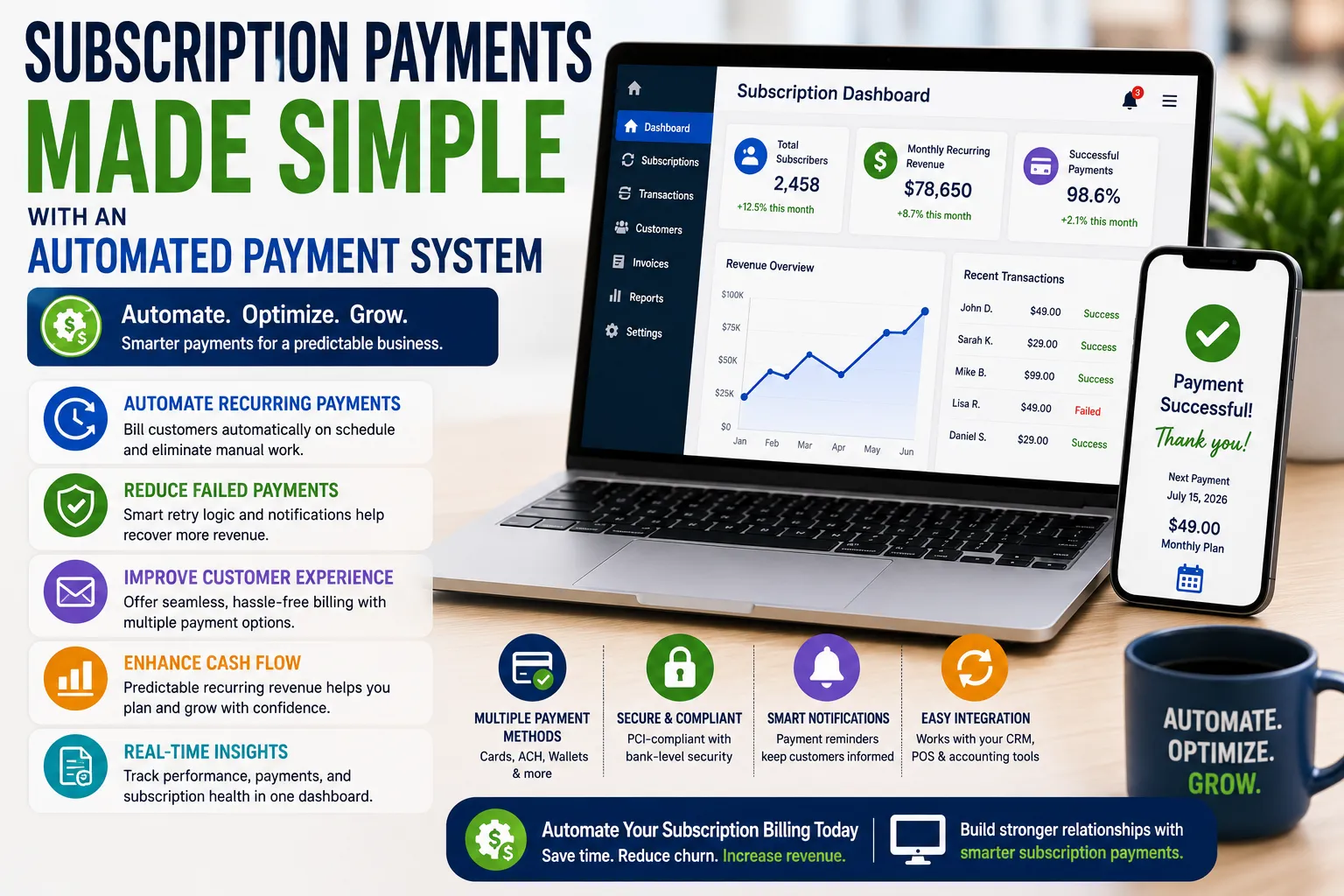
Recurring revenue can give a business greater financial stability, but managing subscription payments manually can quickly become complicated. As the number of customers increases, businesses have to deal with recurring billing dates, payment failures, expired cards, customer notifications, refunds, cancellations, and account updates.
Without an efficient process, these responsibilities can consume valuable employee time and create unnecessary payment delays.
An automated payment system can help businesses organize these activities and make subscription billing more efficient. Instead of manually initiating every transaction, businesses can establish billing rules that allow payments to be processed automatically according to each customer's subscription plan.
For companies that depend on memberships, subscriptions, service agreements, or recurring invoices, payment automation can improve cash flow while creating a more convenient experience for customers.
What Are Subscription Payments?
Subscription payments are recurring transactions collected from customers at predetermined intervals. The customer agrees to pay a specific amount in exchange for continued access to a product or service.
Depending on the business model, billing may occur:
- Weekly
- Monthly
- Quarterly
- Annually
- According to a customized schedule
Subscription billing is commonly used by software companies, gyms, membership organizations, professional service providers, online platforms, and other businesses that provide ongoing services.
The challenge is maintaining accurate and timely collections as the customer base grows.
What Does an Automated Payment System Do?
An automated payment system uses payment technology to manage transactions with minimal manual involvement. Once a customer authorizes recurring payments, the system can follow the established billing schedule and initiate transactions automatically.
A typical automated workflow includes:
- Customer enrollment
- Secure payment authorization
- Subscription plan configuration
- Scheduled payment processing
- Transaction confirmation
- Failed-payment management
- Reporting and reconciliation
This process can significantly reduce the amount of repetitive billing work performed by employees.
Problems Caused by Manual Subscription Billing
Manual billing may appear manageable when a business has only a few recurring customers. However, the process becomes increasingly difficult as transaction volume grows.
Missed Billing Dates
Employees may accidentally overlook a scheduled invoice or payment, creating unnecessary revenue delays.
Expired Payment Information
Customers frequently replace credit or debit cards. If updated information is not provided, recurring transactions can fail.
Time-Consuming Follow-Ups
Staff may need to contact customers individually when payments are declined or invoices remain unpaid.
Inconsistent Cash Flow
A high number of delayed payments can make monthly revenue less predictable.
Increased Administrative Costs
The more time employees spend managing routine billing activities, the less time they have available for customer service and business development.
Payment automation helps address these problems through standardized and repeatable processes.
How Automation Improves Subscription Payment Collection
An automated payment system can make recurring billing more reliable by connecting customer accounts with predefined payment schedules.
For example, a business offering a monthly membership can establish the customer's billing date when the account is created. The system can then process future payments automatically without requiring the customer to manually submit a payment each month.
If a transaction fails, available recovery tools can help the business respond quickly rather than discovering the issue weeks later.
This creates a more consistent billing cycle and reduces unnecessary interruptions.
Benefits of Automating Subscription Payments
More Predictable Revenue
Recurring billing allows businesses to establish a more consistent collection schedule.
Although no payment system can guarantee that every transaction will succeed, automated processing reduces missed billing opportunities and provides better visibility into expected revenue.
This can make it easier to plan:
- Payroll
- Inventory
- Marketing
- Equipment purchases
- Expansion projects
Reduced Administrative Work
Automation can handle repetitive tasks such as payment processing, receipts, billing notifications, and transaction records.
Employees can therefore spend more time on activities that directly support customers and business growth.
Improved Customer Convenience
Customers do not want to repeatedly enter payment information or remember every billing date.
Once recurring billing is properly authorized, future payments can occur automatically. This creates a simpler experience and reduces the effort required to maintain an active subscription.
Better Payment Accuracy
Automated billing follows predefined instructions, helping reduce errors associated with manually entering transaction amounts and payment dates.
Accurate billing also makes financial reconciliation easier.
Managing Failed Subscription Payments
Payment failures are an important consideration for any subscription business.
Transactions can fail for several reasons, including:
- Expired cards
- Insufficient funds
- Incorrect billing information
- Bank declines
- Temporary processing issues
A modern payment platform may provide tools for payment retries, customer notifications, and payment method updates.
Businesses should establish a clear recovery process so customers can quickly resolve unsuccessful transactions without unnecessary disruption to their service.
Features to Consider When Choosing a Payment System
Not every payment platform provides the same capabilities. Businesses should evaluate solutions based on their specific billing requirements.
Recurring Billing Management
The system should make it easy to create, modify, pause, and cancel recurring payment schedules.
Multiple Payment Methods
Customers may prefer credit cards, debit cards, ACH payments, digital wallets, or other electronic payment methods. Supporting several options can improve flexibility.
Secure Payment Processing
Payment security should be a priority. Businesses should look for appropriate encryption, tokenization, fraud prevention, and PCI-related security controls.
Automated Notifications
Payment confirmations, upcoming billing notices, and failed-payment alerts can keep customers informed.
Reporting and Analytics
Detailed reports can help businesses monitor recurring revenue, successful transactions, failed payments, refunds, and cancellations.
Integrating Subscription Billing With Business Software
Payment automation becomes even more useful when connected with other business applications.
Integration with accounting software can simplify reconciliation. Connecting payment processing with CRM platforms can improve customer record management. POS and business management integrations can also help keep transaction information organized.
A connected payment environment reduces duplicate data entry and provides employees with better access to relevant customer and financial information.
How to Create a Better Subscription Billing Experience
Technology alone does not guarantee a successful recurring payment strategy. Businesses should also focus on clear customer communication.
Before enrollment, customers should understand:
- Subscription pricing
- Billing frequency
- Renewal terms
- Payment methods
- Cancellation procedures
- Refund policies
Businesses should also make it easy for customers to update payment information and manage their accounts.
Clear policies combined with convenient payment technology can reduce confusion and improve customer trust.
Who Can Benefit From Automated Subscription Billing?
Automated recurring payments can benefit many types of organizations.
Software companies can collect monthly or annual subscriptions without manually processing each customer's payment.
Fitness centers can automate membership dues while reducing administrative follow-up.
Professional service providers can establish recurring payments for ongoing contracts.
Maintenance companies can collect scheduled payments for service agreements.
Membership organizations can simplify recurring dues and account management.
The best approach depends on the business model, customer expectations, transaction volume, and billing requirements.
Final Thoughts
Subscription payments can provide businesses with recurring revenue and stronger financial visibility, but manually managing those transactions can become difficult as a company grows. An automated payment system provides a practical way to streamline billing, reduce repetitive work, improve payment collection, and deliver greater convenience to customers.
Businesses should evaluate payment platforms based on security, recurring billing capabilities, payment recovery tools, reporting, integrations, and customer management features. A well-designed payment process can reduce operational friction while helping businesses maintain a more reliable revenue cycle.

 English
 Arabic
 French
 Spanish
 Portuguese
 Turkish
 Dutch
Dutch
 Italiano
 Russian
 Romaian
 Portuguese (Brazil)
 Greek
Greek
