
How to Choose Commercial Network Cabling in Colorado Springs
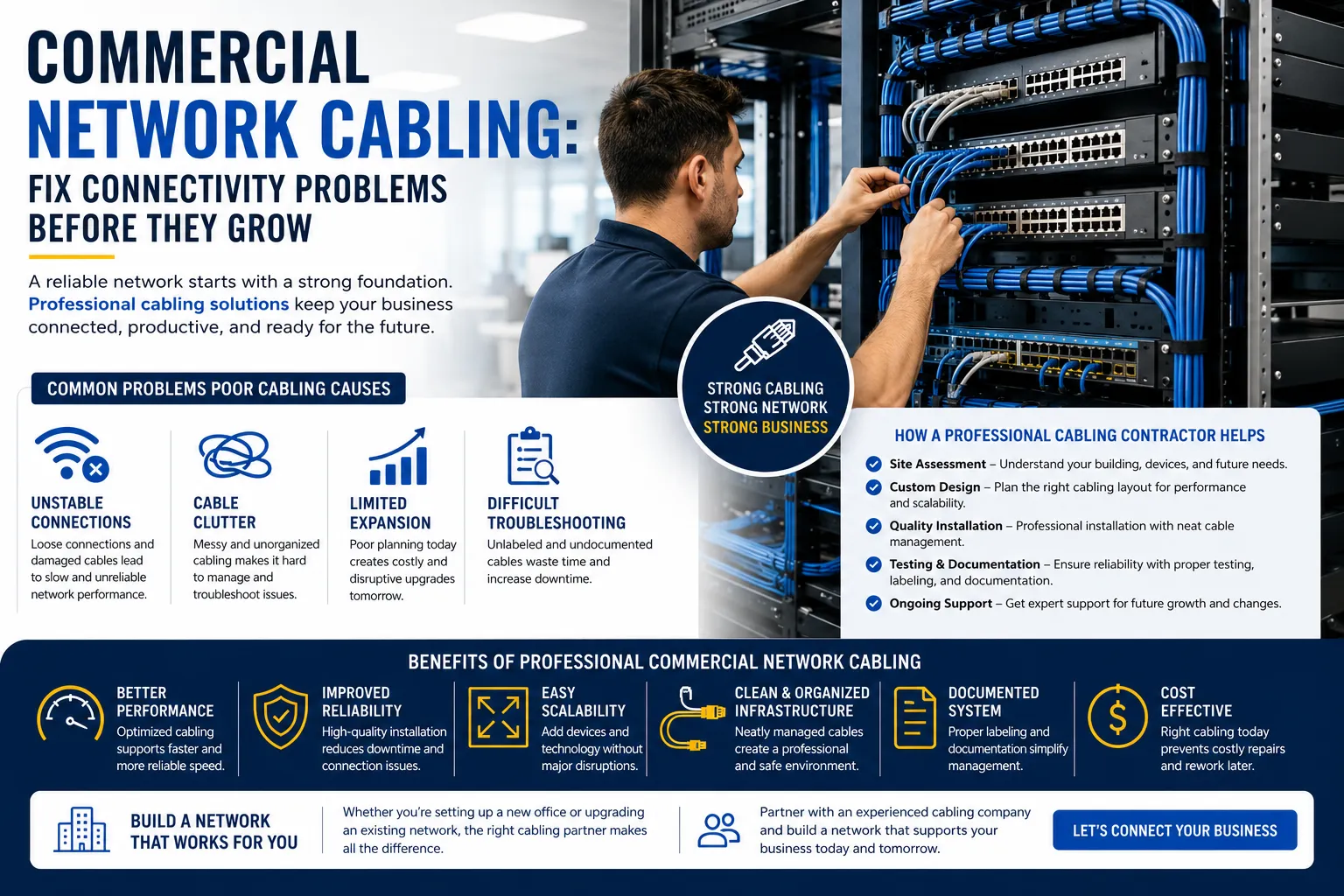
A business network is only as dependable as the infrastructure supporting it. Routers, switches, wireless access points, servers, computers, security cameras, and VoIP phones all need reliable physical connections to communicate effectively.
When network cabling is outdated, poorly organized, or installed without a long-term plan, businesses can experience intermittent connections, slow performance, difficult troubleshooting, and expensive interruptions. These issues can become even more noticeable as a company adds employees, devices, offices, and cloud-based services.
For organizations in Colorado Springs, a well-planned commercial cabling system can provide a structured foundation for everyday connectivity while making future upgrades easier. The goal is not simply to install more cable. It is to create an organized infrastructure that matches the building, technology requirements, and expected business growth.
What Is Commercial Network Cabling?
Commercial network cabling is the physical communication infrastructure installed throughout a business facility. It can include copper Ethernet cable, fiber optic cable, patch panels, network racks, telecommunications rooms, wall outlets, cable pathways, connectors, and cable management components.
A structured system allows different technologies to share a planned infrastructure. Depending on the business, the cabling may support:
- Desktop computers and workstations
- Wireless access points
- VoIP and business telephone systems
- Network printers
- Servers and storage equipment
- IP surveillance cameras
- Access control systems
- Conference room technology
- Building automation equipment
- Internet and internal network connections
Instead of adding cables whenever a new device appears, a structured approach creates a network foundation that can accommodate current and future requirements.
Network Problems That Better Cabling Can Help Prevent
Many companies replace network equipment when connectivity problems occur, but the underlying issue may be the physical infrastructure. Before investing in new hardware, businesses should consider whether their cabling is contributing to the problem.
Unreliable Connections
Damaged cables, loose terminations, improper installation, and excessive cable stress can cause intermittent connectivity. These issues may be difficult to identify because the network can appear to work normally for periods of time.
Professional installation and cable testing can help identify faulty connections before they create recurring disruptions.
Poor Cable Organization
A crowded telecommunications room filled with unidentified cables makes maintenance unnecessarily difficult. Technicians may have to trace individual connections manually, increasing the time required to resolve an issue.
Proper labeling, patch panels, cable pathways, and rack management create a cleaner and more serviceable environment.
Limited Capacity for Growth
A business that installs exactly enough connections for today's devices may quickly outgrow its infrastructure. New employees, wireless access points, cameras, phones, and other technologies can increase demand.
Planning additional capacity during the original installation can reduce the need for disruptive construction or emergency cabling later.
Choosing the Right Cabling Type
Not every connection requires the same type of cable. The appropriate solution depends on distance, network speed, building design, equipment, environmental conditions, and future requirements.
Copper Ethernet cabling is commonly used for workstations, phones, wireless access points, printers, and other network devices. It is a practical choice for many standard office connections.
Fiber optic cabling can be valuable for backbone links, longer-distance connections, data centers, and environments where high bandwidth or resistance to electromagnetic interference is important.
In many commercial facilities, the best design combines copper and fiber. A qualified installer can evaluate the network architecture and recommend an appropriate combination rather than applying the same solution to every connection.
Why Work With a Cabling Contractor in Colorado Springs?
Commercial cabling projects involve more than running cable between two points. A professional cabling contractor in Colorado Springs can evaluate the facility, identify practical cable routes, determine equipment locations, and develop an installation plan around business operations.
A typical project may involve several stages.
Site Assessment
The installer reviews the building layout, existing network infrastructure, telecommunications spaces, equipment locations, and future technology requirements.
Cabling Design
A detailed plan identifies cable routes, outlets, racks, patch panels, backbone connections, and other infrastructure components. Good planning can also reduce unnecessary cable lengths and make future maintenance easier.
Professional Installation
Cables are routed through appropriate pathways and installed with proper support and handling. Careful installation helps protect the cable from unnecessary physical stress and keeps the infrastructure organized.
Testing and Certification
Installed connections should be tested to verify that they meet the required performance specifications. Testing can identify issues that may not be visible during a basic visual inspection.
Labeling and Documentation
Every connection should be easy to identify. Clear labeling and documentation help technicians troubleshoot the network and make future changes more efficiently.
What to Ask a Cabling Company Before Hiring
Choosing a cabling company based only on price can create problems later. Businesses should ask potential providers about their commercial installation experience, testing procedures, documentation, cable management practices, and approach to future expansion.
It is also helpful to ask whether the provider understands the operational requirements of your facility. An office, warehouse, medical facility, retail location, and data-intensive business can have very different infrastructure needs.
A reputable provider should be able to explain the reasoning behind its recommendations in straightforward language. You should understand what is being installed, why it is necessary, how it will be tested, and how the system can support future growth.
How to Prepare for a Commercial Cabling Project
Before contacting an installer, create a basic inventory of the technology currently connected to the network. Include computers, phones, wireless access points, cameras, printers, servers, conference room equipment, and other connected devices.
Then consider what the business may add over the next several years. Planning for future devices can help prevent the infrastructure from becoming outdated soon after installation.
If an existing network is being upgraded, document known problems such as dead connections, slow ports, damaged cables, unexplained outages, or areas with poor wireless coverage. This information can help the installer focus on the most important issues.
Businesses researching their options can use commercial network infrastructure services as an anchor resource when evaluating broader connectivity needs. For organizations comparing local installation options, professional network cabling services in Colorado Springs can also serve as a useful starting point for planning a network upgrade.
Benefits of a Well-Planned Cabling Infrastructure
A properly designed network infrastructure can deliver benefits that extend beyond basic connectivity.
Businesses may experience:
- More organized network rooms
- Easier troubleshooting
- Better infrastructure scalability
- Improved connection reliability
- Simpler equipment upgrades
- Reduced cable clutter
- Better documentation
- More efficient maintenance
- Greater flexibility for future technology
The biggest advantage is often predictability. When the physical network is clearly designed, labeled, tested, and documented, technicians can understand the infrastructure more quickly and businesses can make changes with less disruption.
Final Thoughts
Commercial network cabling is an important investment for businesses that depend on reliable connectivity. A poorly planned infrastructure can make even advanced networking equipment harder to manage, while a structured and professionally installed system provides a stronger foundation for daily operations and future expansion.
Whether a Colorado Springs business is moving into a new facility, remodeling an existing location, adding employees, or experiencing recurring connectivity problems, evaluating the physical network can reveal issues that are easy to overlook.
 Turkish
 English
 Arabic
 French
 Spanish
 Portuguese
 Deutsch
 Dutch
Dutch
 Italiano
 Russian
 Romaian
 Portuguese (Brazil)
 Greek
Greek
