
Standard Quartz Slab Sizes in India: What Buyers Should Know Before Ordering
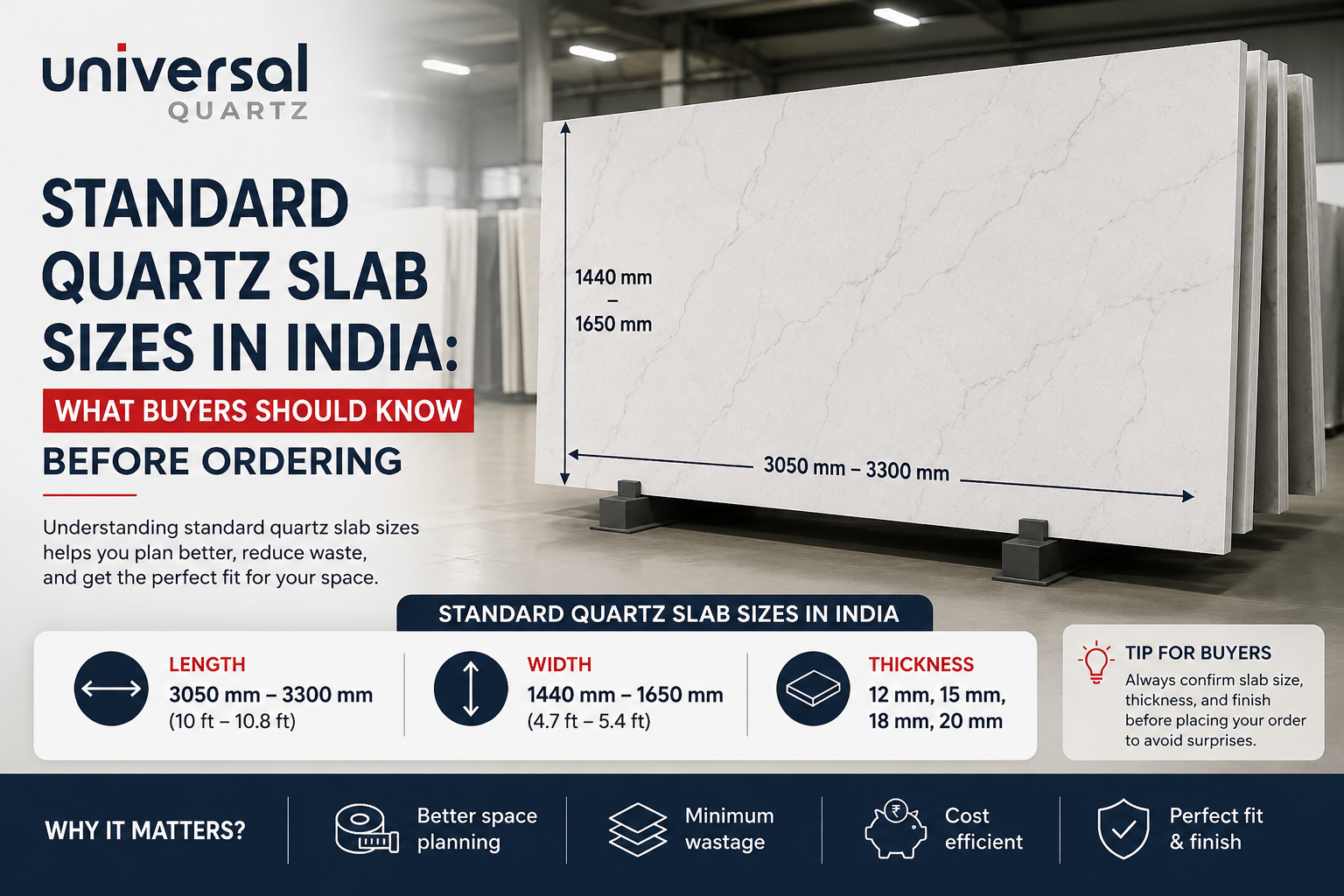
Slab size rarely gets the attention it deserves in the quartz buying process. Most conversations focus on color, finish, and price — and size only comes up once a fabricator starts laying out seams on a kitchen plan. By then, options have already narrowed. Understanding standard slab sizes before you order gives you far more control over the final look, cost, and timeline of a project.
Why Slab Size Is a Design Decision, Not Just a Logistics One
The size of the slab a manufacturer produces directly determines how many seams appear across a countertop, wall, or floor. Fewer seams generally means a cleaner, more continuous appearance — which is why large-format slabs command a premium in kitchen islands and statement walls. But size isn't only an aesthetic lever. It also affects:
- Wastage during fabrication — the size of the raw slab relative to the cut pieces needed determines how much material is unused
- Transport and handling — larger slabs require more careful logistics and specialized handling equipment
- Seam placement options — a fabricator working with larger slabs has more flexibility in where seams fall relative to sinks, hobs, and visual sightlines
- Overall project cost — larger format slabs typically cost more per square foot, but can reduce labor and wastage in the right application
What "Standard" Actually Means
Quartz manufacturers in India typically produce slabs within a standard size range, with some offering extended or jumbo formats for large-scale commercial and premium residential projects. It's worth asking any manufacturer directly:
- What are their standard slab dimensions?
- Do they offer larger or jumbo-format slabs, and at what lead time?
- Are all colors and finishes available across every size, or does size vary by product line?
That last question catches a lot of buyers off guard. Not every quartz series is produced in every size — a particular color or finish that's readily available in standard dimensions might require a special order in a larger format, with a longer lead time attached.
Matching Slab Size to the Project
Residential kitchens typically work well within standard slab sizes, since most countertop runs and islands fit comfortably within them, sometimes with a single seam. This keeps costs predictable and lead times shorter.
Kitchen islands and waterfall edges often benefit from larger-format slabs specifically to avoid a visible seam on a highly visible surface. This is one of the more common reasons buyers move up to a bigger slab size despite the added cost.
Large commercial and hospitality projects — reception counters, feature walls, large-format flooring — frequently specify the largest slab format a manufacturer offers, purely to minimize the number of seams across an expansive surface.
Wall cladding and backsplashes can often use smaller offcuts or standard sizes efficiently, since seam placement is generally less visually critical than on a horizontal work surface.
Slab Size and Thickness Are a Package Deal
Size decisions can't really be made in isolation from thickness. A large-format slab in a thinner profile is heavier to handle safely and may need additional support during installation and use, while the same large format in a thicker profile adds substantially to weight and cost. Buyers who lock in a slab size before understanding how it interacts with thickness options often end up revisiting the decision mid-project. It's worth reviewing both together — this guide to quartz slab thickness is a useful reference for understanding how thickness and size decisions typically play out together before finalizing an order.
Questions to Ask Before Placing an Order
- What's the maximum slab size available in the specific color and finish I've chosen?
- How many seams will my layout require at this slab size, and where will they fall?
- What's the wastage percentage I should expect, and does that factor into the quoted price?
- What's the lead time difference between standard and larger-format slabs?
The Bottom Line
Slab size shapes the final look of a project as much as color or finish does, but it's usually the last thing buyers think to ask about. Getting clarity on what sizes a manufacturer actually offers — and how that interacts with thickness, wastage, and cost — before finalizing a design avoids surprises at the fabrication stage and gives architects and homeowners real control over how the finished surface looks.
 English
 Arabic
 French
 Spanish
 Portuguese
 Deutsch
 Turkish
 Dutch
Dutch
 Italiano
 Russian
 Romaian
 Portuguese (Brazil)
 Greek
Greek
