IoT MVNO Market: Key Segmentations, Growth Drivers, Recent Developments and Future Outlook
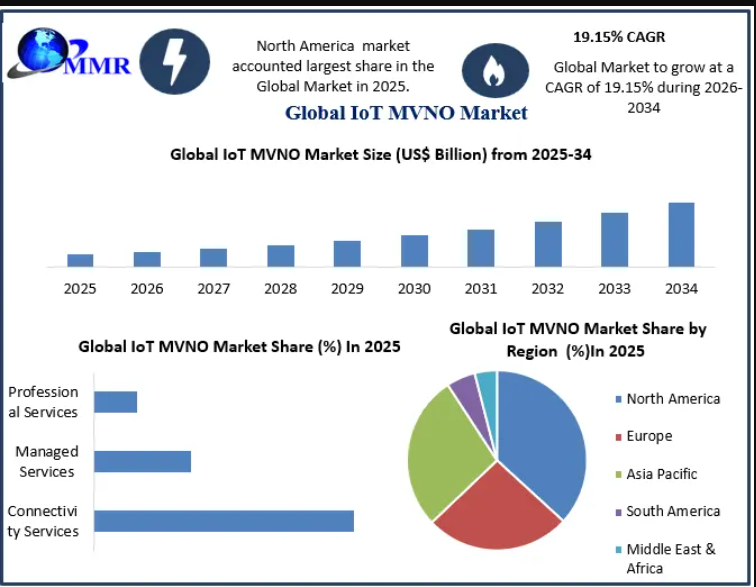
The globalIoT MVNO Market is expanding rapidly as enterprises increasingly depend on reliable, flexible, and scalable cellular connectivity for connected devices, vehicles, industrial equipment, healthcare systems, smart infrastructure, and logistics assets. An IoT Mobile Virtual Network Operator (MVNO) provides connectivity without necessarily owning a complete physical mobile network, instead using wholesale access to one or multiple mobile networks and adding services such as device management, roaming, analytics, security, SIM provisioning, and connectivity orchestration. The market is gaining importance as businesses move from isolated IoT deployments toward large-scale, geographically distributed connected-device ecosystems. Recent industry estimates place the IoT MVNO market on a strong growth trajectory, with one 2026 forecast estimating growth from USD 17.6 billion in 2026 to USD 68.9 billion by 2034 at a CAGR of 19.5%. Other estimates use a narrower market definition and forecast growth from USD 4.16 billion in 2025 to USD 13.98 billion by 2032, demonstrating how market size varies according to the services and connectivity revenues included.
IoT MVNOs serve as an important bridge between telecommunications networks and enterprises deploying connected products. Instead of negotiating connectivity separately with different mobile operators in every country, enterprises can use an MVNO platform to manage SIMs, subscriptions, network selection, data consumption, device activation, roaming, and lifecycle management through a centralized interface. This is particularly valuable for companies operating connected vehicles, industrial equipment, smart meters, medical devices, asset trackers, and logistics fleets across multiple geographical markets.
The market is evolving beyond basic connectivity. IoT MVNOs increasingly provide managed connectivity, cloud integration, device management, cybersecurity, analytics, eSIM orchestration, remote provisioning, and network optimization. This transformation is allowing providers to compete through value-added services rather than relying solely on connectivity pricing. Current industry analysis indicates that IoT MVNOs managed approximately 290 million connections in 2025, compared with 45 million in 2017, and the number could reach approximately 600 million by 2031.
Key Segmentations of the IoT MVNO Market
The global IoT MVNO Market can be segmented by operational model, connectivity technology, application vertical, SIM solution, enterprise size, and region. By operational model, the market includes Full MVNO, Service-Provider MVNO, and Reseller MVNO. Full MVNOs operate a more extensive technological infrastructure and typically maintain greater control over network management, subscriber platforms, and core network capabilities. Service-provider MVNOs generally focus more heavily on service delivery and customer management, while reseller MVNOs purchase connectivity from network operators and package it for specific customer segments.
Full MVNOs represented a leading portion of the market because enterprises increasingly require greater control over connectivity, multi-network access, provisioning, and service management. However, reseller models remain attractive for businesses seeking faster market entry with lower infrastructure investment. Industry estimates indicate that reseller MVNOs are also experiencing rapid growth as specialized IoT connectivity becomes more accessible.
By connectivity technology, the market encompasses 2G/3G, 4G/LTE, 5G, NB-IoT, LTE-M, and satellite IoT. 4G/LTE remains an important technology because of its broad geographic availability and compatibility with a large installed base of IoT devices. However, 5G is expected to experience strong growth because it supports high bandwidth, low latency, network slicing, and large-scale device connectivity. Industry analysis estimates that 4G/LTE accounted for approximately 46.25% of IoT MVNO market revenue in 2024, while 5G services are forecast to grow at more than 21% annually through 2030.
NB-IoT and LTE-M are particularly important for low-power applications such as smart meters, environmental sensors, agricultural devices, asset trackers, and industrial monitoring equipment. Satellite IoT is an emerging opportunity for applications operating outside terrestrial cellular coverage, including remote agriculture, mining, maritime operations, oil and gas, and logistics.
By application vertical, the market includes automotive and transportation, energy and utilities, industrial and manufacturing, healthcare, smart cities and public sector, agriculture, retail, logistics, and supply-chain management. Automotive and transportation currently represent a major demand center because connected vehicles require continuous connectivity for telematics, navigation, remote diagnostics, fleet management, emergency services, and digital services.
The energy and utilities segment is expected to grow strongly as utilities deploy connected electricity, gas, and water meters, grid sensors, and distributed-energy monitoring systems. Industrial companies are also using cellular IoT connectivity to monitor equipment, automate operations, improve predictive maintenance, and optimize production processes.
By SIM solution, the market is divided into physical SIM, eSIM, and iSIM. Physical SIMs continue to have a substantial installed base, but eSIM and iSIM technologies are increasingly important because they support remote provisioning and simplify international IoT deployment. Industry estimates indicate that physical SIMs represented approximately 67.43% of the market in 2024, while iSIM shipments are expected to grow rapidly during the forecast period.
Growth Drivers of the IoT MVNO Market
The most important growth driver is the rapid expansion of connected IoT devices. Enterprises are deploying millions of sensors and connected devices across geographically distributed environments, creating a requirement for reliable cellular connectivity that can be centrally managed. IoT MVNOs can provide multi-network access and centralized connectivity management, reducing the operational complexity associated with large-scale deployments.
The growing adoption of 5G technology is another major driver. 5G can provide higher data rates, lower latency, greater network capacity, and support for massive machine-type communications. These capabilities make 5G particularly suitable for autonomous vehicles, smart factories, connected healthcare, industrial robotics, video surveillance, and other applications requiring reliable real-time connectivity.
The increasing adoption of eSIM and iSIM technologies is also accelerating the market. Traditional physical SIM cards can create logistical challenges for devices deployed internationally because SIM cards may need to be replaced when changing connectivity providers or regions. eSIM enables remote profile provisioning, allowing connectivity to be managed digitally. iSIM integrates SIM functionality directly into a device chipset, helping reduce component requirements and enabling smaller, more power-efficient IoT devices.
Enterprises are also increasingly demanding global connectivity. A connected vehicle manufactured in one country may be sold and operated in several regions, while industrial equipment, shipping containers, medical devices, and tracking systems can move across national borders. IoT MVNOs can aggregate multiple carrier relationships and provide a unified connectivity layer for these international deployments.
The growing emphasis on IoT cybersecurity is another significant opportunity. As connected devices become more numerous, they also create additional attack surfaces. IoT MVNOs are therefore integrating security into connectivity platforms through private networking, device authentication, traffic monitoring, threat detection, secure SIM technologies, and zero-trust architectures.
Platform-Based IoT Connectivity
A major trend in the market is the transition from basic connectivity services toward platform-based IoT management. Enterprises increasingly want a single dashboard through which they can activate devices, monitor data usage, change network profiles, diagnose connectivity issues, analyze device performance, and manage subscriptions.
This shift is creating opportunities for MVNOs to offer software and analytics as part of connectivity packages. Industry analysis identifies platform-based connectivity and global IoT management as major trends, driven by increasing cellular IoT connections and enterprise demand for centralized device management.
Artificial intelligence is further enhancing these platforms. AI can analyze network performance, detect unusual device behavior, predict connectivity problems, optimize network selection, and identify potential security threats. AI-driven network optimization is therefore becoming an important differentiator for IoT MVNOs.
Automotive and Connected Transportation
The automotive and transportation sector is one of the most important IoT MVNO application areas. Connected vehicles require cellular connectivity for telematics, fleet tracking, infotainment, emergency communications, remote diagnostics, and software updates. Commercial fleets use connectivity to monitor vehicle locations, fuel consumption, driver behavior, maintenance requirements, and route efficiency.
The growth of electric vehicles is creating additional demand because EV manufacturers increasingly integrate connected services for battery monitoring, charging management, remote diagnostics, and digital customer experiences. IoT MVNOs can support these international deployments by providing multi-network connectivity and remote SIM management.
Industrial IoT and Smart Manufacturing
Industrial and manufacturing applications are another important growth area. Factories are deploying connected sensors, machines, robots, cameras, meters, and monitoring systems to improve productivity and reduce downtime. Cellular connectivity provides an alternative or complement to traditional wired and local wireless networks, particularly when equipment is distributed across large sites or multiple facilities.
Predictive maintenance is a particularly attractive application. Connected sensors can continuously monitor equipment conditions and transmit information to analytics platforms. Companies can identify potential equipment failures before they occur, reducing downtime and maintenance costs.
Healthcare, Agriculture and Smart Cities
IoT MVNOs are increasingly supporting connected healthcare applications such as remote patient monitoring, connected medical devices, emergency-response equipment, and wearable healthcare technologies. Reliable cellular connectivity is particularly important for medical devices that need to operate continuously and independently from local Wi-Fi networks.
In agriculture, connected sensors can monitor soil moisture, temperature, livestock, weather conditions, irrigation systems, and agricultural equipment. Low-power cellular technologies such as NB-IoT and LTE-M can support long-duration deployments in rural areas.
Smart cities are also creating significant opportunities. Connected streetlights, parking sensors, environmental monitoring systems, waste-management equipment, public transportation systems, surveillance infrastructure, and smart meters all require scalable connectivity. IoT MVNOs can provide centralized connectivity management for these large deployments.
Recent Developments in the IoT MVNO Market
The IoT MVNO sector has experienced several important developments during 2025 and 2026. In April 2026, Telenor IoT made SGP.32 SIM cards available for customer orders, supporting new global IoT deployment and remote SIM-management capabilities. The development demonstrates the industry's transition toward advanced eSIM standards and more flexible connectivity provisioning.
In January 2026, 1NCE launched 1NCE Insights, a data-focused service for its IoT software and connectivity platform. The offering provides customers with anonymized network-wide information that can help compare device behavior and deployment choices, adding a data-analysis layer to its connectivity ecosystem.
In April 2025, BICS launched eSIM Hub, an orchestration platform designed to help enterprises provision, manage, and switch eSIM connectivity for IoT deployments. The development highlights the growing importance of centralized eSIM management as enterprises expand connected-device operations across multiple markets.
A major development in June 2026 was the launch of Cellular SASE for IoT by NTT DOCOMO BUSINESS and TRANSATEL in collaboration with Zscaler. The solution combines global MVNO connectivity with zero-trust security and is designed to protect IoT devices and enterprise mobile endpoints without requiring conventional VPNs or software agents on devices. This development demonstrates the increasing convergence between IoT connectivity and cybersecurity.
The industry is also experiencing strategic consolidation, although the pace has moderated. According to industry analysis, only nine IoT MVNOs were acquired by other MVNOs between December 2023 and June 2026, compared with 16 during the preceding two-year period. Wireless Logic remained one of the most active consolidators, completing acquisitions including Arqia, Comms365, and Zipit Wireless.
North America remains a major IoT MVNO market because of advanced IoT infrastructure, strong enterprise adoption, connected-vehicle deployments, smart-city initiatives, and a mature telecommunications ecosystem. Industry estimates place North America's market share at approximately 38.54% in 2024.
Europe is an important market because of its strong automotive industry, industrial digitization, smart-city programs, and regulatory emphasis on data security and connectivity. The region is also witnessing increasing adoption of eSIM-based connectivity and cross-border IoT services.
Asia Pacific is expected to experience the fastest growth, supported by manufacturing digitization, expanding 5G infrastructure, smart-city investments, automotive production, and large-scale IoT deployment. Industry forecasts estimate regional growth of approximately 19.7% annually through 2030.
The Middle East and Africa are gaining opportunities through smart-city development, energy digitization, logistics, connected infrastructure, and remote monitoring. Latin America is also adopting cellular IoT for agriculture, transportation, utilities, logistics, and smart infrastructure.
Competitive Landscape
The competitive landscape includes KORE Wireless, Aeris, 1NCE, Eseye, EMnify, Wireless Logic, BICS, Transatel, Tele2 IoT, Orange, Vodafone, AT&T, Verizon, T-Mobile, Telefónica, Soracom, Pelion, A1 Digital, and other specialized providers.
Future competition will increasingly focus on multi-network connectivity, eSIM and iSIM orchestration, AI-powered network optimization, cybersecurity, cloud integration, global roaming, and vertical-specific managed services. Providers that can offer a single platform for connectivity, security, analytics, and device lifecycle management are likely to gain an advantage as enterprises seek to simplify increasingly complex IoT environments.
Overall, the IoT MVNO Market is positioned for strong long-term expansion as connected-device deployments become increasingly global, intelligent, and business-critical. The combination of 5G, NB-IoT, LTE-M, eSIM, iSIM, satellite connectivity, AI, and IoT cybersecurity is transforming MVNOs from simple connectivity intermediaries into strategic digital infrastructure providers. The continued growth of connected vehicles, smart factories, healthcare devices, utilities, agriculture, logistics, and smart cities will create substantial opportunities through the coming decade. As enterprises prioritize reliable global connectivity and centralized management, IoT MVNOs are expected to play an increasingly important role in enabling the next generation of connected products and digital services.
About Maximize Market Research
Maximize Market Research is a multifaceted market research and consulting company with professionals from several industries. Some of the industries we cover include medical devices, pharmaceutical manufacturers, science and engineering, electronic components, industrial equipment, technology and communication, cars and automobiles, chemical products and substances, general merchandise, beverages, personal care, and automated systems. To mention a few, we provide market-verified industry estimations, technical trend analysis, crucial market research, strategic advice, competition analysis, production and demand analysis, and client impact studies.
Contact Maximize Market Research
3rd Floor, Navale IT Park, Phase 2 Pune Bangalore Highway, Narhe, Pune, Maharashtra 411041, India sales@maximizemarketresearch.com +91 96071 95908, +91 9607365656

 Turkish

 English
 Arabic
 French
 Spanish
 Portuguese
 Deutsch
 Dutch
Dutch
 Italiano
 Russian
 Romaian
 Portuguese (Brazil)
 Greek
Greek