
Real Estate Tokenization Development: How Property Data Moves Across the Platform
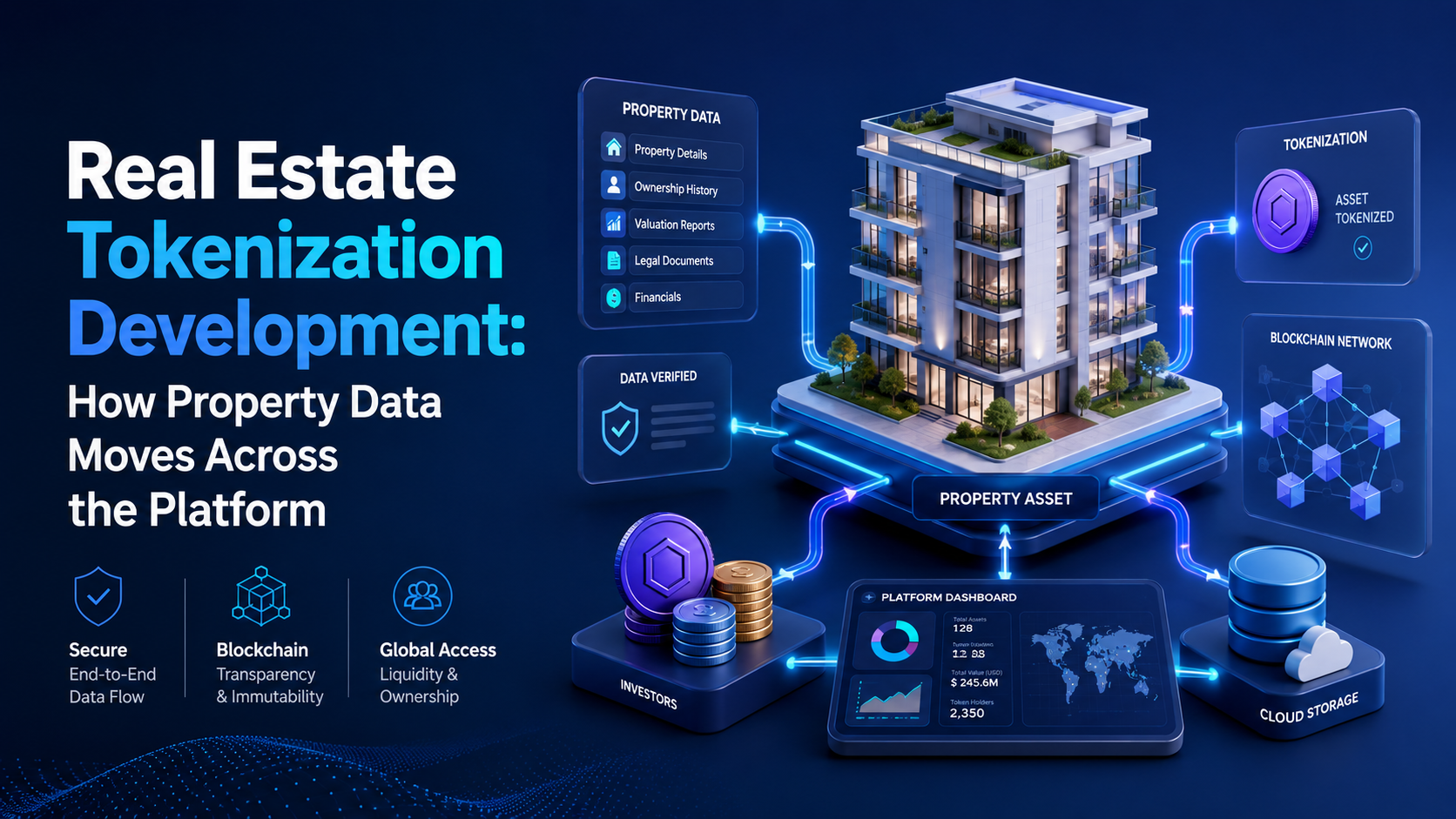
Real estate tokenization depends on more than converting property ownership into digital tokens. A tokenization platform also needs a reliable way to collect, verify, organize, transfer, and update property information. Details such as ownership records, valuation reports, property documents, investor information, rental income, compliance records, and token balances may pass through several platform layers before reaching the final user.
In real estate tokenization development, this movement of information needs careful planning because different users require different data. Property owners may submit asset documents, investors may view offering information, administrators may review compliance records, and smart contracts may receive only the information required for token transactions. The platform therefore acts as a connected data environment where off-chain systems and blockchain networks work together.
For businesses considering real estate tokenization, understanding this data flow helps with platform architecture, security planning, compliance, and user experience. This article explains how property data moves through a tokenization platform and what happens at each stage.
1. Property Data Starts With Asset Onboarding
The data journey usually begins when a property owner, asset manager, or authorized representative submits a property for tokenization. The platform collects information such as property type, location, ownership details, valuation, income history, legal documents, photographs, tax records, insurance details, and other relevant information.
A property onboarding module can provide forms for entering structured information and document upload functions for supporting files. The submitted information is then stored in the platform's database or document management system.
At this stage, the platform should distinguish between data that can be displayed publicly and information that must remain restricted. For example, general property details may be available to verified investors, while private identity documents should remain accessible only to authorized administrators and compliance personnel.
2. Document Verification Takes Place Before Tokenization
Property data normally passes through a verification process before the asset is presented for investment. Administrators or external verification providers may review ownership documents, valuation reports, property registrations, financial statements, and other records.
The verification layer can record the status of each document. A document may be marked as submitted, under review, approved, rejected, or requiring additional information.
This process gives the platform a structured record of what has been reviewed. A real estate tokenization company can also use document hashes or other blockchain references to record evidence that a particular file existed in a specific version without placing the entire document on-chain.
3. Property Data Is Organized Into Structured Records
After verification, the platform converts property information into structured records. Instead of treating the asset as a collection of unrelated files, the system creates a property profile containing fields such as asset ID, ownership entity, property category, valuation, token supply, investment terms, income details, and status.
This database becomes an important reference point for the rest of the platform.
For example, if a commercial property has a valuation of $10 million and the issuer decides to create 1 million tokens, the platform can associate the property record with the token issuance record. Other information, such as distribution schedules and investor eligibility requirements, can also be connected to the same asset record.
4. Off-Chain Data and Blockchain Data Have Different Roles
One of the most important parts of real estate tokenization platform development is deciding which information should remain off-chain and which information should interact with the blockchain.
Large documents, personal information, valuation reports, legal agreements, and detailed financial records are generally better handled through conventional databases or secure document storage. Blockchain networks can then store transaction records, token balances, ownership movements, contract states, and selected references.
This approach prevents unnecessary data from being placed directly on a blockchain while allowing blockchain records to support token-related activities.
A real estate asset tokenization company may therefore use a combination of databases, cloud storage, APIs, identity systems, and blockchain infrastructure rather than relying on one technology for every type of property data.
5. The API Layer Connects Platform Components
APIs act as communication points between different platform services. When an investor opens a property page, for example, the application may request property information from the database through an API.
The same layer can connect compliance services, payment systems, identity verification providers, blockchain nodes, analytics systems, and administrative applications.
A typical flow may look like this:
Property owner → onboarding system → verification service → property database → tokenization module → smart contract → investor dashboard
Data does not necessarily move in one direction. Updates can travel back through the same infrastructure. When a token transaction occurs, blockchain information can be read by the platform and displayed in an investor account.
6. Smart Contracts Receive Selected Property Information
Smart contracts do not usually need the complete property file. They require specific information related to token rules and transactions.
For instance, a smart contract may contain the token supply, transfer restrictions, ownership balances, distribution rules, or transaction conditions. The contract can then process token transfers according to predefined logic.
Suppose a property has 500,000 issued tokens. When an investor purchases 5,000 tokens, the blockchain records the token movement. The platform can retrieve that transaction and associate it with the investor's account and the relevant property record.
This creates a connection between the platform database and blockchain without requiring every property document to exist on-chain.
7. Identity and Compliance Data Moves Through a Separate Layer
Investor information follows another path. During registration, an investor may provide identity information, residency details, accreditation information where applicable, and other compliance data.
The platform can send this information to a KYC or AML service. Once verification is completed, the result can be returned to the platform. The investor's account can then receive an appropriate status based on the verification result.
The blockchain may not need to store the investor's personal documents. Instead, the platform can use a verified status or permission mechanism when deciding whether a wallet can participate in certain token activities.
This separation helps reduce unnecessary exposure of personal information.
8. Investment Data Connects Users With Property Records
Once an investor is approved, investment activity creates another data flow. The investor selects a property, reviews the offering, completes the required payment process, and receives tokens according to the platform's rules.
The platform records the relationship between the investor, property, transaction, and token balance.
For example:
Investor account → selected property → investment order → payment confirmation → token allocation → blockchain transaction → updated portfolio
Each event can generate records in different systems. Payment information may sit within a payment service, while token ownership is recorded on-chain. The platform database links these events so the investor can view the investment from one dashboard.
9. Property Performance Data Can Return to the Platform
Property data does not stop moving after token issuance. Real estate assets generate new information over time.
Rental income, occupancy, expenses, maintenance activity, valuation updates, refinancing events, property sales, and distributions may all change the asset record.
An administrator can update the relevant database records, after which selected information may appear on investor dashboards. If a distribution is linked to token ownership, the platform may calculate eligible amounts and initiate the required payment process.
This creates an ongoing data cycle rather than a one-time token issuance process.
10. Oracles Can Carry External Information to Smart Contracts
Some property-related information may need to reach a smart contract. This is where oracle infrastructure can be useful.
An oracle can provide external information to a blockchain application when the smart contract needs data that does not naturally exist on-chain. Depending on the platform design, this could involve approved valuation information, exchange rates, payment confirmations, or other defined data points.
The oracle should not be treated as a general-purpose data storage system. Its role is to provide selected external information to blockchain logic under defined conditions.
11. Admin Systems Control Data Updates
Administrators require a separate interface for reviewing and updating property information. This dashboard may show asset status, documents, investors, token supply, transactions, distributions, compliance records, and platform activity.
Role-based permissions can determine who is allowed to edit different categories of information. A compliance officer may review investor records, while an asset manager may update property information. A technical administrator may manage blockchain settings without having access to private investor documents.
This division reduces unnecessary access and creates a more organized operational process.
12. Data Changes Need an Audit Trail
Property records can change over time, so a tokenization platform should maintain records of important updates.
For example, if a property valuation changes from $8 million to $8.5 million, the system should record when the change occurred, who submitted it, what document supported the update, and whether the change was approved.
Transaction records on a blockchain already provide a historical record for many token activities. Off-chain records can use application logs, version history, timestamps, and document references to provide similar visibility for property administration.
For a real estate token development project, this audit layer can be particularly useful during compliance reviews, investor inquiries, and operational investigations.
13. Security Controls Protect Property Information
Property platforms handle valuable financial and personal information, so data security needs to be considered throughout the data flow.
Common controls can include encryption, access permissions, secure authentication, wallet management procedures, API authentication, database protection, document access restrictions, and activity monitoring.
The platform should also avoid sending sensitive information to systems that do not need it. Data minimization can reduce the amount of information exposed during each transaction.
Security testing should cover both conventional application components and blockchain-related functions.
14. Data Synchronization Keeps Different Systems Consistent
A tokenization platform may use several systems at once. The property database, blockchain, payment provider, identity verification service, document storage, and investor dashboard can all contain related information.
Synchronization mechanisms help keep these systems aligned.
For example, after a blockchain transaction is confirmed, the platform should update the relevant investment record. If the transaction fails, the order status should not remain marked as completed.
Event-driven architecture, webhooks, queues, scheduled reconciliation, and blockchain listeners can be used depending on the platform's requirements.
This is one area where careful real estate tokenization development can prevent operational issues that may otherwise become difficult to identify.
15. Investor Dashboards Present the Final Data Layer
Investors usually do not see the technical journey behind their property investment. They see a dashboard containing property details, token holdings, transaction history, distributions, documents, and portfolio information.
The dashboard gathers information from multiple backend systems and presents it in a usable format.
For example, the property page may retrieve asset information from the database, ownership information from blockchain records, compliance status from the user service, and transaction history from the transaction database.
The interface therefore represents the final stage of a much larger data journey.
How Real Estate Tokenization Companies Can Plan the Data Flow
Businesses evaluating a real estate tokenization development company should examine how the proposed architecture handles data movement rather than focusing only on the token contract.
A useful evaluation can cover several areas:
-
Property data storage and document management
-
Identity and compliance integrations
-
API communication between services
-
Blockchain connectivity
-
Smart contract data requirements
-
Payment and settlement records
-
Data synchronization
-
Permission management
-
Audit logs
-
Backup and recovery procedures
The same approach can help when comparing Top real estate tokenization companies or Best real estate tokenization companies. The quality of a platform is not determined only by its token interface. The systems behind the interface have a major role in daily operations.
What This Means for Real Estate Tokenization Platform Development
Real estate tokenization platform development involves much more than issuing tokens. Property information needs to move through onboarding, verification, storage, compliance, investment, blockchain processing, reporting, and administration.
A well-planned architecture gives every type of data an appropriate destination. Sensitive documents can remain in controlled storage, operational records can stay in databases, and token-related events can be recorded on blockchain networks.
For businesses planning real estate tokenization, this approach can make the platform easier to manage and audit. It also helps development teams decide which integrations are required before development begins.
A real estate tokenization platform development company should therefore map data flows before implementing individual modules. The data map can show where information enters the platform, where it is validated, which services access it, where changes are recorded, and how the final result reaches users.
Future Data Flows in Real Estate Tokenization
As tokenized property markets develop, platforms may connect with more financial services, property management systems, valuation providers, accounting tools, identity networks, and secondary trading environments.
This means property data may eventually travel across a wider ecosystem. Instead of keeping investment information within one platform, different systems may exchange verified records through APIs and standardized interfaces.
Real estate tokenization development will therefore increasingly involve data architecture, integration planning, security controls, compliance processes, and blockchain infrastructure together.
Conclusion
Property data is the information layer that keeps real estate tokenization working from asset onboarding to investor reporting. Documents, ownership records, valuations, compliance information, payment records, token balances, and property performance data each have different requirements, so they should not all be handled in the same way. A well-planned platform connects databases, document storage, APIs, identity services, blockchain networks, smart contracts, and investor dashboards so that information reaches the right system at the right stage. Businesses considering real estate tokenization should pay close attention to these data paths when selecting a real estate tokenization company or planning their own platform. Blockchain App Factory provides Real estate tokenization development services that can support businesses in planning and developing platforms for tokenized property assets.
FAQs
1. What is property data flow in real estate tokenization?
Property data flow refers to how asset information moves between onboarding systems, databases, verification services, blockchain networks, smart contracts, payment systems, and user dashboards.
2. Is all property data stored on a blockchain?
No. Large documents, private information, and many operational records can remain in secure off-chain systems. Blockchain storage is generally used for information that benefits from decentralized transaction records and token ownership tracking.
3. Why are APIs important in real estate tokenization?
APIs allow different platform components to exchange information. They can connect property databases with identity services, payment providers, blockchain infrastructure, analytics tools, and user applications.
4. What property information can be linked to tokens?
Depending on the project structure, tokens can be associated with information such as asset identity, ownership interests, investment terms, token supply, distribution rules, and relevant transaction records.
5. How does KYC data move through a tokenization platform?
Investor information can be collected during registration and sent to a verification provider. The provider returns a verification result, which the platform can use when determining investor eligibility.
6. What happens to property data after token issuance?
Property information can continue to change as the asset generates rental income, expenses, valuation updates, maintenance records, distributions, or other events. The platform can update relevant records and display them to authorized users.
7. What should businesses consider during real estate token development?
Businesses should consider data storage, blockchain selection, smart contracts, identity verification, compliance, APIs, payment processing, access controls, audit records, security testing, and system synchronization.
8. Why is data architecture important for real estate tokenization?
A data architecture determines where information is stored, how systems communicate, who can access records, and how updates are recorded. It provides the technical structure needed for day-to-day platform operations.

 English
 Arabic
 Spanish
 Portuguese
 Deutsch
 Turkish
 Dutch
Dutch
 Italiano
 Russian
 Romaian
 Portuguese (Brazil)
 Greek
Greek
