
Real Estate Token Development: Hidden Expenses Businesses Should Consider Before Launch
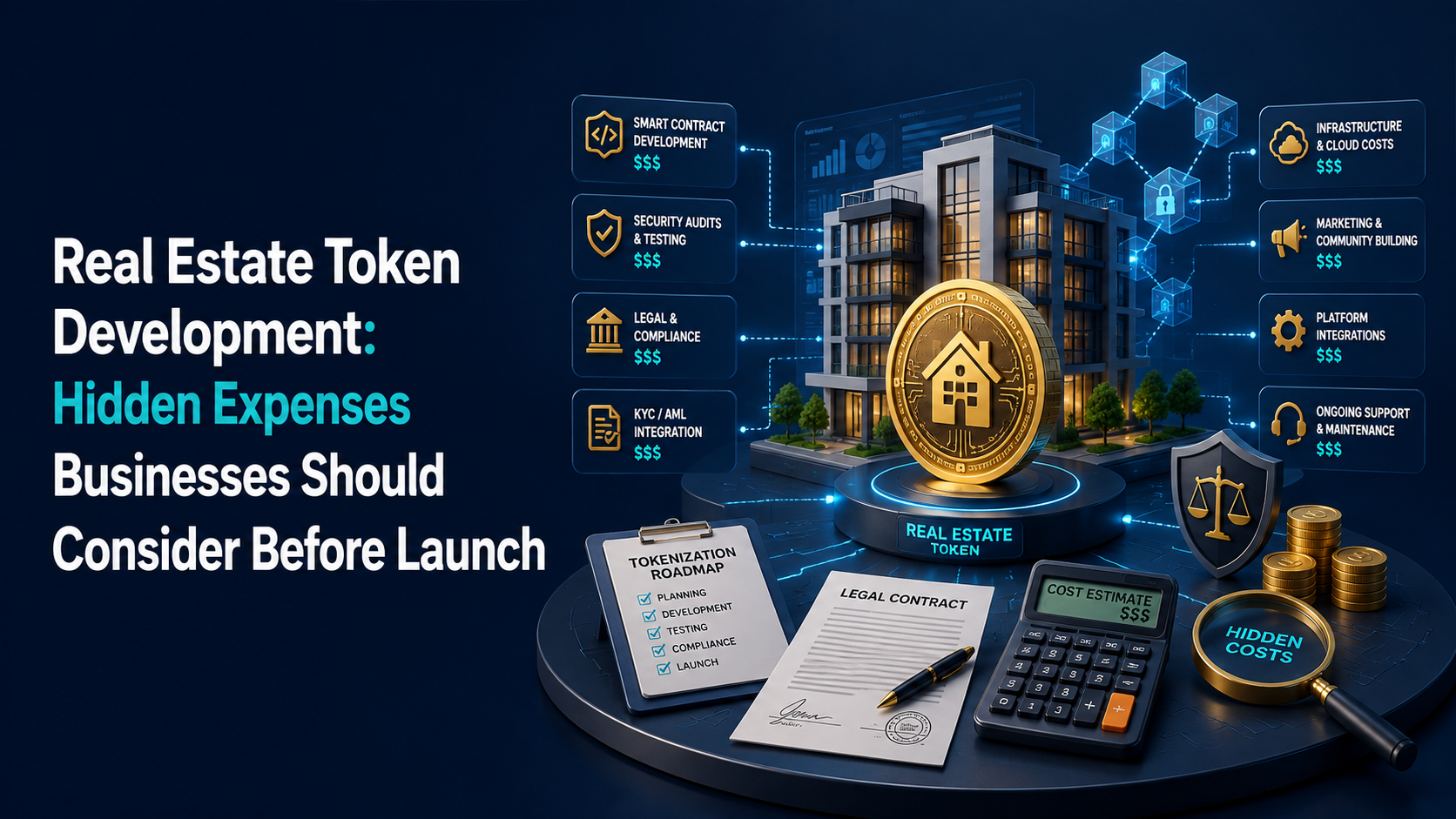
Real estate token development is often discussed through the lens of blockchain infrastructure, token creation, smart contracts, and platform features. Those areas matter, but they do not represent the complete budget. Businesses entering real estate tokenization also need to account for legal work, property due diligence, compliance, investor onboarding, security reviews, custody, payment infrastructure, liquidity arrangements, maintenance, audits, marketing, and operational support.
A platform can look financially attractive during the planning stage and still require a much larger budget once these additional expenses appear. This is particularly relevant for businesses working with regulated property investments, multiple jurisdictions, institutional investors, or secondary trading.
For a business considering real estate token development, identifying these expenses before development begins can make financial planning more realistic. The following sections examine the less visible costs that can affect a launch budget.
1. Legal Structuring and Property Ownership Costs
One of the first expenses comes from deciding how the property will be legally represented. A token usually does not replace the legal ownership structure of a property. Depending on the jurisdiction and investment model, a special purpose vehicle, partnership, trust, company, or another legal arrangement may be required.
Legal professionals may need to review property ownership, investor rights, token-holder rights, transfer restrictions, taxation, securities regulations, and contractual relationships. Each property may also require separate documentation.
Businesses should therefore budget for entity formation, legal opinions, offering documents, subscription agreements, property contracts, and ongoing legal consultations. If the platform handles properties across several countries, local legal advice can increase the overall expense considerably.
2. Property Due Diligence
Real estate tokenization begins with an underlying asset, so property due diligence becomes an important expense. A business may need property valuation, title verification, ownership checks, tax records, environmental assessments, insurance verification, financial statements, lease reviews, and inspection reports.
Commercial properties can require additional analysis involving tenants, rental contracts, maintenance obligations, debt arrangements, and historical income.
These costs are easy to overlook because they do not belong directly to the software development budget. However, poor property verification can create legal and financial problems after token issuance. Businesses should treat asset-level due diligence as a recurring operating expense rather than a one-time technical cost.
3. Compliance and Regulatory Consultation
Compliance can become one of the largest expenses in real estate tokenization. The applicable requirements depend on the structure of the offering, investor type, location, property type, and characteristics of the token.
Businesses may need professional assistance for securities classification, KYC and AML procedures, investor eligibility, transaction monitoring, reporting, record keeping, and regulatory filings.
A real estate tokenization development company may provide technical infrastructure, but legal and regulatory responsibilities generally require specialist professionals. Businesses should keep a separate compliance budget rather than assuming that platform development includes every regulatory requirement.
4. KYC and AML Infrastructure
Investor verification introduces another recurring cost. A platform may require identity verification, sanctions screening, address verification, document checks, accreditation or eligibility checks, and ongoing monitoring.
Third-party KYC providers commonly charge according to verification volume or service usage. Some also charge for additional checks, business verification, monitoring, or recurring compliance services.
For platforms expecting thousands of investors, these fees can become substantial. Businesses should estimate costs based on projected user numbers instead of considering KYC as a small one-time integration expense.
5. Smart Contract Audits
Smart contracts determine how tokens are issued, transferred, restricted, burned, redeemed, or otherwise managed. A coding error can have financial consequences, particularly when tokens represent claims connected to valuable property.
Independent security audits therefore deserve their own budget. Costs can include initial review, remediation review, multiple contract audits, formal testing, and security assessments of related contracts.
The expense may increase when a platform supports several token standards, complex transfer restrictions, whitelisting, corporate actions, dividend distribution, or cross-chain functionality.
6. Custody and Wallet Infrastructure
Token holders need a way to store and manage their assets. Depending on the platform design, businesses may provide self-custody, managed custody, or integration with external custody providers.
Custody infrastructure can involve wallet management, private-key security, transaction approval systems, recovery procedures, access controls, institutional custody services, and monitoring.
Institutional investors may also expect custody arrangements that meet specific operational and regulatory standards. These requirements can increase expenses beyond ordinary wallet integration.
7. Blockchain Transaction and Network Costs
Blockchain transactions are not always free. Minting tokens, transferring assets, recording ownership changes, distributing income, and executing other smart contract functions can create network fees.
The amount depends on the selected blockchain, transaction volume, contract complexity, and network conditions. A platform serving many users should model these expenses under both normal and high-activity scenarios.
Businesses also need to decide whether transaction fees are paid by the platform, investors, or incorporated into platform charges. That decision affects both operating expenses and user experience.
8. Payment Gateway and Banking Expenses
Real estate token platforms often need fiat payment support because many investors may want to purchase tokens using conventional currencies.
This can require payment gateways, banking relationships, fiat on-ramps, payment processors, reconciliation systems, fraud monitoring, and transaction reporting.
Payment providers may charge setup fees, transaction fees, monthly charges, currency conversion fees, or compliance-related costs. International payments can introduce additional expenses.
A business should calculate these costs before deciding its pricing model.
9. Secondary Market Infrastructure
Launching a token does not automatically create a liquid market for it. If investors are expected to trade tokens after issuance, the business may need a marketplace, order management system, transfer controls, investor eligibility checks, settlement infrastructure, and market monitoring.
Depending on the jurisdiction, secondary trading may also require specific regulatory arrangements.
Businesses sometimes focus heavily on primary issuance and underestimate the cost of supporting secondary transactions. Yet secondary-market functionality can require significant technical, legal, and operational resources.
10. Liquidity and Market-Making Expenses
Liquidity is another expense that may remain outside the initial development estimate. If a platform wants active trading, it may need liquidity providers or market-making arrangements.
The actual cost depends on the asset, market structure, expected trading volume, and contractual arrangement. Some businesses may use internal liquidity mechanisms, while others may work with external market participants.
This is not simply a technology expense. It is part of the commercial strategy surrounding tokenized property.
11. Oracle and Property Data Services
Smart contracts may require external information such as property valuations, rental income, occupancy data, interest rates, or other verified records.
Oracle services can connect blockchain applications with external data sources. Property data providers, valuation databases, financial information services, and verification systems can also involve subscription or usage charges.
The expense becomes more significant when a platform manages a large portfolio of properties with frequent updates.
12. Cloud Hosting and Infrastructure
Real estate tokenization platform development requires more than blockchain contracts. The surrounding application may include investor dashboards, property listings, administrative panels, databases, APIs, identity verification connections, payment systems, analytics, notification services, and document storage.
Cloud hosting costs depend on traffic, storage, database activity, API calls, backups, monitoring, and security requirements.
A platform that starts with a small investor base may have modest infrastructure expenses. Those expenses can rise as more properties, users, documents, and transactions are added.
13. Security Monitoring and Penetration Testing
A smart contract audit does not cover every part of a platform. Web applications, APIs, databases, administrator accounts, authentication systems, cloud infrastructure, and third-party integrations require separate security testing.
Penetration testing can identify vulnerabilities before launch. Businesses may also need recurring vulnerability assessments, security monitoring, incident response procedures, and security reviews after major software changes.
Security spending should continue after launch because new integrations and platform updates can introduce new risks.
14. Insurance and Risk Management
Insurance can become another overlooked expense. Depending on the business model, property insurance, cyber insurance, professional liability coverage, directors and officers coverage, or other forms of protection may be relevant.
Tokenized property platforms may also need policies covering operational incidents, technology risks, or custody-related exposure.
The appropriate coverage depends on the jurisdiction and business structure, so insurance costs should be assessed during the planning stage rather than after the platform becomes operational.
15. Accounting, Tax, and Financial Reporting
Tokenized real estate introduces accounting questions involving property income, token sales, investor distributions, asset valuation, transaction records, and taxation.
Businesses may require accountants and tax professionals who understand both real estate and digital assets. The platform may also need reporting systems that produce investor statements and transaction histories.
If income is distributed to token holders, automated payment calculations and tax reporting may require additional software and professional services.
16. Investor Onboarding and Customer Support
A real estate tokenization platform is also an investment-facing product. Investors may need assistance with registration, verification, wallet setup, payments, token purchases, distributions, and account issues.
Businesses may therefore need customer support staff, helpdesk software, documentation, training materials, and communication systems.
Support expenses tend to increase with investor numbers and geographic coverage. Platforms targeting professional or institutional investors may require dedicated account management as well.
17. Documentation and Content Production
Legal documentation is not the only material required before launch. Businesses may need property reports, investor presentations, platform guides, risk disclosures, educational materials, FAQs, terms of use, privacy policies, and onboarding instructions.
Each property may also require its own investment information package.
Professional writing, design, legal review, translation, and document management can add meaningful costs, particularly when a platform lists properties in multiple regions.
18. Marketing and Investor Acquisition
Launching a platform does not automatically create investor demand. Businesses need a marketing budget covering search marketing, content production, public relations, social media, partnerships, events, advertising, and investor outreach.
Marketing expenses vary widely depending on the target market. A platform targeting retail investors may require broad digital campaigns, while an institutional-focused business may spend more on relationship development and industry events.
A real estate tokenization company should therefore separate technology costs from customer acquisition costs when calculating the launch budget.
19. Maintenance and Product Updates
Development expenses do not end when the platform goes live. Software requires bug fixes, infrastructure maintenance, security patches, dependency updates, blockchain upgrades, monitoring, and feature improvements.
Smart contracts may also need additional versions when regulatory rules or business models change. Platform updates can require renewed testing and security reviews.
A business should prepare a post-launch maintenance budget rather than treating the launch as the final development expense.
20. Third-Party Integration Fees
A tokenization platform commonly connects with several external services. These can include KYC providers, payment processors, custody services, blockchain infrastructure providers, analytics systems, email services, property databases, document storage platforms, and compliance tools.
Each integration may have setup charges, monthly fees, API usage costs, or transaction-based pricing.
The number of integrations should therefore be considered when comparing estimates from a real estate tokenization development company.
21. Multi-Jurisdiction Expansion Costs
A platform designed for one market can become much more expensive when it expands internationally. Different countries may have different securities rules, tax treatment, investor restrictions, property ownership rules, data protection requirements, and reporting obligations.
International expansion can require additional legal opinions, compliance procedures, entity structures, translations, payment providers, and local partnerships.
Businesses should avoid assuming that a platform legally prepared for one jurisdiction can immediately operate in another.
22. Technology Selection and Architecture Changes
Choosing the wrong technology early can create additional expenses later. Businesses may initially select a blockchain, custody model, wallet structure, or token standard and later find that it does not fit regulatory or commercial requirements.
Changing architecture after development has started can involve contract redevelopment, data migration, interface changes, testing, security reviews, and integration work.
This is why the planning stage of real estate tokenization development deserves sufficient attention before significant coding begins.
23. Costs Businesses Should Include in the Initial Budget
A realistic budget should include more than the development quotation from a vendor. Businesses can divide expenses into several categories:
| Expense Category | Examples |
|---|---|
| Legal | Entity formation, contracts, legal opinions |
| Property | Valuation, title checks, inspections, due diligence |
| Compliance | KYC, AML, regulatory consulting |
| Technology | Blockchain, smart contracts, web application |
| Security | Audits, penetration testing, monitoring |
| Infrastructure | Cloud, storage, APIs, databases |
| Finance | Payments, banking, accounting, tax |
| Operations | Support, administration, reporting |
| Market | Marketing, partnerships, investor acquisition |
| Liquidity | Market-making and secondary trading |
| Maintenance | Updates, monitoring, fixes, upgrades |
This broader view provides a more useful estimate than focusing only on software development.
24. How Businesses Can Reduce Unexpected Expenses
The goal should not be to remove every expense. Instead, businesses should identify which costs are necessary for their particular model before development starts.
A property issuer with one jurisdiction and a limited investor base may not need the same infrastructure as a global marketplace. Businesses can begin with a defined asset class, investor group, jurisdiction, and transaction model.
They should also request detailed proposals from a real estate tokenization platform development company that separate development, third-party services, compliance support, maintenance, and optional features.
Comparing several vendors can also help businesses understand market pricing. Researching the Top real estate tokenization companies and Best real estate tokenization companies can provide useful references when evaluating platform structures, features, and service models, although businesses should assess providers based on their actual requirements rather than rankings alone.
Conclusion
Real estate token development involves considerably more than creating tokens and launching a blockchain platform. Legal structuring, property due diligence, compliance, KYC, security audits, custody, payment infrastructure, cloud services, liquidity, investor support, marketing, insurance, accounting, and ongoing maintenance can all affect the final investment. Businesses that identify these expenses before development can prepare a more realistic financial plan and reduce the possibility of major budget changes during implementation. The right approach is to define the property model, jurisdiction, investor profile, trading structure, compliance requirements, and technology requirements before development begins, then separate one-time costs from recurring operational expenses. Blockchain App Factory provides Real estate tokenization development services for businesses planning tokenized property platforms and related blockchain-based investment solutions.
FAQs
1. What are the hidden expenses in real estate token development?
Common hidden expenses include legal services, property due diligence, regulatory consulting, KYC and AML services, smart contract audits, custody, payment processing, cloud infrastructure, security testing, marketing, customer support, and ongoing maintenance.
2. Is smart contract development the biggest cost in real estate tokenization?
Not necessarily. Smart contract development can be significant, but legal, compliance, property verification, security, operational, and regulatory expenses can collectively represent a large portion of the overall budget.
3. Does real estate tokenization require KYC and AML procedures?
In many investment structures, KYC and AML processes are important requirements. The exact obligations depend on the jurisdiction, asset structure, investor type, and nature of the token offering.
4. Why does property due diligence matter in tokenization?
Tokenization represents an underlying real-world asset or related economic interest. Verifying ownership, valuation, financial information, legal status, leases, taxes, and other property details helps establish a reliable foundation for the offering.
5. Are there ongoing expenses after launching a tokenization platform?
Yes. Businesses may continue paying for cloud hosting, security monitoring, compliance services, third-party APIs, customer support, maintenance, audits, marketing, accounting, and regulatory work.
6. How can a business estimate real estate tokenization costs accurately?
Start by defining the property type, number of assets, jurisdiction, investor category, token structure, payment methods, custody model, secondary-market requirements, and compliance needs. Then obtain separate estimates for technology, legal, compliance, operations, and third-party services.
7. Can a white-label platform reduce development expenses?
A white-label approach can reduce some software development time because certain platform components may already exist. However, businesses should still account for legal, compliance, property due diligence, integrations, security, branding, deployment, and ongoing operational costs.
8. What should businesses ask a real estate tokenization development company before hiring?
Businesses should ask about technology architecture, smart contract standards, security audits, integrations, ownership of source code, maintenance, deployment, third-party costs, compliance support, upgrade procedures, and the estimated cost of future changes.
9. Does secondary trading add to the cost?
Yes. Secondary trading may require additional marketplace functionality, transfer restrictions, investor eligibility checks, settlement systems, compliance monitoring, liquidity arrangements, and potentially additional regulatory work.
10. Is real estate tokenization suitable for every property business?
Not necessarily. The economics depend on the property type, investment structure, jurisdiction, target investors, expected transaction volume, regulatory requirements, and business objectives. A feasibility assessment should come before platform development.

 English
 Arabic
 French
 Spanish
 Deutsch
 Turkish
 Dutch
Dutch
 Italiano
 Russian
 Romaian
 Portuguese (Brazil)
 Greek
Greek
