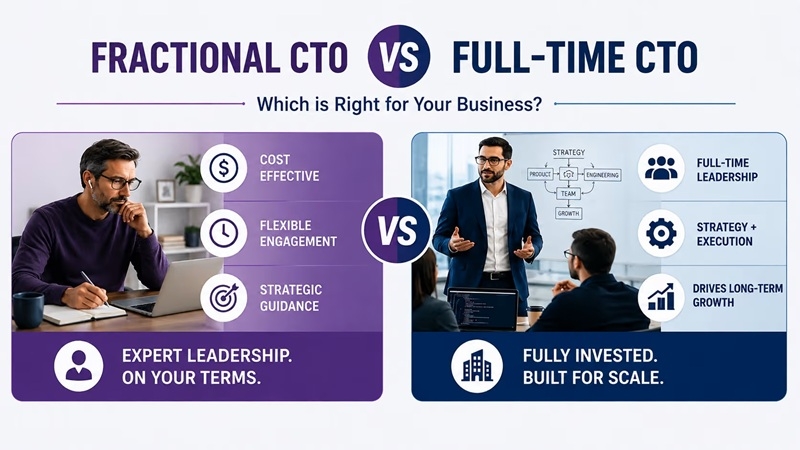
Choosing between a fractional CTO vs full-time CTO depends on a company’s stage, technology needs, growth plans, and the level of leadership required.
Both roles provide strategic technology direction, but they differ significantly in terms of commitment, cost, responsibilities, and long-term involvement. A startup that needs senior technology expertise but does not yet require a permanent executive may benefit from a fractional CTO. On the other hand, a growing or established company with complex technology operations may need a full-time CTO who can take complete ownership of the technology function.
Purple Quarter helps organisations identify and hire technology leaders based on their specific business and engineering requirements. Understanding the difference between these two models can help companies make a more practical leadership decision.
What Is a Fractional CTO?
A fractional CTO is an experienced technology leader who works with a company on a part-time, contract, or limited-engagement basis.
Instead of joining the organisation as a permanent full-time executive, the fractional CTO provides strategic guidance for a defined number of hours, days, or projects.
A fractional CTO may help with technology strategy, architecture decisions, engineering leadership, vendor evaluation, product development, team structure, or a specific transformation initiative.
This model can be useful for startups and growing companies that need senior-level technology expertise but may not yet have the scale or budget to justify a full-time CTO.
However, a fractional CTO has limited availability and may work with more than one organisation. This means the role may not be suitable when a company requires continuous executive involvement.
What Is a Full-Time CTO?
A full-time CTO is a permanent technology executive responsible for leading the organisation’s long-term technology strategy and, depending on the company, broader areas such as engineering, product technology, infrastructure, security, and innovation.
The CTO is deeply involved in the business and works closely with founders, executives, engineering leaders, product teams, and other stakeholders.
A full-time CTO can take ownership of building and scaling technology teams, establishing engineering processes, making long-term architecture decisions, managing technology investments, and aligning technical capabilities with business strategy.
Because the CTO is fully committed to one organisation, they can develop a deeper understanding of its products, culture, customers, and long-term objectives.
Fractional CTO vs Full-Time CTO: The Core Difference
The main difference is the level of commitment and organisational ownership.
A fractional CTO provides senior technology expertise for a limited period or scope. A full-time CTO becomes an embedded executive leader with ongoing responsibility for the organisation's technology direction.
A fractional CTO is often focused on solving specific leadership or technology challenges. A full-time CTO is generally responsible for building long-term technology capability and leading the organisation through continuous growth and change.
The right choice depends on whether the company needs expert guidance for a particular stage or challenge, or a dedicated executive to own the technology function over the long term.
Commitment and Availability
A fractional CTO works for an agreed level of engagement. This could involve a few days each month, a few days each week, or a project-based arrangement.
Their availability is therefore limited compared with an internal executive.
A full-time CTO is available to focus on the organisation’s priorities every working day. They can respond more directly to technology challenges, leadership needs, customer requirements, and changes in business strategy.
For companies operating in fast-moving or highly complex environments, continuous leadership involvement can become increasingly important.
Cost Considerations
Cost is often a major factor in the fractional CTO vs full-time CTO decision.
A fractional CTO can provide access to senior expertise without the complete cost of a permanent executive position. This can be attractive for early-stage businesses or companies managing a specific technology challenge.
A full-time CTO requires a significantly larger long-term investment that may include salary, equity, benefits, and executive compensation.
However, comparing only the direct cost can be misleading.
A company that requires constant technology leadership may eventually spend more trying to fill gaps through multiple consultants or temporary arrangements. The decision should be based on the actual level of leadership required rather than simply choosing the lower-cost option.
Strategic Technology Ownership
A fractional CTO can help create a technology roadmap, assess existing systems, guide architecture decisions, and establish priorities.
However, their involvement may reduce after the engagement ends.
A full-time CTO is responsible for maintaining and evolving the technology strategy as the organisation changes.
They can continuously align technology investments with product strategy, business growth, customer expectations, and market developments.
This deeper level of ownership is one of the most important advantages of a full-time CTO for companies with long-term technology ambitions.
Team Leadership and Culture
Technology leadership is not only about making technical decisions.
A CTO may need to hire senior engineers, develop engineering managers, establish leadership structures, resolve organisational challenges, and build a strong technology culture.
A fractional CTO can support team assessment and help establish a leadership framework.
However, building trust, mentoring leaders, and shaping organisational culture often requires consistent involvement.
A full-time CTO is generally better positioned to provide continuous leadership, accountability, and cultural direction as the engineering organisation grows.
When Does a Fractional CTO Make Sense?
A fractional CTO can be a practical option when a company needs senior technology expertise but does not yet require a full-time executive.
This may include an early-stage startup validating its product, a company planning a technology transformation, or an organisation that needs an experienced leader to assess architecture and engineering capabilities.
It can also be useful during a transition period, such as when a company is searching for a permanent CTO.
The key limitation is that a fractional CTO should not be used as a permanent substitute when the business clearly requires full-time executive ownership.
When Does a Full-Time CTO Make Sense?
A full-time CTO may be the better choice when technology is central to the company's growth, product strategy, competitive advantage, or daily operations.
Companies that are scaling engineering teams, managing complex platforms, developing proprietary technology, or undergoing significant digital transformation may require dedicated technology leadership.
A permanent CTO can also be important when the organisation needs someone to represent technology at the executive and board level.
As the technology function becomes more complex, leadership continuity and accountability become increasingly valuable.


 English
 Arabic
 French
 Spanish
 Portuguese
 Turkish
 Dutch
Dutch
 Italiano
 Russian
 Romaian
 Portuguese (Brazil)
 Greek
Greek
