
Could Artificial Intelligence Unlock the Next Phase of 3D Machine Vision?
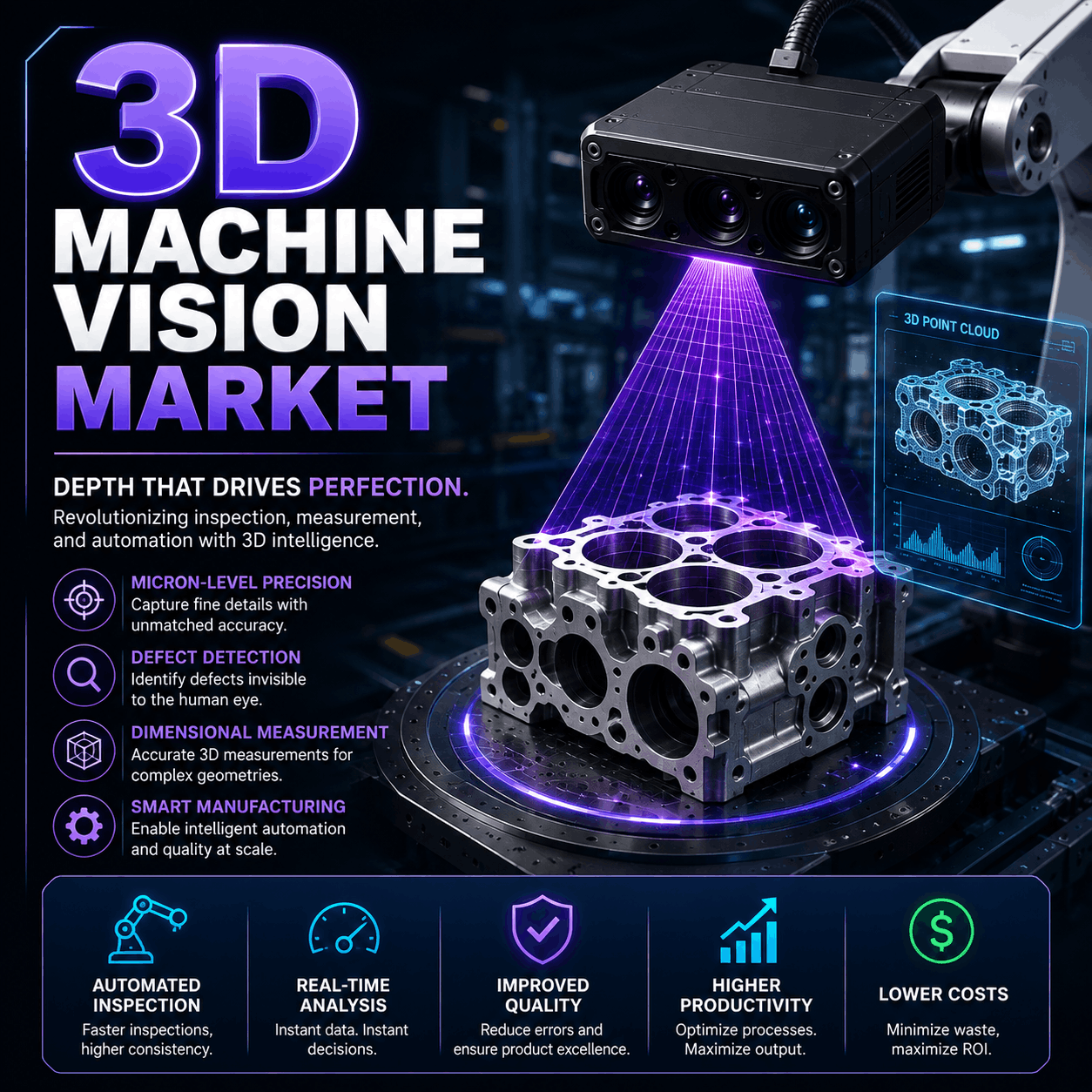
The 3D Machine Vision Market is entering an exciting phase as artificial intelligence increasingly enhances the ability of machines to interpret complex visual environments. While 3D imaging provides information about shape, depth, and spatial relationships, AI can help transform this raw information into meaningful decisions.
Together, these technologies are creating opportunities for more intelligent inspection, robotics, automation, and industrial analytics.
From Seeing Objects to Understanding Them
Capturing an image is only the first step.
The real challenge is understanding what the image represents.
AI can analyze visual data and identify patterns, objects, and anomalies.
When combined with 3D data, AI systems can potentially develop a more complete understanding of an environment.
This can help machines answer important questions:
-
What is the object?
-
Where is it located?
-
What is its orientation?
-
Is it defective?
-
How should a robot interact with it?
These capabilities are becoming increasingly important as automation moves into more complex environments.
Deep Learning and Machine Vision
Deep learning is particularly relevant to advanced machine vision.
Instead of programming every possible scenario, developers can train algorithms using large datasets.
The system can then learn to recognize specific features or patterns.
In industrial applications, this can support automated defect detection and object classification.
3D information can add another layer of detail by providing physical characteristics that may not be visible in a flat image.
Improving Defect Detection
Traditional inspection systems may perform well when products are highly consistent.
However, identifying unusual or complex defects can be challenging.
AI-powered 3D vision can analyze detailed information about surfaces and structures.
This may help manufacturers identify subtle variations.
Potential benefits include:
-
Earlier defect detection
-
Improved inspection consistency
-
Reduced manual effort
-
Better classification of defects
-
Continuous learning from production data
As quality requirements increase, intelligent inspection could become an increasingly valuable application.
Smarter Robots Through AI Vision
Robots must understand more than simple coordinates when operating in dynamic environments.
AI-powered 3D vision can help robots recognize different objects and determine how they should interact with them.
For example, a warehouse robot may need to select products that vary in shape and packaging.
The combination of AI and 3D sensing can help the system identify the object and estimate its position.
This could improve automation flexibility.
Real-Time Decision-Making
Industrial operations often require fast responses.
A vision system that takes too long to process information may limit automation performance.
Advances in edge computing and specialized processors are helping AI models operate closer to the point of data collection.
This could enable faster responses from 3D vision systems.
Real-time capabilities may be especially important for:
-
Robotic movement
-
High-speed inspection
-
Autonomous navigation
-
Production monitoring
Data Is Becoming a Strategic Asset
AI systems depend on data.
As 3D machine vision systems are deployed across industrial facilities, they can generate large volumes of information.
This data can be used to understand recurring production problems and improve processes.
Over time, companies may develop more intelligent systems that learn from historical visual information.
This could transform machine vision from a simple inspection tool into a broader source of operational intelligence.
Challenges Around AI Adoption
AI-powered systems can require high-quality training data.
Poor or incomplete datasets may affect performance.
Businesses must also consider computing requirements, cybersecurity, and data management.
Another challenge is explainability. In critical industrial applications, companies may need to understand why an AI system reached a particular decision.
Addressing these issues will be important for wider adoption.
The Future Is More Autonomous
The combination of AI and 3D vision could support increasingly autonomous industrial systems.
Machines may eventually become capable of observing their environment, identifying changes, and responding with limited human intervention.
This does not mean human expertise will disappear. Instead, workers may increasingly focus on system design, monitoring, analysis, and higher-value activities.
Conclusion
The 3D Machine Vision Market is likely to benefit from the continued expansion of artificial intelligence. 3D sensing provides machines with detailed spatial information, while AI can help interpret that information and support intelligent action.
As these technologies become increasingly integrated, the future of machine vision could involve systems that not only see the world in three dimensions but also understand and respond to it.
Who We Are
About 6Wresearch: It is a commercial strategy and growth advisory firm founded in 2011 and headquartered in New Delhi, India, with partners across Southeast Asia and the Middle East & Africa. The firm has delivered over 20,000 commercial engagements for over 2,000 organizations, including Fortune 500 companies, government agencies, and multilateral institutions such as the World Bank and the Asian Development Bank. 6Wresearch combines proprietary intelligence, advanced analytics, and sector expertise to help organizations navigate market complexity and drive sustainable growth. These capabilities explain why organizations trust 6Wresearch for reliable commercial insights and confident decision-making.
Our Proprietary Platform: 6W Export GTM
6W Export GTM is 6Wresearch's proprietary trade intelligence and go-to-market platform, built on UN Comtrade data and enhanced with 6Wresearch's in-house analytical and simulation models, including system dynamics-based forecasting. Unlike broad, sector-level market sizing tools, 6W Export GTM operates at the individual product level down to specific HS codes and micro-segments to identify precise, actionable export opportunities by country and product pair, including markets where trade currently does not exist. This granular, simulation-driven approach allows 6W Export GTM to surface opportunities that sector-wide analysis typically misses, positioning it among a small number of platforms globally offering this depth of product-and-country-specific export intelligence.

 English
 Arabic
 French
 Spanish
 Deutsch
 Turkish
 Dutch
Dutch
 Italiano
 Russian
 Romaian
 Portuguese (Brazil)
 Greek
Greek
