
Pilot Training in India: A Step-by-Step Roadmap for Aspiring Aviators
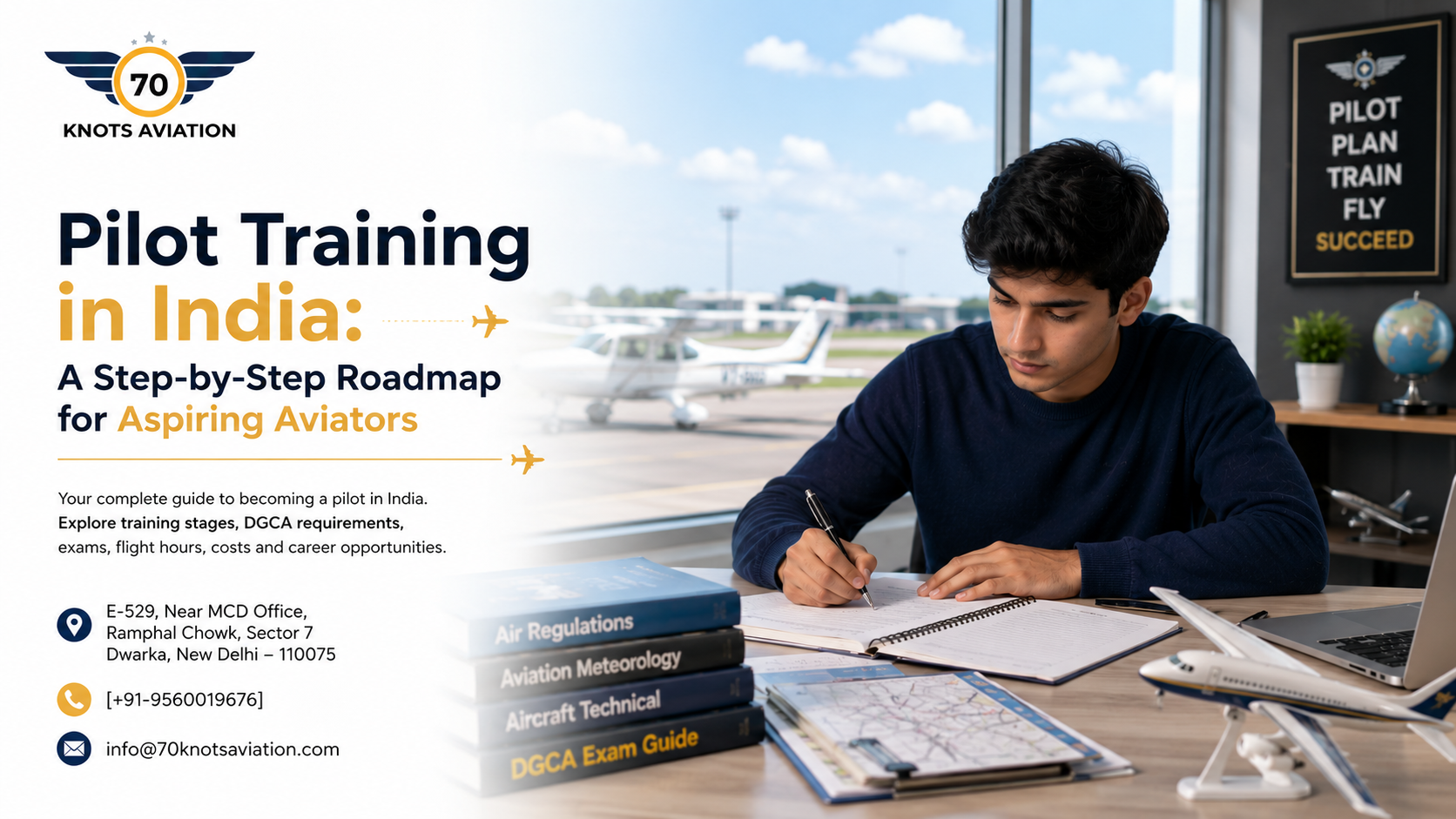
The aviation industry continues to attract students who dream of flying commercial aircraft and building a professional career in the skies. Becoming a pilot is an exciting goal, but it also requires careful preparation, technical knowledge, practical training, financial planning, and a strong commitment to safety.
Many students begin their research with a simple question: How to become a pilot in India? The answer involves several stages, starting with educational eligibility and medical requirements and continuing through ground training, aviation examinations, flight training, and licensing.
For students and parents, understanding this journey before selecting a training programme can make the decision-making process much easier. 70Knots Aviation aims to help aspiring aviation students understand the different aspects of pilot education and prepare for their journey with greater clarity.
Why Pilot Training Requires Proper Planning
Pilot training is different from many conventional academic programmes. It combines classroom-based theoretical education with practical flight training.
A student needs to understand aviation concepts while simultaneously developing practical skills. This makes consistency extremely important throughout the training process.
There are also financial and administrative considerations that should be evaluated before joining a programme. Students may need to plan for training fees, examinations, medical assessments, travel, accommodation, and other expenses.
Instead of making a quick decision based on advertisements or promises, aspiring pilots should research the complete process and compare their options carefully.
How to Become a Pilot in India
The question of How to become a pilot has several parts because professional pilot training is a step-by-step process.
Although individual circumstances may differ, students generally need to consider the following stages:
- Meet the required educational qualifications.
- Understand the applicable aviation medical requirements.
- Complete the necessary registration and documentation.
- Undertake theoretical ground training.
- Prepare for the relevant DGCA examinations.
- Begin and complete the required practical flight training.
- Fulfil the applicable flying and licensing requirements.
- Obtain the relevant pilot licence.
- Continue with career-oriented preparation and additional qualifications where applicable.
Students should understand that becoming a professional pilot is a process rather than a single course.
Educational Preparation for Aspiring Pilots
Academic preparation provides the foundation for aviation training.
Students planning a professional flying career should carefully review the educational eligibility requirements applicable to the licence they intend to pursue. Physics and Mathematics are particularly relevant to professional pilot training.
A strong academic foundation can also make several aviation subjects easier to understand. Mathematical concepts can be useful when studying navigation and aircraft performance, while physics provides a foundation for understanding aerodynamics and aircraft behaviour.
Students who are still in school can begin preparing by strengthening their understanding of mathematics, physics, English communication, and general problem-solving.
Medical Fitness and Pilot Training
Medical fitness is another important part of the pilot-training journey.
Aviation requires pilots to meet specific medical standards because they are responsible for operating aircraft safely. Students should therefore investigate the applicable medical requirements before making a substantial financial commitment to training.
Understanding medical requirements at an early stage can help students plan their career pathway more responsibly.
The Importance of Ground School
Many people associate pilot training primarily with flying an aircraft. However, theoretical education is equally important.
Ground school introduces students to the knowledge they need to understand aviation operations.
Depending on the training and licence requirements, students may study subjects such as:
- Air Navigation
- Aviation Meteorology
- Air Regulations
- Aircraft Technical Knowledge
- Communication procedures
- Flight planning
- Aviation safety principles
Ground classes provide the theoretical foundation that supports practical flying.
For example, a student learning about navigation needs to understand how charts, headings, distances, time, and other factors influence flight planning.
Similarly, meteorology helps aspiring pilots understand how weather conditions can affect aircraft operations.
Preparing for DGCA Pariksha
The theoretical examination stage is an important milestone for aspiring pilots in India.
DGCA Pariksha requires students to approach their studies systematically. Aviation examinations can cover technical information, regulations, calculations, procedures, and concepts that require regular revision.
Students should avoid depending entirely on last-minute preparation. Instead, they can create a study routine that divides the syllabus into manageable sections.
Start With Concepts
Before solving practice questions, students should understand the underlying concepts. This approach helps them apply their knowledge to unfamiliar questions.
Practise Regularly
Regular practice helps students become comfortable with calculations, technical questions, and examination patterns.
Revise Frequently
Aviation education contains a large amount of technical information. Frequent revision helps students retain important concepts over a longer period.
Identify Weak Areas
Students should monitor their progress and spend additional time on topics they find difficult.
What Subjects Do Pilot Students Study?
Pilot training introduces students to several specialised areas of aviation.
Air Navigation
Navigation is essential because pilots must understand how to plan and monitor their routes. Students learn concepts related to direction, distance, time, charts, and flight planning.
Aviation Meteorology
Weather plays an important role in flight safety and planning. Meteorology introduces students to atmospheric conditions and weather phenomena relevant to aviation.
Air Regulations
Pilots operate within a highly regulated environment. Understanding aviation regulations and procedures is essential for responsible operations.
Aircraft Technical Knowledge
Students learn about aircraft systems and technical principles. This knowledge helps pilots understand the aircraft they operate and recognise important operational considerations.
Communication
Professional aviation depends on clear communication. Students develop knowledge of appropriate communication procedures used during flight operations.
Understanding Pilot Training Cost in India
Financial planning is an essential part of preparing for pilot training.
The pilot training cost in india can differ from one student and training organisation to another. There is no universal figure that applies to every aspiring pilot.
Several factors can influence the final expense.
These may include:
- Ground school fees
- Flight training charges
- Aircraft usage
- Instructor fees
- Fuel-related expenses
- Examination charges
- Medical examinations
- Licence-related costs
- Accommodation
- Food and daily living
- Transportation
- Additional flying hours
Students should therefore ask for a detailed breakdown before joining a programme.
Why Training Expenses Can Vary
Flight training is affected by factors such as aircraft availability, fuel prices, weather, operational conditions, and individual student progress.
Some students may require additional practice before becoming comfortable with specific flying skills. Additional flight hours can increase the overall training expense.
For this reason, students should maintain a realistic financial buffer when planning their aviation education.
How to Compare Pilot Training Institutes
Students searching for the Best pilot training institute in India may find many institutes making different claims.
Instead of relying only on promotional statements, prospective students should conduct their own evaluation.
Training Quality
Understand how theoretical and practical training are structured. A clear programme can help students understand their expected progression.
Faculty
Experienced and supportive instructors can make a significant difference in learning technical aviation concepts.
Flight Training
Students should investigate where practical flight training is conducted and understand the aircraft and operational arrangements involved.
Fee Transparency
A transparent fee structure allows students and parents to prepare a more accurate budget.
Academic Support
Students should consider whether the institute provides adequate support for theoretical preparation and examinations.
Overall Learning Environment
A professional learning environment can help students remain focused and disciplined throughout training.
Questions to Ask Before Joining a Pilot Training Programme
Before paying fees or signing up for a programme, students and parents should ask detailed questions.
They can ask:
- What does the training fee include?
- Which expenses are charged separately?
- How is flight training scheduled?
- What academic support is available?
- What subjects are covered in ground training?
- How are students prepared for examinations?
- What happens if additional flying hours are required?
- What documentation is required?
- What are the expected stages of the training process?
Getting clear answers can prevent misunderstandings later.
Developing the Skills of a Professional Pilot
A successful pilot needs more than the ability to operate an aircraft.
Professional pilots need strong communication skills, discipline, situational awareness, technical knowledge, teamwork, and decision-making ability.
Students can begin developing these qualities during their training.
Communication Skills
Clear communication is essential when working with instructors, air traffic controllers, crew members, and aviation personnel.
Situational Awareness
Pilots must remain aware of their surroundings, aircraft condition, weather, navigation, and operational environment.
Decision-Making
Aviation often requires pilots to evaluate information and make appropriate decisions while following established procedures.
Discipline
Checklists, regulations, procedures, and safety standards are central to professional aviation.
Continuous Learning
Pilots continue learning throughout their careers as aircraft technology, procedures, and regulations evolve.
How 70Knots Aviation Helps Students Understand Their Aviation Journey
70Knots Aviation provides aviation education and preparation support for students interested in building a professional career in aviation.
For students who are beginning their research, understanding the complete training pathway can help them make informed decisions.
Whether a student is researching How to become a pilot, preparing for DGCA Pariksha, estimating the pilot training cost in india, or comparing options while searching for the Best pilot training institute in India, proper information is an important starting point.
70Knots Aviation encourages aspiring pilots to approach their training with realistic expectations and a commitment to education, discipline, safety, and continuous improvement.
Frequently Asked Questions
What qualifications are required to begin pilot training?
Students need to satisfy the applicable educational, medical, and regulatory requirements for the pilot licence they plan to pursue. The exact requirements should be confirmed according to the current DGCA framework.
How long does it take to become a pilot?
The timeline can vary depending on training progress, examinations, aircraft availability, weather, scheduling, and individual circumstances. Students should focus on completing each stage properly rather than selecting a programme solely on the basis of a promised completion period.
Is DGCA Pariksha difficult?
The examinations can be challenging because they involve technical subjects, regulations, calculations, and aviation concepts. Regular study, practice, and revision can make preparation more manageable.
What affects pilot training cost in india?
The overall expense can be influenced by flying hours, aircraft, fuel, instructor charges, ground training, examinations, accommodation, medical requirements, and additional training.
How can I identify the Best pilot training institute in India?
There is no single factor that makes an institute suitable for every student. Compare training structure, faculty, flight arrangements, facilities, fee transparency, academic support, and the overall learning environment.
Is ground training important for pilots?
Yes. Ground training develops the theoretical knowledge required to understand aviation operations, regulations, navigation, meteorology, aircraft systems, and other important subjects.
Can students start preparing before joining a flight-training programme?
Yes. Students can strengthen their mathematics, physics, English communication, general aviation awareness, and study habits before beginning formal training.
Planning Your Next Step in Aviation
A professional pilot career requires careful preparation at every stage. Students should understand their eligibility, medical requirements, theoretical education, examinations, practical flight training, licensing process, and financial responsibilities before beginning.
The journey can seem complicated when viewed as a whole, but breaking it into individual stages makes it easier to understand.
From learning How to become a pilot to preparing for DGCA Pariksha, estimating the pilot training cost in india, and evaluating institutes when searching for the Best pilot training institute in India, informed planning can help students approach aviation training with greater confidence.
70Knots Aviation is located in Dwarka, New Delhi, and provides aviation education and preparation support for students interested in pursuing a career in aviation.
Contact 70Knots Aviation
70Knots Aviation
E-529, Near MCD Office, Ramphal Chowk, Sector 7 Dwarka, New Delhi – 110075
Website: https://70knotsaviation.com/
Phone: +91-9560019676
Email: info@70knotsaviation.com

 English
 Arabic
 French
 Spanish
 Portuguese
 Deutsch
 Turkish
 Dutch
Dutch
 Italiano
 Russian
 Romaian
 Portuguese (Brazil)
