Gas Turbine Upgrades for Performance Enhancement Market: Growth Drivers, Segmentation, Trends and Recent Developments
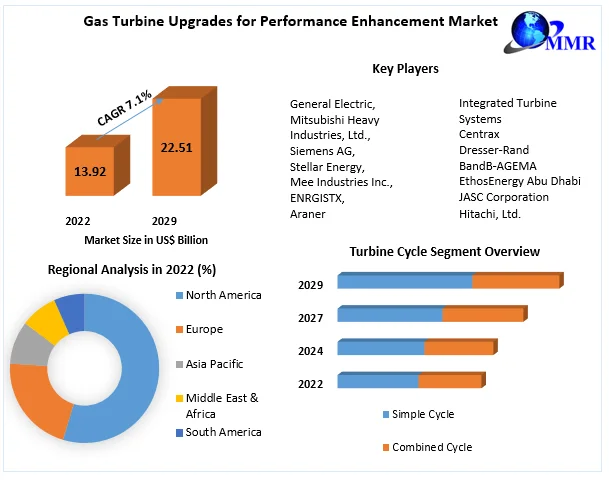
The Gas Turbine Upgrades for Performance Enhancement Market is gaining strong momentum as power producers, industrial operators, and energy companies increasingly focus on improving the efficiency, reliability, flexibility, and operating life of installed gas turbine fleets. Rather than replacing aging turbines with entirely new systems, operators are investing in upgrade technologies that can increase power output, reduce fuel consumption, lower emissions, improve heat rates, and extend maintenance intervals. According to Maximize Market Research, the global Gas Turbine Upgrades for Performance Enhancement Market was valued at approximately USD 13.92 billion in 2022 and is projected to reach USD 22.51 billion by 2029, expanding at a 7.1% CAGR during the forecast period. Asia Pacific represented the largest regional market, accounting for more than 32.5% of the market, while Europe is also expected to experience significant growth. More recent industry estimates continue to indicate steady expansion, supported by modernization of aging power infrastructure, increasing electricity demand, emissions regulations, and digitalization of turbine operations.
Gas Turbine Upgrades for Performance Enhancement Market Overview
Gas turbines are widely deployed for electricity generation and industrial applications because of their fast start-up capabilities, operational flexibility, and relatively high efficiency, particularly when configured in combined-cycle plants. Over time, however, turbine components experience degradation caused by high temperatures, corrosion, fouling, thermal stress, and continuous operation. This degradation can reduce power output and increase heat rate and maintenance requirements. Performance enhancement upgrades provide operators with an economical way to restore or improve turbine performance without constructing a completely new facility. Upgrade programs can involve compressor improvements, inlet-air cooling, hot-section modifications, combustion-system improvements, coatings, control-system modernization, and other technologies designed around the operating conditions of individual turbines. The market is therefore closely linked to the global installed base of gas turbines and the growing requirement to extract greater value from existing energy assets.
The business case for upgrades has strengthened because operators are under pressure to balance energy security, operating costs, environmental compliance, and capital expenditure. Recent market research indicates that utilities and industrial companies are increasingly upgrading existing assets to improve output and reliability while avoiding the higher costs and longer timelines associated with new installations. At the same time, gas turbines are increasingly being used to complement variable renewable generation, creating demand for technologies that improve ramping capability, operational flexibility, and performance under changing load conditions.
Key Market Segmentation
The Gas Turbine Upgrades for Performance Enhancement Market can be segmented by turbine cycle, upgrade type, and region. By turbine cycle, the market is divided into simple cycle and combined cycle turbines. Simple-cycle turbines are commonly used where fast-starting generation and peaking capacity are required, while combined-cycle systems integrate gas turbines with steam turbines to achieve higher overall plant efficiency. Recent industry estimates indicate that combined-cycle turbine upgrades continue to represent an important growth segment because operators are seeking higher efficiency and greater output from existing combined-cycle facilities.
By upgrade type, the market includes comprehensive upgrades, compressor coating, inlet air fogging, evaporative cooling, fogging, inlet chilling, and other performance-enhancement solutions. Comprehensive upgrades can involve multiple turbine components and control systems and are generally selected when operators seek substantial improvements in output, efficiency, reliability, and service life. Compressor-related technologies are important because compressor fouling and degradation can significantly affect turbine performance. Inlet-air treatment technologies, meanwhile, help increase air density and improve power output, particularly in hot climates where turbine performance can deteriorate as ambient temperature increases. Emerging upgrade approaches also include hot-section improvements, combustor modifications, advanced materials, and sophisticated monitoring systems. Recent market analyses identify hot-section upgrades and combustor modifications among important areas of investment.
Regionally, the market covers North America, Europe, Asia Pacific, Latin America, and the Middle East & Africa. Asia Pacific has historically held a leading position in the market, supported by expanding electricity consumption, industrialization, power-generation infrastructure, and modernization of existing turbine fleets. China, India, Japan, South Korea, Australia, and Southeast Asian countries provide significant opportunities for upgrade suppliers. North America also represents a major market because of its substantial installed base and increasing demand for flexible gas-fired generation. Europe is being influenced by energy-security considerations, efficiency requirements, and emissions-reduction objectives.
Rising Electricity Demand Driving Market Growth
One of the strongest growth drivers is the continuous increase in global electricity demand. Data centers, manufacturing facilities, urbanization, electrification, and digital infrastructure are increasing the requirement for dependable electricity. Gas turbines can provide dispatchable generation and can respond more quickly than many conventional thermal technologies. This is creating opportunities for upgrading existing plants so that they can deliver additional capacity without requiring completely new generating facilities.
The rapid development of artificial intelligence and data-center infrastructure is also creating a new source of electricity demand. In 2026, reports indicated that companies developing large AI data centers are increasingly considering natural-gas generation because grid interconnection can take significant time. The resulting demand is contributing to tight availability of gas turbines and their critical components. This environment can strengthen the business case for performance upgrades because improving existing turbines may provide additional capacity faster than building new plants.
Aging Gas Turbine Fleets Create Upgrade Opportunities
A large installed base of gas turbines has been operating for many years, creating substantial demand for modernization. Aging equipment generally experiences declining efficiency, increased component wear, higher maintenance requirements, and reduced reliability. Replacing an entire turbine or power plant can require substantial investment and lengthy project schedules. Consequently, operators are increasingly evaluating upgrade packages that extend asset life while restoring lost performance.
Modern upgrade programs can replace or modify selected components rather than the complete turbine. This allows operators to address specific performance bottlenecks while retaining valuable existing infrastructure. The aging-fleet factor is identified by recent market research as a major driver of upgrade adoption.
Environmental Regulations and Efficiency Requirements
Stricter environmental regulations are another important market driver. Power producers face increasing pressure to reduce carbon dioxide and nitrogen oxide emissions while improving the efficiency of electricity generation. Improving turbine efficiency can reduce fuel consumption per unit of electricity generated and consequently help lower emissions intensity.
Upgrade technologies such as advanced combustion systems, compressor improvements, inlet-air cooling, hot-section enhancements, and advanced coatings can help operators achieve better performance while maintaining compliance with evolving environmental requirements. Research published in 2026 also highlights the growing role of Dry Low-NOx systems, water or steam injection, hydrogen-fuel flexibility, and degradation-control technologies in improving gas turbine performance and emissions characteristics.
Digitalization and Predictive Maintenance
Digitalization is transforming turbine upgrade strategies. Modern monitoring platforms can continuously evaluate operating parameters, detect deviations, predict equipment degradation, and support maintenance planning. Artificial intelligence, machine learning, digital twins, sensors, and advanced analytics are increasingly being incorporated into turbine performance management.
Digital twins can create virtual representations of turbines and help operators evaluate performance under different operating conditions. Recent research has examined deep-learning-powered digital twins for gas turbine performance analysis, demonstrating the increasing intersection between advanced analytics and turbine optimization. Predictive maintenance can also reduce unexpected outages by identifying potential component failures before they become major problems, supporting higher availability and longer equipment life.
Recent developments demonstrate how turbine technology is becoming strategically important for rapidly expanding power requirements. In 2026, SpaceX announced plans to manufacture gas-turbine blades and vanes internally to address turbine-component constraints associated with growing AI infrastructure power requirements. Reports indicated that the initiative is intended to reduce turbine deployment delays, highlighting the increasing strategic value of turbine component supply chains.
Meanwhile, research and technology development are increasingly focused on integrating performance optimization with emissions reduction, advanced maintenance, and alternative fuels. Recent research identifies inlet-air cooling, compressor fouling control, high-temperature corrosion mitigation, condition-based maintenance, AI-based diagnostics, digital twins, Dry Low-NOx technology, and hydrogen-fuel flexibility as important areas for future gas turbine enhancement. These developments indicate that future upgrade packages will increasingly combine mechanical improvements with software, automation, and environmental technologies.
Competitive Landscape
The competitive landscape includes major turbine manufacturers, engineering companies, component suppliers, and specialized upgrade providers. Key companies identified in the Maximize Market Research report include General Electric, Mitsubishi Heavy Industries, Siemens, Stellar Energy, Mee Industries, ENRGISTX, Araner, Integrated Turbine Systems, Centrax, Dresser-Rand, B&B-AGEMA, EthosEnergy Abu Dhabi, JASC Corporation, and Hitachi. Companies are focusing on technology development, strategic partnerships, service agreements, modernization packages, and lifecycle-support solutions to strengthen their positions.
The outlook for the Gas Turbine Upgrades for Performance Enhancement Market remains positive as energy producers seek higher efficiency and greater value from existing assets. Current industry forecasts continue to show sustained growth through the early 2030s, supported by electricity-demand growth, aging turbine fleets, environmental requirements, and the need for flexible generation. The expansion of AI data centers could further increase demand for dependable gas-fired generation, while digital twins, predictive maintenance, advanced coatings, improved combustion technologies, and alternative-fuel capabilities are expected to broaden the scope of upgrade programs.
Overall, the market is moving beyond traditional component replacement toward integrated performance-enhancement strategies that combine higher efficiency, increased output, emissions management, digital monitoring, reliability improvement, and extended asset life. As operators prioritize cost-effective modernization over complete plant replacement, gas turbine upgrades are expected to remain an important investment area across power generation, oil and gas, manufacturing, and other energy-intensive industries.
About Maximize Market Research
Maximize Market Research is a multifaceted market research and consulting company with professionals from several industries. Some of the industries we cover include medical devices, pharmaceutical manufacturers, science and engineering, electronic components, industrial equipment, technology and communication, cars and automobiles, chemical products and substances, general merchandise, beverages, personal care, and automated systems. To mention a few, we provide market-verified industry estimations, technical trend analysis, crucial market research, strategic advice, competition analysis, production and demand analysis, and client impact studies.
Contact Maximize Market Research
3rd Floor, Navale IT Park, Phase 2 Pune Bangalore Highway, Narhe, Pune, Maharashtra 411041, India sales@maximizemarketresearch.com +91 96071 95908, +91 9607365656


 English
 Arabic
 French
 Spanish
 Portuguese
 Deutsch
 Turkish
 Italiano
 Russian
 Romaian
 Portuguese (Brazil)
 Greek
Greek
