
Japan Oil Condition Monitoring Market: Predictive Maintenance, AI and Smart Manufacturing Drive Rapid Growth
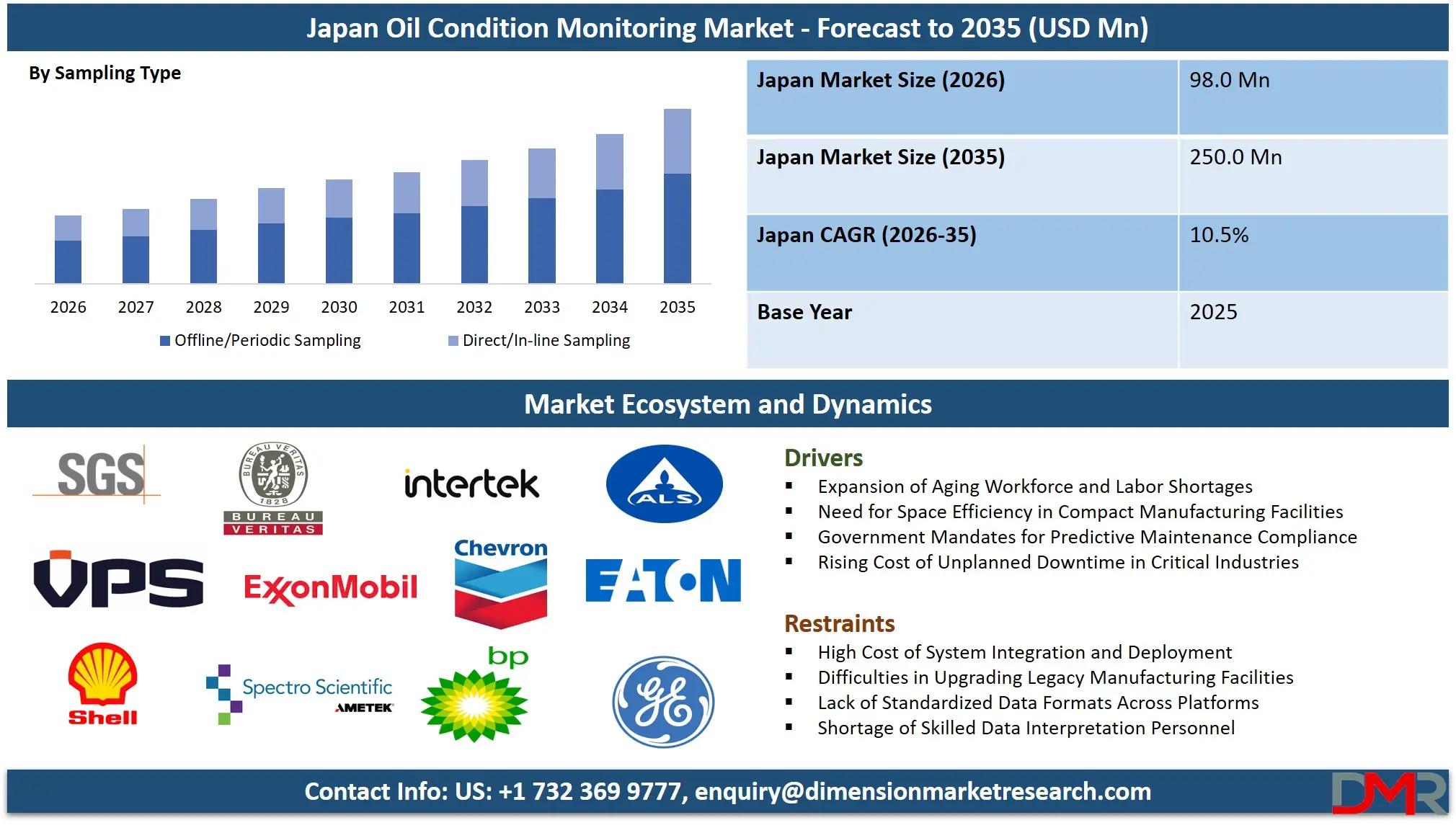
According to Dimension Market Research, the Japan Oil Condition Monitoring Market is estimated at USD 98.0 million in 2026 and is projected to reach USD 250.0 million by 2035, expanding at a 10.5% CAGR during the forecast period. Growing demand for predictive maintenance, labor-saving technologies, industrial automation, and advanced equipment diagnostics is accelerating adoption across Japan's manufacturing, transportation, energy, and industrial sectors.
Oil condition monitoring involves the systematic analysis of lubricants, hydraulic fluids, and industrial oils to assess equipment health and identify indicators of wear, contamination, degradation, and potential failure. The technology enables companies to move from reactive servicing toward condition-based maintenance, helping improve equipment reliability and optimize maintenance schedules.
Predictive Maintenance Becomes a Strategic Priority
Japan's highly developed industrial sector relies on machinery that must operate with exceptional reliability and precision. Unexpected equipment failure can interrupt production, increase maintenance costs, and affect delivery schedules.
Oil condition monitoring provides maintenance teams with information about lubricant health and machinery condition before a severe failure occurs. By identifying abnormal wear, contamination, or oil degradation at an earlier stage, companies can plan maintenance activities more effectively.
The shift toward predictive maintenance is particularly important in Japan because manufacturers are increasingly seeking ways to improve productivity while dealing with a shortage of skilled maintenance personnel.
Labor Shortages Accelerate Automation
Japan's aging workforce and shortage of technical personnel are important factors influencing the adoption of automated monitoring solutions.
Manual inspection and laboratory-based processes can require trained specialists and significant time. Automated analyzers, sensors, and connected monitoring systems can reduce repetitive diagnostic work and provide maintenance teams with faster access to equipment information.
This does not eliminate the need for skilled technicians, but it enables available personnel to focus on more complex diagnostic and maintenance activities.
Smart Manufacturing Supports Market Development
Japan is a major adopter of precision manufacturing, robotics, industrial automation, and connected production systems.
The expansion of smart factories is creating a favorable environment for oil condition monitoring because monitoring data can be integrated with other industrial systems.
Connected oil sensors can become part of broader asset-health platforms that combine machine information, maintenance histories, production data, and operating conditions.
This integration is helping transform oil monitoring from an individual diagnostic activity into part of a larger digital maintenance strategy.
AI Is Transforming Oil Analysis
Artificial intelligence is becoming an important technology within Japan's condition monitoring ecosystem.
AI-based systems can analyze large volumes of lubricant and equipment data to identify patterns associated with wear, contamination, and degradation.
Machine-learning algorithms can support anomaly detection and predictive maintenance by comparing current readings with historical equipment behavior.
DMR notes that AI-driven monitoring can help reduce unexpected downtime and improve maintenance decision-making.
AI can also support automated alerts, allowing maintenance personnel to prioritize equipment that requires attention.
Spectrometric Analysis Improves Diagnostic Depth
Spectrometric analysis provides detailed information about lubricant and equipment conditions.
By analyzing elements and particles within oil, monitoring systems can provide insight into wear, contamination, additive depletion, and other changes.
The increasing use of AI-enabled spectrometric analysis is creating opportunities for more automated and faster oil diagnostics.
This is particularly relevant to Japanese industries where precision and reliable equipment performance are major operational priorities.
Request Sample URL: https://dimensionmarketresearch.com/request-sample/japan-oil-condition-monitoring-market/
On-Site Monitoring Kits and Portable Analyzers Lead
On-site monitoring kits and portable analyzers are projected to dominate the product segment. DMR reports that this category accounted for approximately 70.9% of market revenue in 2026 in its product-type analysis.
Portable technologies provide maintenance teams with flexibility because measurements can be performed close to the equipment.
This can reduce dependence on centralized testing and provide faster diagnostic information.
Portable analyzers are particularly useful for distributed assets, transportation fleets, field equipment, industrial machinery, and applications where rapid maintenance decisions are important.
Laboratory-Based Services Remain Valuable
Although portable and on-site systems are gaining strong adoption, laboratory-based oil analysis remains important for detailed diagnostics.
Laboratories can perform specialized chemical and spectrometric analysis that may be difficult to conduct using basic field instruments.
This creates a complementary relationship between portable testing and laboratory analysis. Companies can use field devices for rapid screening and laboratory services for more detailed investigations when required.
The combination of both approaches can provide a more comprehensive asset-monitoring strategy.
Continuous Online Monitoring Gains Momentum
Continuous online monitoring systems are becoming increasingly relevant for critical and high-value assets.
These systems can monitor oil conditions continuously rather than relying solely on periodic sample collection.
Online monitoring can help identify sudden changes in viscosity, contamination, wear particles, or other indicators that might otherwise go unnoticed between scheduled inspections.
Japan's energy and power-generation industries are expected to provide important opportunities for continuous monitoring as operators focus on equipment reliability and operational continuity.
Offline Sampling Remains the Leading Sampling Method
Offline and periodic sampling is projected to account for approximately 44.8% of the market in 2026.
The approach remains attractive because it is relatively simple and can be integrated into existing maintenance workflows.
Many businesses already have established procedures for collecting oil samples and sending them for analysis.
However, direct and in-line sampling is gaining attention as companies seek more immediate and continuous equipment information.
Physical Properties Dominate Measurement Demand
Physical properties such as viscosity, density, and temperature are expected to represent approximately 40.1% of the measurement type segment in 2026.
These measurements are widely used because they provide basic information about lubricant health and operating conditions.
Changes in viscosity can indicate oil degradation or contamination, while density and temperature measurements can provide additional context about operating conditions.
Routine measurement of physical properties can therefore serve as an important foundation for broader condition-monitoring programs.
Wear and Contamination Monitoring Detect Equipment Problems
Wear and contamination monitoring is another important measurement category.
Techniques such as wear-debris analysis, particle counting, and ferrous-density measurement can provide indications of component deterioration.
This can be valuable for engines, gearboxes, hydraulic systems, turbines, compressors, and other oil-lubricated machinery.
Early identification of abnormal particles can help maintenance teams investigate the underlying cause before equipment damage becomes more serious.
Chemical Property Analysis Provides Deeper Insight
Chemical analysis measures parameters such as Total Acid Number (TAN), Total Base Number (TBN), oxidation, nitration, additive depletion, and other lubricant characteristics.
These measurements can indicate whether oil is approaching the end of its useful service life or whether operating conditions are causing accelerated degradation.
As Japanese manufacturers seek to optimize oil-drain intervals and minimize unnecessary lubricant replacement, chemical analysis can provide useful information for maintenance planning.
Transportation Represents the Largest Industry Vertical
Transportation is projected to lead the Japan Oil Condition Monitoring Market with approximately 52.0% share in 2026. The segment includes automotive fleets, aviation, marine, and railways.
Transportation assets depend heavily on reliable engines, transmissions, hydraulic systems, and other lubricated components.
Because equipment downtime can disrupt transportation schedules and increase operating costs, fleet operators have strong incentives to adopt predictive maintenance.
Japan's advanced automotive and railway industries create particularly strong opportunities for oil monitoring technologies.
Automotive Fleet Maintenance Creates Strong Demand
Japanese automotive fleets operate under demanding reliability expectations.
Oil monitoring can help fleet managers evaluate engine condition and determine whether lubricant changes or inspections are necessary.
On-site monitoring can reduce waiting times and support faster maintenance decisions.
As Japanese transportation companies increasingly use digital fleet-management platforms, oil condition information can also become part of a broader vehicle-health management system.
Railway Applications Benefit from Portable Diagnostics
Railway systems require high levels of reliability and operational consistency.
Portable analyzers can be useful for checking hydraulic fluids and lubricants in railway equipment and maintenance environments.
DMR specifically identifies railway hydraulic-system analysis as an important use case in Japan, including applications related to high-speed rail.
Combining portable analysis with scheduled maintenance can help operators monitor equipment health across geographically distributed assets.
Energy and Power Generation Offer Additional Opportunities
Power-generation assets often operate continuously, making equipment reliability critical.
Turbines, generators, gearboxes, and other machinery require effective lubrication, and changes in lubricant condition can provide valuable indicators of equipment health.
Continuous online monitoring is particularly relevant to high-value power assets where unplanned failure can result in substantial downtime.
Renewable-energy assets such as wind turbines also create opportunities for monitoring technologies because gearboxes and other mechanical systems require ongoing condition assessment.
Industrial Manufacturing Remains a Major Application
Japan's manufacturing sector is heavily dependent on precision machinery, robotics, production equipment, pumps, compressors, and hydraulic systems.
A failure in a critical production machine can create downtime across an entire manufacturing line.
Oil condition monitoring can provide early warnings that help maintenance teams prevent avoidable interruptions.
The technology also fits naturally into Japan's broader culture of continuous improvement and equipment reliability.
Heavy Machinery Creates Additional Demand
Construction and mining equipment can operate under harsh conditions and experience significant mechanical stress.
Oil analysis can help monitor hydraulic systems, engines, transmissions, and gearboxes.
Portable equipment is especially useful for machinery operating away from centralized maintenance facilities.
As Japanese companies and equipment operators adopt connected fleet technologies, oil monitoring can increasingly become part of broader machine-health platforms.
Marine Applications Require Reliable Oil Monitoring
Marine engines and mechanical systems operate under demanding conditions, and maintenance opportunities can be limited while vessels are in service.
Offline oil sampling can help identify fuel dilution, water contamination, and other issues that can influence engine performance.
DMR highlights marine engine oil testing as an important use case within Japan.
The combination of portable and laboratory-based analysis can support reliable maintenance planning for commercial shipping fleets.
Compact Manufacturing Environments Encourage Smart Solutions
Japanese manufacturing facilities often prioritize efficient use of available space.
The DMR report identifies space efficiency as an important market factor, with manufacturers increasingly using compact and flexible monitoring systems that can fit within existing production environments.
Miniaturized sensors and portable analyzers can therefore provide practical advantages.
Compact technologies may also make it easier for smaller facilities to adopt condition monitoring without extensive plant modifications.
Legacy Equipment Creates Integration Challenges
Many industrial facilities continue to operate older equipment and maintenance systems.
Legacy machinery may not have the interfaces required to connect directly with modern online sensors or digital platforms.
Retrofitting connected oil monitoring systems can therefore require additional engineering and integration investment.
This is an important challenge for companies seeking to modernize older facilities without replacing their entire equipment base.
High System Costs Can Slow Adoption
Advanced oil condition monitoring systems can require investment in sensors, analyzers, communication infrastructure, software, integration, and employee training.
Smaller manufacturers may find these expenses difficult to justify, particularly when equipment is not considered mission-critical.
Portable analyzers and periodic sampling can provide a lower-cost entry point.
As digital monitoring technologies become more affordable, wider adoption of integrated systems is likely to become more practical.
Digital Maintenance Improves Resource Efficiency
Condition monitoring can support sustainability by helping manufacturers extend equipment life and optimize lubricant use.
More accurate maintenance decisions can reduce unnecessary oil changes and prevent avoidable component replacement.
Longer asset lifecycles can also reduce the material and energy requirements associated with producing replacement machinery.
These advantages align with Japan's broader focus on operational efficiency and resource optimization.
Cloud-Based Diagnostics Expand Remote Monitoring
Cloud connectivity can enable maintenance teams to access condition-monitoring information from different plants and locations.
This can be particularly valuable for companies with distributed production facilities or large equipment fleets.
Cloud platforms can combine oil-analysis data with equipment histories and maintenance schedules.
Remote monitoring also enables specialists to review data without being physically present at every site.
Predictive Alerts Support Faster Decisions
Automated alerts can help maintenance teams respond more quickly when oil conditions move outside expected ranges.
Instead of reviewing every piece of equipment manually, maintenance personnel can focus attention on assets identified by the monitoring system.
This can improve efficiency and reduce the time between detection and intervention.
AI-based alerting can further improve the process by distinguishing normal operating variation from potentially significant abnormalities.
Competitive Landscape
The Japan Oil Condition Monitoring Market includes inspection and testing companies, lubricant suppliers, industrial technology providers, sensor manufacturers, and specialized oil-analysis companies.
Key players identified by Dimension Market Research include SGS S.A., Bureau Veritas S.A., Intertek Group plc, ALS Limited, Veritas Petroleum Services, Shell plc, ExxonMobil Corporation, Chevron Corporation, BP plc, TotalEnergies SE, ENEOS Corporation, Idemitsu Kosan Co., Ltd., Cosmo Energy Holdings Co., Ltd., Kyodo Yushi Co., Ltd., Parker Hannifin Corporation, Eaton Corporation plc, General Electric Company, Spectro Scientific, Tan Delta Systems plc, and SKF Group.
Companies compete through analytical accuracy, portable technologies, AI capabilities, sensor integration, laboratory services, connectivity, and technical support.
Recent Industry Developments
The market is experiencing continued development in portable analysis, digital diagnostics, and predictive maintenance.
In August 2025, Spectro Scientific enhanced its portable and integrated oil-analysis offerings, with greater emphasis on fast, site-based diagnostics.
In February 2025, ExxonMobil increased investment in digital and predictive maintenance technologies for industrial processes.
In January 2025, Bureau Veritas entered merger discussions with SGS, highlighting broader consolidation trends in inspection, testing, and analysis services.
These developments demonstrate the growing integration of oil analysis with digital maintenance and industrial asset-management strategies.
Future Outlook
The Japan Oil Condition Monitoring Market is expected to continue its rapid expansion as manufacturers and transportation operators adopt predictive maintenance to improve reliability and manage workforce constraints.
From USD 98.0 million in 2026, the market is projected to reach USD 250.0 million by 2035, representing a 10.5% CAGR.
Future development is likely to center on AI-based diagnostics, portable analyzers, cloud-connected monitoring, continuous online sensors, automated alerts, and integration with industrial IoT systems.
The shift from scheduled maintenance toward condition-based and predictive strategies is expected to remain a central market trend.
Checkout / Buy Report URL: https://dimensionmarketresearch.com/checkout/japan-oil-condition-monitoring-market/
Conclusion
The Japan Oil Condition Monitoring Market is evolving as businesses seek more reliable, automated, and data-driven approaches to equipment maintenance.
The combination of an aging industrial workforce, skilled-labor shortages, precision manufacturing, and strong automation capabilities is creating a favorable environment for advanced oil-analysis technologies.
On-site monitoring kits and portable analyzers currently dominate the product segment, while continuous online systems and AI-based diagnostics are gaining importance.
Transportation is the leading industry vertical, supported by automotive, aviation, marine, and railway applications, while manufacturing, energy, and heavy machinery provide additional opportunities.
With the market projected to reach USD 250.0 million by 2035 at a 10.5% CAGR, companies that combine accurate diagnostics, compact hardware, AI analytics, cloud connectivity, and practical maintenance services can benefit from Japan's transition toward smarter and more predictive asset management.

 English
 Arabic
 French
 Spanish
 Portuguese
 Turkish
 Dutch
Dutch
 Italiano
 Russian
 Romaian
 Portuguese (Brazil)
 Greek
Greek
