
Dredging Market: Marine Infrastructure, Environmental Solutions and Digital Innovation Shape Future Growth
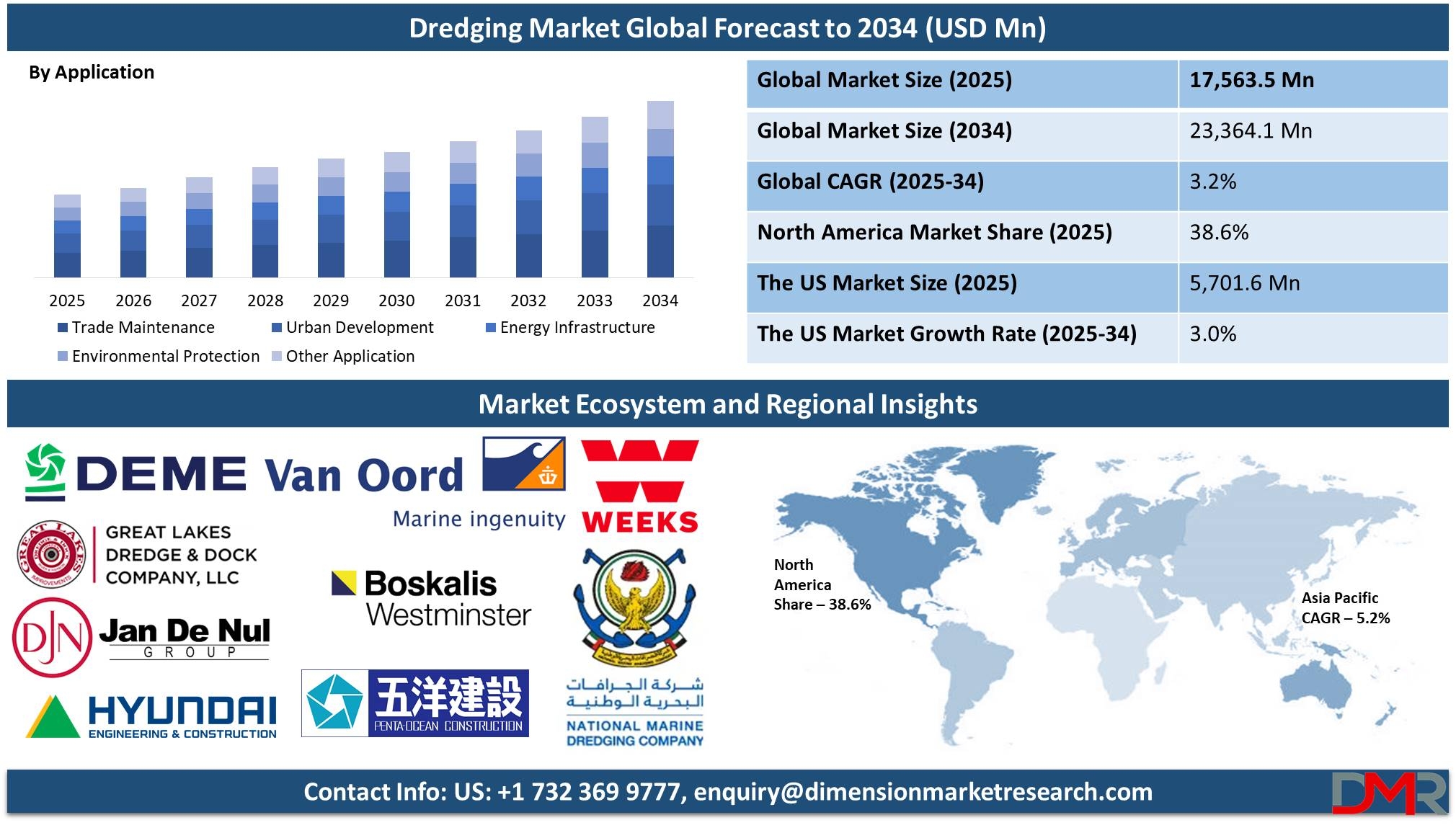
According to Dimension Market Research, the Dredging Market is evolving as marine infrastructure, port modernization, coastal resilience, offshore energy, and environmental restoration create sustained demand for underwater excavation and sediment-management services. The market is projected to reach USD 17,563.5 million in 2025 and is expected to grow to USD 23,364.1 million by 2034, registering a 3.2% CAGR during the forecast period.
Dredging supports a wide range of activities, from maintaining commercial shipping channels and deepening harbors to preparing seabeds for offshore infrastructure and removing contaminated sediments. The industry has become increasingly connected with global trade, urban development, energy infrastructure, and environmental management.
Technology is also reshaping the sector. GPS-guided positioning, automated dredging systems, sensors, real-time monitoring, artificial intelligence, machine learning, and digital twins are helping contractors improve precision and operational efficiency. At the same time, environmental requirements are pushing the industry toward cleaner equipment, better sediment controls, and more accurate ecological monitoring.
Dredging Becomes Essential to Marine Infrastructure
Modern maritime infrastructure depends on navigable waterways with predictable depth and adequate capacity.
Sediment naturally accumulates in ports, rivers, estuaries, canals, and offshore areas. Without effective sediment management, these deposits can restrict vessel movement, reduce cargo capacity, and affect the performance of marine infrastructure.
Dredging removes accumulated material and helps restore required water depths.
For port operators and governments, this makes dredging an important part of long-term infrastructure planning rather than a purely construction-related activity.
Maritime Trade Supports Recurring Demand
Commercial shipping is one of the most important structural drivers for dredging demand.
Large container vessels, bulk carriers, tankers, and other cargo ships require suitable channel depths to operate efficiently. Port authorities therefore need regular maintenance dredging to keep navigation routes accessible.
The DMR report identifies trade maintenance as the leading application segment, highlighting the importance of dredging to the maritime transportation system.
Unlike one-time construction projects, maintenance dredging can generate recurring demand because sediment continues to accumulate over time.
This gives established dredging contractors opportunities to develop long-term relationships with ports and infrastructure operators.
Port Expansion Supports Larger Project Sizes
Ports are expanding to accommodate increasing cargo volumes, larger vessels, and changing logistics patterns.
Expansion projects can involve:
- Channel deepening
- Harbor widening
- Berth preparation
- Turning basin excavation
- Access channel development
- Land reclamation
- Sediment removal
As ports become larger and more automated, dredging must meet increasingly precise engineering requirements.
Contractors with advanced equipment, experienced marine crews, navigation systems, and environmental-management capabilities can be better positioned to participate in major infrastructure projects.
Land Reclamation Creates New Development Space
Land reclamation is another major opportunity for the dredging industry.
Coastal cities often face constraints on available land while continuing to experience population growth and industrial expansion. Reclaimed areas can provide space for logistics facilities, industrial zones, transportation infrastructure, housing, commercial developments, and public projects.
Dredging equipment can remove suitable seabed materials and transport them to designated reclamation locations.
Large reclamation programs have demonstrated how dredging can become part of broader urban-development strategies.
The potential to combine excavation with land creation gives dredging an important role in supporting coastal economic development.
Coastal Resilience Creates New Demand
Coastal infrastructure faces growing exposure to erosion, flooding, storms, and changing environmental conditions.
Dredging can contribute to projects involving flood channels, sediment management, coastal defense, shoreline stabilization, and waterway improvement.
Governments are increasingly evaluating infrastructure investments based on long-term resilience.
This creates opportunities for dredging contractors to participate in public projects designed to strengthen coastal communities.
Dredging companies that can combine excavation capabilities with marine engineering and environmental expertise may benefit from this expanding application area.
Offshore Wind Expands the Dredging Opportunity
The transition toward offshore renewable energy is creating new requirements for underwater construction.
Offshore wind projects can involve seabed preparation, foundation installation, cable trenching, anchoring, and associated marine infrastructure.
These activities can require specialized dredging and excavation capabilities.
The DMR report identifies offshore wind farm development as an emerging opportunity for the dredging market, particularly in Europe, the United States, and China.
As offshore renewable capacity expands, dredging companies with specialized marine construction fleets may gain access to new project pipelines.
Oil and Gas Continues to Support Demand
Oil and gas remains an important end-user industry for dredging.
Offshore developments may require seabed preparation for platforms, pipelines, subsea equipment, anchors, and associated infrastructure.
Coastal energy terminals and LNG facilities can also require deep and reliable marine access for large vessels.
The oil and gas sector is therefore expected to remain a major source of project demand, particularly in regions with significant offshore energy infrastructure.
At the same time, dredging contractors serving this industry may increasingly diversify into offshore wind and other marine energy projects.
Cutter Suction Dredgers Maintain a Leading Position
Cutter Suction Dredgers (CSDs) are projected to hold the largest share of the dredging equipment market in 2025.
CSDs are suited to a wide variety of sediment conditions and can handle materials ranging from sand and compacted soil to harder formations.
The cutter head breaks up material before it is pumped from the excavation area.
Their versatility makes CSDs suitable for port development, channel deepening, river projects, land reclamation, and infrastructure construction.
Their ability to operate in different water conditions further strengthens their position across multiple project types.
Trailing Suction Hopper Dredgers Serve Large Marine Projects
Trailing Suction Hopper Dredgers, or TSHDs, are particularly relevant to large-scale marine sediment removal.
These vessels can collect dredged material and transport it to designated disposal or reclamation areas.
Their mobility makes them useful for projects involving navigation channels, offshore construction, coastal maintenance, and large-volume sediment removal.
The demand for different dredger types depends heavily on project size, water depth, sediment properties, required production rate, transportation distance, and environmental constraints.
This creates opportunities for equipment manufacturers offering specialized fleets for specific applications.
Digital Technology Improves Excavation Accuracy
Technology is becoming one of the strongest differentiators in the modern dredging industry.
GPS positioning, digital terrain models, sensors, automation, and real-time control systems can help contractors maintain accurate excavation profiles.
Accurate positioning reduces unnecessary digging and can improve consistency across large work areas.
Digital systems can also provide project managers with information about progress, productivity, equipment status, and resource use.
As customers demand greater project transparency, digital reporting and real-time visibility are becoming increasingly valuable.
Artificial Intelligence Supports Smarter Fleet Management
Artificial intelligence can help dredging contractors turn large volumes of operational data into practical insights.
AI systems can analyze information about engines, pumps, cutter heads, excavation conditions, fuel consumption, vessel movements, and equipment utilization.
This can help operators identify patterns associated with:
- Equipment deterioration
- Excessive fuel use
- Maintenance requirements
- Production inefficiencies
- Operational anomalies
- Potential downtime
Predictive analytics can allow maintenance activities to be scheduled before failures affect project schedules.
Over time, AI-based systems may become increasingly integrated into fleet-management platforms.
Digital Twins Enable Simulation and Optimization
Digital twins can create virtual representations of vessels, equipment, seabeds, and operating environments.
Dredging companies can use these models to evaluate different project scenarios before physical work begins.
Applications can include equipment planning, seabed modeling, excavation sequencing, maintenance analysis, and project optimization.
A digital twin can also support training and simulation by allowing operators and project teams to test different operating strategies.
As computing power and data availability improve, digital twin adoption could become increasingly relevant to large and technically complex dredging projects.
Environmental Dredging Expands Beyond Infrastructure
Dredging is increasingly being used as an environmental management tool.
Contaminated sediments can accumulate in industrial waterways, ports, rivers, lakes, and estuaries.
Environmental dredging removes these materials under controlled conditions to support remediation and ecological restoration.
Such projects can require highly specialized equipment, containment techniques, monitoring systems, and disposal processes.
This segment is strategically important because it combines dredging expertise with environmental engineering.
Government remediation programs and water-quality initiatives can provide long-term opportunities for contractors with specialized environmental capabilities.
Turbidity Control Becomes Increasingly Important
Sediment disturbance can increase turbidity and potentially affect aquatic ecosystems.
As environmental regulations become more stringent, dredging operators are increasingly expected to control sediment dispersion.
Technologies such as turbidity curtains, containment systems, controlled excavation, and real-time monitoring can help reduce environmental impacts.
The industry is therefore moving toward more measured and controlled dredging practices.
Environmental performance is becoming a competitive consideration alongside equipment productivity and project cost.
Lower-Emission Dredging Technology Gains Attention
Fuel use is an important component of dredging operating costs.
Large vessels and support equipment consume substantial amounts of energy, creating both economic and environmental pressures.
Operators are therefore exploring more efficient engines, optimized operating cycles, hybrid technologies, alternative fuels, and energy-management systems.
Reducing fuel consumption can help lower operating costs while contributing to emissions-reduction objectives.
As environmental standards develop, energy efficiency is expected to become increasingly important in equipment selection.
North America Holds a Leading Position
North America is projected to account for approximately 38.6% of Dredging Market revenue in 2025, making it the largest regional market.
The region benefits from major commercial ports, extensive coastlines, offshore energy infrastructure, environmental programs, and ongoing maritime investment.
The United States represents the dominant contributor within the region.
DMR projects the U.S. Dredging Market at USD 5,701.6 million in 2025, reaching USD 7,444.3 million by 2034 at a 3.0% CAGR.
U.S. demand spans port maintenance, channel deepening, environmental remediation, coastal resilience, and offshore energy development.
U.S. Port Infrastructure Supports Recurring Projects
The U.S. has a large network of ports and navigable waterways.
Commercial shipping generates continuous demand for maintaining access channels and harbor infrastructure.
Port modernization programs can require major dredging activities when channel dimensions are expanded to accommodate larger vessels.
Coastal states also require sediment-management and resilience programs, creating additional opportunities.
The combination of commercial maritime activity and public infrastructure investment gives the U.S. market a relatively diverse demand base.
Asia-Pacific Provides Strong Infrastructure Potential
Asia-Pacific is expected to remain one of the most important long-term opportunity areas.
Rapid urbanization, industrialization, port development, trade growth, and offshore energy investment are supporting demand across the region.
China and India are major contributors, while Southeast Asian countries are also investing in ports, coastal developments, and marine infrastructure.
Land reclamation remains particularly relevant in densely populated coastal regions.
The combination of trade expansion and infrastructure modernization can support demand for both large dredging contractors and equipment suppliers.
Request a Free Sample Report:
https://dimensionmarketresearch.com/request-sample/dredging-market/
Europe Combines Environmental and Offshore Demand
Europe represents an important market where traditional dredging activities increasingly overlap with sustainability requirements.
European ports require regular maintenance and modernization, while offshore wind development creates additional seabed preparation and cable-related work.
Environmental regulations are also influencing how dredging projects are designed and executed.
This is driving interest in precise excavation, lower-emission equipment, sediment management, and environmental monitoring.
Europe can therefore serve as an important market for advanced and environmentally focused dredging technologies.
Emerging Economies Create New Infrastructure Opportunities
Developing markets across Africa, Southeast Asia, Latin America, and other coastal regions are investing in maritime infrastructure.
New ports and logistics corridors can require significant dredging during construction and ongoing maintenance afterward.
Inland waterways can also provide opportunities where governments are seeking more efficient transportation systems.
International dredging companies can participate in these projects through partnerships, concessions, engineering contracts, and equipment deployment.
Local infrastructure growth can therefore create new geographic opportunities for the industry.
High Capital Requirements Remain a Challenge
The dredging industry requires significant upfront investment.
Dredgers, vessels, pumps, pipelines, cutters, navigation systems, support equipment, maintenance facilities, and specialized personnel all contribute to capital requirements.
Advanced automation and environmental systems can increase initial equipment costs.
Smaller companies may therefore face difficulties competing for large contracts without adequate access to financing or fleet capacity.
Efficient asset utilization and project scheduling remain essential to maintaining profitability.
Environmental Rules Increase Project Complexity
Environmental regulations can significantly influence project design and execution.
Dredging near sensitive habitats, wetlands, coral ecosystems, estuaries, and populated coastlines may require extensive assessments and mitigation measures.
Permitting requirements can increase project timelines and operating expenses.
Contractors must therefore demonstrate not only technical competence but also environmental planning and compliance capabilities.
Companies that can deliver precise dredging while minimizing ecological disturbance may be better positioned as regulations become more demanding.
Skilled Workforce and Technical Expertise Matter
Modern dredging operations increasingly require specialized technical knowledge.
Operators may need to understand marine navigation, equipment controls, seabed data, environmental requirements, digital systems, and maintenance practices.
As equipment becomes more automated, workforce requirements are changing from purely mechanical skills toward combinations of marine engineering and digital competencies.
Training, remote support, digital monitoring, and advanced operator interfaces can help address these requirements.
Competitive Landscape
The Dredging Market includes major marine construction companies, specialist dredging contractors, infrastructure firms, and regional operators.
Dimension Market Research identifies Jan De Nul Group, Royal Boskalis Westminster N.V., DEME Group, Great Lakes Dredge & Dock Corporation, China Communications Construction Company (CCCC), Hyundai Engineering & Construction Co., Ltd., Penta-Ocean Construction Co., Ltd., Van Oord, TOA Corporation, Weeks Marine, Inc., National Marine Dredging Company (NMDC), Boskalis Hirdes, and Gulf Cobla among the prominent participants.
Competition depends on fleet capabilities, engineering expertise, geographic reach, project experience, environmental performance, technology adoption, and the ability to execute complex marine projects.
Companies with diversified fleets and advanced digital capabilities can compete across a wider range of applications.
Future Trends in Dredging
Several trends are expected to shape the next phase of industry development.
Automation is likely to expand as operators seek greater precision and lower dependence on manual control.
AI and predictive maintenance can improve equipment availability and reduce unexpected downtime.
Digital twins can strengthen planning and simulation.
Environmental monitoring can become increasingly integrated with dredging systems.
Low-emission equipment can gain greater importance as sustainability requirements increase.
Offshore wind can provide an expanding source of specialized marine construction demand.
Together, these trends point toward a future dredging industry that is more connected, data-driven, efficient, and environmentally responsible.
Buy / Checkout Dredging Market Report:
https://dimensionmarketresearch.com/checkout/dredging-market/
Market Outlook
The Dredging Market is expected to maintain steady expansion through the forecast period as global maritime infrastructure continues to evolve.
Dimension Market Research projects the market to grow from USD 17,563.5 million in 2025 to USD 23,364.1 million by 2034, representing a 3.2% CAGR.
Port expansion and maintenance will remain foundational demand drivers, while coastal resilience, environmental remediation, land reclamation, offshore wind, and other marine infrastructure projects can broaden the market opportunity.
Technology will increasingly determine how efficiently contractors can deliver these projects. GPS systems, automated dredgers, real-time monitoring, AI, digital twins, and predictive maintenance can improve productivity while helping operators manage increasingly complex environmental and technical requirements.
As governments and businesses continue investing in ports, coastal infrastructure, offshore energy, and environmental restoration, dredging will remain a critical enabling activity across the global marine infrastructure ecosystem.
 Spanish
 English
 Arabic
 French
 Portuguese
 Deutsch
 Turkish
 Dutch
Dutch
 Italiano
 Russian
 Romaian
 Portuguese (Brazil)
 Greek
Greek
