
BIS CRS Certification: Documents, Testing and Application Requirements Explained
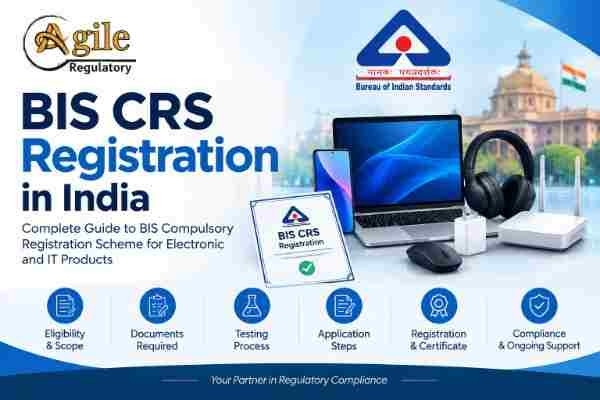
Companies entering the Indian electronics market soon learn that regulatory compliance is not just a matter of filling out an application form. Before bringing the product to market, manufacturers must meet the conformity and registration requirements that apply to products covered by the BIS Compulsory Registration Scheme. Hence, understanding the documentation and test stages is important.
What Is BIS CRS Certification?
BIS CRS certification is a commonly used expression for the compliance process under the BIS Compulsory Registration Scheme.
The scheme requires specified products to conform to relevant Indian Standards and complete the applicable registration procedure.
The exact requirements depend on the product.
Why Testing Matters
“Laboratory testing provides technical evidence of compliance with the applicable standard. Some standards require that a product be tested for certain safety or performance parameters. The manufacturer should verify the correct testing requirements before submitting samples.
Choosing the Correct Product
The sample submitted for testing should correspond to the product intended for registration.
Important characteristics include:
-
Model
-
Hardware configuration
-
Electrical specifications
-
Brand
-
Manufacturer
-
Product construction
If the commercial product differs materially from the tested sample, the manufacturer should evaluate whether additional compliance steps are necessary.
BIS CRS Documents
The documentation required varies depending on the application, but may include:
Manufacturer Information
Legal manufacturer name and manufacturing address.
Product Information
Product name, model number, specifications, and description.
Brand Information
Details of the brand or trademark under which the product will be marketed.
Laboratory Report
The relevant test report from an appropriate laboratory.
Authorization Documents
Where applicable, authorization or representative documentation.
Declarations and Undertakings
Documents required under the applicable BIS procedure.
Why Document Consistency Is Important
Suppose a laboratory report lists a manufacturer as "ABC Electronics Pvt. Ltd." while the application uses "ABC Electronics Private Limited."
Even a small inconsistency may require clarification.
The same principle applies to:
-
Factory addresses
-
Model numbers
-
Brand names
-
Product descriptions
A pre-submission document review can therefore be valuable.
Application Submission
After preparing the relevant documentation, the manufacturer submits the application through the applicable BIS registration system.
The application should accurately represent the product.
The applicant should avoid copying information from unrelated products or older applications without verifying it.
BIS Review
BIS may examine:
-
Application information
-
Test report
-
Manufacturer details
-
Product details
-
Supporting documents
If clarification is required, the applicant may need to provide additional information.
What Happens After Approval?
BIS shall grant registration after successful completion of the applicable requirements. The manufacturer then must meet applicable product marking and continuing compliance requirements.
Maintaining Records
Manufacturers should keep copies of:
-
Test reports
-
BIS registration
-
Product specifications
-
Application information
-
Correspondence
-
Product change records
These records can be valuable if the company later modifies the product or expands its product range.
Agile Regulatory's Role
Agile Regulatory can help businesses organize their BIS CRS compliance workflow.
Support can involve:
-
Product requirement assessment
-
Documentation guidance
-
Laboratory coordination
-
Application preparation
-
Query support
-
Compliance follow-up
Businesses should evaluate the exact requirements applicable to their product before proceeding.
FAQs
Is a test report enough for BIS registration?
No. Testing is an important component, but where CRS registration is mandatory, the applicable BIS registration process must also be completed.
Can I use any laboratory?
The applicable BIS requirements should be checked to determine which laboratory and report are acceptable.
How many documents are required?
There is no universal number. Requirements depend on the product and applicant.
What if my model changes after testing?
The effect depends on the nature of the change. The manufacturer should determine whether additional testing or BIS action is required.
Conclusion
Documentation and testing are two important pillars of BIS CRS compliance. The registration process can be much more organized if companies can identify the correct standard, use the correct testing route and keep consistent documentation. Manufacturers should not see BIS CRS as a paperwork exercise, but incorporate it into their product-development and market-entry plans.

 English
 French
 Spanish
 Portuguese
 Deutsch
 Turkish
 Dutch
Dutch
 Italiano
 Russian
 Romaian
 Portuguese (Brazil)
 Greek
Greek
