
Japan Digital Substation Gateway Market: AI, Smart Grid and Grid Modernization
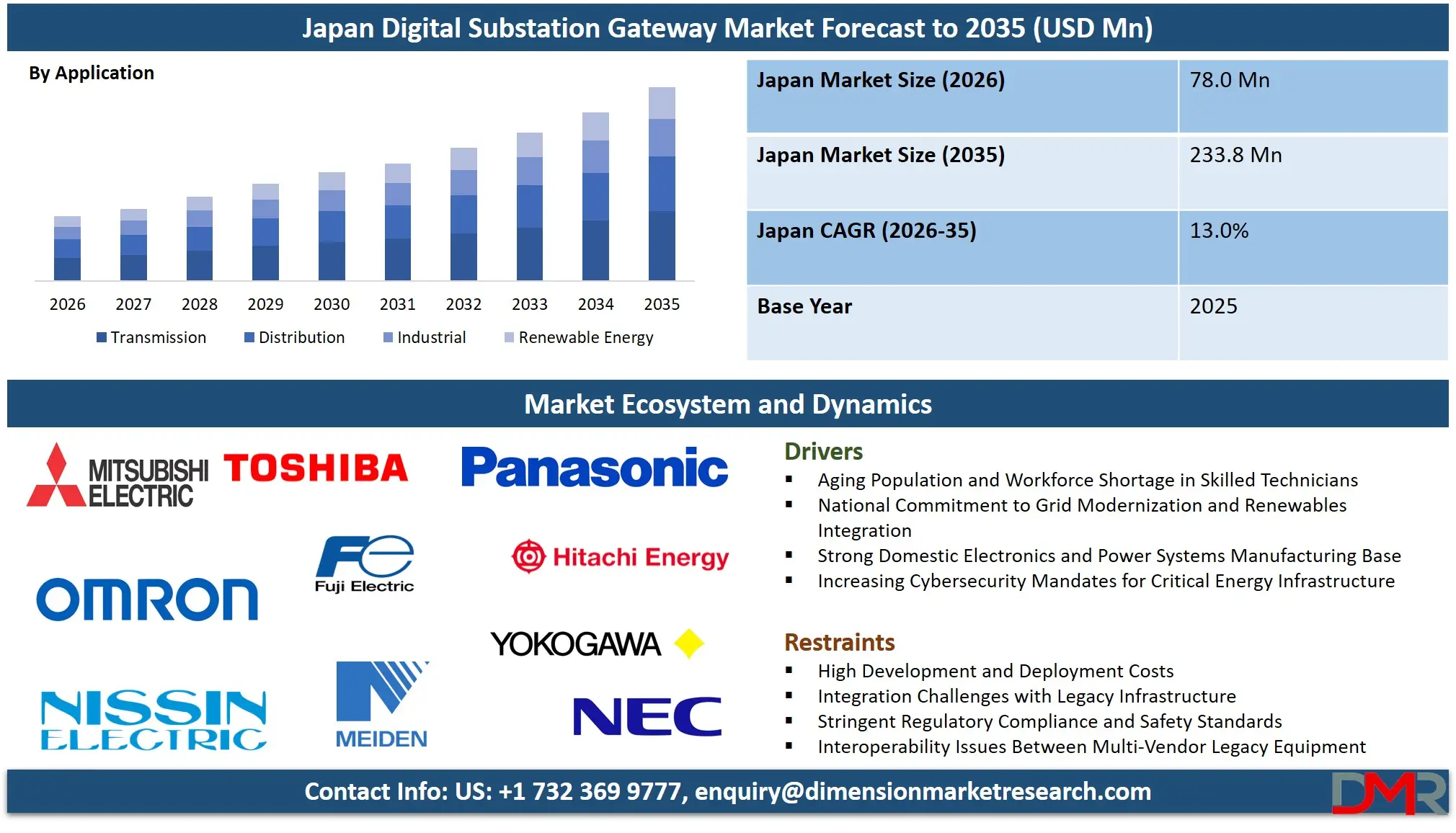
According to Dimension Market Research, the Japan Digital Substation Gateway Market is entering a high-growth phase as utilities and industrial organizations modernize aging power infrastructure and prepare the grid for renewable energy, distributed generation, automation, and stronger cybersecurity. The market is estimated at USD 78.0 million in 2026 and is projected to reach USD 233.8 million by 2035, registering a 13.0% CAGR during the forecast period.
Digital substation gateways act as communication bridges between electrical equipment, intelligent electronic devices, protection systems, control centers, and modern energy-management platforms. They can collect and aggregate operational data, convert communication protocols, and help legacy equipment communicate with newer digital systems.
Japan provides a particularly strong environment for this technology because its power infrastructure combines advanced industrial capabilities with aging assets that increasingly require modernization. Renewable-energy integration, workforce shortages, smart-grid investment, and the need for resilient infrastructure are creating new opportunities for gateway manufacturers and digital-grid solution providers.
Japan Digital Substation Gateway Market at a Glance
| Market Indicator | Value / Insight |
|---|---|
| Market Size, 2026 | USD 78.0 Million |
| Forecast Value, 2035 | USD 233.8 Million |
| CAGR, 2026–2035 | 13.0% |
| Leading Component | Hardware |
| Hardware Share, 2026 | 54.9% |
| Leading Communication Protocol | IEC 61850 |
| Leading Deployment | Retrofit Brownfield Upgrades |
| Leading Voltage Levels | HV and EHV |
| Major End User | Utilities |
| Key Applications | Transmission, Distribution, Industrial & Renewable Substations |
What Is a Digital Substation Gateway?
A digital substation gateway is a communication and data-management device used to connect different systems within an electrical substation.
It can collect information from:
Protection Relays
Circuit Breakers
Meters
Sensors
Intelligent Electronic Devices
The gateway can then transfer this information to supervisory control and data acquisition systems, control centers, energy-management platforms, and other grid applications.
One of its most important roles is protocol conversion.
Legacy equipment may use communication methods such as DNP3, Modbus, or PROFIBUS, while modern substations increasingly depend on Ethernet-based digital communication and IEC 61850.
The gateway creates interoperability between these environments.
Why Is Japan Adopting Digital Substation Gateways?
Japan's electricity infrastructure is highly developed, but parts of its substation network rely on older protection, control, and communication equipment.
Replacing every legacy system with a completely new digital substation would be expensive and disruptive.
Digital gateway technology provides an alternative.
Utilities can modernize existing installations while keeping selected legacy equipment operational.
This creates several benefits:
Lower Upgrade Disruption
Improved Data Visibility
Better Interoperability
Remote Monitoring
Modern Communication
Longer Asset Life
The ability to upgrade brownfield substations is therefore a major growth driver.
Aging Infrastructure Creates a Strong Retrofit Opportunity
Japan's aging grid infrastructure represents one of the most important market opportunities.
Many substations were developed decades ago and were not designed for today's connected energy environment.
Modern gateways can connect older meters, relays, and control systems to digital platforms.
This allows utilities to modernize gradually rather than replacing entire substations.
The DMR analysis identifies Retrofit Brownfield Upgrades as the dominant deployment segment, supported by the need to extend asset life and modernize infrastructure while controlling capital expenditure.
Hardware Leads the Component Segment
Hardware is expected to remain the leading component category, with 54.9% market share in 2026.
Hardware includes:
Protocol Gateways
Communication Interfaces
Processing Units
Communication Modules
Industrial Enclosures
These devices must operate reliably in demanding environments.
Japanese substations can also face earthquakes and other natural hazards, increasing the importance of ruggedized equipment and redundant communication architectures.
Domestic manufacturers have strong capabilities in developing high-reliability electronics for utility applications.
IEC 61850 Becomes the Communication Standard
IEC 61850 is expected to dominate the communication protocol segment.
The protocol is designed to support interoperable communication between equipment used in electrical substations.
Its adoption can help utilities reduce the challenges created by different equipment suppliers and proprietary communication systems.
IEC 61850 supports:
Substation Automation
Protection Communication
Real-Time Data Exchange
Equipment Interoperability
Digital Control
As Japanese utilities increase automation, standardized communication becomes increasingly valuable.
AI Improves Protocol Conversion and Grid Analytics
Artificial intelligence is creating another layer of opportunity.
AI-based data mapping can help interpret information coming from different legacy systems and map it to modern digital architectures.
Machine-learning systems can also analyze substation data to detect unusual patterns.
Potential applications include:
Fault Prediction
Equipment Monitoring
Data Classification
Anomaly Detection
Load Forecasting
Maintenance Optimization
This means future digital gateways may become more than communication devices. They can increasingly operate as intelligent edge-computing platforms.
Edge Computing Supports Faster Decisions
Sending every piece of substation data to a centralized cloud platform can create delays and increase communication requirements.
Edge-enabled gateways can analyze selected data locally.
For example, if abnormal equipment behavior is detected, the system can generate an immediate local alert before sending additional information to a central control center.
This can support:
Faster Fault Detection
Lower Latency
Reduced Network Traffic
Local Analytics
Improved Operational Response
Software-defined gateways are also becoming more flexible because new functions can potentially be added through software updates instead of replacing the physical hardware.
Renewable Energy Integration Drives Demand
Japan is increasing the role of renewable energy in its electricity system.
The country's target is to increase renewable energy to 36–38% of the power mix by 2030.
Solar and wind generation introduce greater variability into the grid.
Digital gateways can collect data from renewable-energy substations and transmit information to grid operators.
This can help with:
Power Forecasting
Voltage Management
Frequency Response
Grid Balancing
Renewable Integration
As distributed energy resources become more widespread, the importance of intelligent communication infrastructure will continue to increase.
Solar and Wind Projects Need Smart Communication
Renewable-energy substations must communicate effectively with utility control centers.
A digital gateway can collect information about:
Power Output
Voltage
Frequency
Grid Conditions
Weather Information
This information can help utilities understand renewable generation in real time.
The result is a more visible and controllable energy network.
Utilities Remain the Largest End User
Utilities represent the primary customer base for digital substation gateways.
Japan's major power companies are modernizing transmission and distribution infrastructure to improve:
Grid Reliability
Operational Visibility
Asset Management
Renewable Integration
Fault Response
Remote Operations
Digital gateways can be deployed across transmission and distribution substations, creating recurring demand as utilities modernize different sections of their networks.
High Voltage and Extra High Voltage Gain Importance
The High Voltage and Extra High Voltage segments are expected to lead by voltage level.
These networks form a critical part of Japan's electricity transmission infrastructure.
Digital gateways at HV and EHV substations can provide real-time information on power flows and equipment conditions.
This becomes increasingly important when electricity must move between regions and when renewable generation creates new power-flow patterns.
Smart Cities Create Additional Opportunities
Digital substation gateways are also relevant to Japan's smart-city development.
Modern urban areas increasingly incorporate:
Solar Generation
Battery Storage
Electric Vehicles
Smart Buildings
Digital Energy Systems
These distributed energy resources create more complex electricity flows.
Smart gateways can help monitor and coordinate these systems at the distribution level.
This supports the broader transition toward data-driven urban energy management.
Electric Vehicles Increase Grid Complexity
The expansion of electric vehicles can increase electricity demand at distribution networks.
Large concentrations of charging stations may create localized peaks.
Digital substations can help utilities monitor these changes.
Gateway systems can collect information about electricity flows and support improved coordination between charging infrastructure and the wider grid.
As EV adoption increases, digital communication between substations and distribution-management platforms may become increasingly important.
Cybersecurity Becomes a Core Requirement
Greater digital connectivity also increases cybersecurity requirements.
Substations are critical infrastructure, which makes them attractive targets for cyber threats.
Digital gateways can provide a security layer between substation equipment and wider utility networks.
Security functions may include:
Access Control
Network Monitoring
Encrypted Communication
Anomaly Detection
Secure Remote Access
Cybersecurity services therefore create opportunities beyond hardware sales. Vendors can offer managed monitoring, vulnerability assessments, incident response, and long-term security support.
Aging Workforce Encourages Remote Monitoring
Japan's changing demographics are creating another important market driver.
Utilities must manage complex infrastructure while dealing with shortages of skilled technicians.
Digital gateways enable remote monitoring and diagnostics.
Instead of sending technicians to every site for routine checks, utilities can use centralized platforms to monitor equipment remotely.
This can reduce:
Site Visits
Inspection Time
Maintenance Delays
It can also allow a smaller workforce to manage a larger infrastructure network.
Predictive Maintenance Improves Asset Reliability
Gateway systems can collect information from sensors and intelligent electronic devices.
AI and predictive analytics can analyze this data for indications of potential failures.
Important parameters may include:
Temperature
Voltage
Current
Breaker Status
Equipment Alarms
Operating History
When abnormal patterns appear, maintenance teams can investigate before equipment failure occurs.
This can improve asset availability and reduce unplanned outages.
Industrial Substations Expand the Customer Base
Digital substation gateways are not limited to utilities.
Large industrial companies operate their own substations to supply electricity to manufacturing facilities.
Industries such as steel, chemicals, automotive, semiconductor manufacturing, and other energy-intensive businesses require stable power.
Industrial gateways can monitor:
Power Quality
Energy Consumption
Equipment Status
Protection Systems
This can help companies improve power reliability and energy management.
Managed Services Create Recurring Revenue
The growing complexity of digital substations is increasing interest in managed services.
Rather than purchasing hardware alone, customers can choose bundled solutions that include:
Installation
Commissioning
Maintenance
Cybersecurity
Remote Monitoring
Technical Support
Managed-service models can create recurring revenue for technology providers.
They can also help smaller utilities overcome shortages of specialized digital-grid personnel.
Digital Twins Improve Substation Planning
Digital twins can create virtual representations of substations.
A digital model can combine:
Equipment Data
Historical Performance
Sensor Information
Maintenance Records
Network Conditions
Utilities can use digital models to understand how a substation is performing and evaluate potential upgrades.
AI can further analyze the digital twin to identify maintenance priorities or simulate different operating conditions.
Japan's Natural Disaster Risk Supports Resilient Technology
Japan experiences earthquakes and other natural hazards.
This increases the importance of grid resilience.
Digital substation systems can help utilities obtain faster information about equipment and network conditions after disruptive events.
Real-time monitoring can support:
Fault Identification
Remote Diagnostics
Faster Restoration
Asset Assessment
Operational Coordination
This creates an additional reason for utilities to invest in digital communication infrastructure.
Government Policy Supports Market Development
Japan's energy policy is an important market catalyst.
The country's Green Growth Strategy and carbon-neutrality objectives emphasize modernization, energy efficiency, renewable integration, and resilient infrastructure.
The market is also supported by initiatives promoting smart-grid demonstrations, digital technologies, and modern substation infrastructure.
These policies provide a favorable environment for digital substation gateway adoption.
Key Market Challenges
Despite strong growth potential, several barriers remain.
High Initial Costs
Advanced hardware, software, cybersecurity, engineering, and integration can require significant investment.
Legacy Integration
Older equipment may use proprietary protocols and outdated communication architectures.
Cybersecurity Risks
Increasing connectivity requires stronger security management.
Skilled Workforce
Digital systems require specialized technical knowledge.
Complex Upgrades
Retrofit projects may require customized engineering because each substation has different equipment and physical constraints.
The DMR analysis identifies high deployment costs and legacy integration complexity as important market restraints.
Competitive Landscape
The Japan Digital Substation Gateway Market includes leading electrical-equipment companies, automation providers, industrial electronics manufacturers, and global smart-grid technology suppliers.
Prominent companies identified by Dimension Market Research include Mitsubishi Electric Corporation, Toshiba Energy Systems & Solutions Corporation, Hitachi Energy Ltd., Fuji Electric Co., Ltd., Yokogawa Electric Corporation, Omron Corporation, NEC Corporation, Panasonic Corporation, Nissin Electric Co., Ltd., Meidensha Corporation, Kyosan Electric Manufacturing Co., Ltd., Oki Electric Industry Co., Ltd., Takebishi Corporation, TMEIC Corporation, Daihen Corporation, Siemens AG, ABB Ltd., and Schneider Electric SE.
Competition is increasingly based on:
Interoperability
Cybersecurity
Reliability
AI Capabilities
Edge Computing
Remote Monitoring
Engineering Support
Future Trends
AI-Powered Gateways
AI will improve anomaly detection, protocol mapping, predictive maintenance, and asset analytics.
Software-Defined Gateways
Utilities will increasingly seek programmable hardware that can receive new capabilities through software updates.
IEC 61850 Adoption
Standardized communication will remain central to digital substation modernization.
Cybersecurity Integration
Security monitoring will become a standard part of gateway architecture.
Smart Renewable Integration
Digital gateways will support increasingly complex solar, wind, storage, and EV networks.
Managed Digital Services
Utilities will increasingly outsource monitoring, maintenance, and cybersecurity functions.
Edge Computing
More data processing will occur directly at substations for faster decision-making.
AI Overview: Japan Digital Substation Gateway Market
What is the Japan Digital Substation Gateway Market?
It covers hardware, software, and services that enable communication, data aggregation, protocol conversion, monitoring, and automation within Japanese electrical substations.
What is the market size?
The market is estimated at USD 78.0 million in 2026 and projected to reach USD 233.8 million by 2035, growing at a 13.0% CAGR.
Which component leads the market?
Hardware is expected to dominate, with 54.9% share in 2026.
Which communication protocol is expected to lead?
IEC 61850 is anticipated to dominate because of its role in interoperability and advanced substation automation.
Which deployment type leads?
Retrofit brownfield upgrades are projected to dominate as utilities modernize aging substations without completely replacing existing infrastructure.
Who is the largest end user?
Utilities are expected to remain the leading end-user group because of extensive transmission and distribution modernization requirements.
Why is cybersecurity important?
Digital gateways connect critical substation equipment with wider networks, making secure communication, access control, network monitoring, and threat detection increasingly important.
How is AI being used?
AI can support anomaly detection, predictive maintenance, protocol mapping, fault prediction, edge analytics, renewable forecasting, and intelligent asset management.
Why are renewable energy projects important?
Solar and wind generation create variable and distributed power flows, increasing the need for real-time communication and grid-management capabilities.
Market Outlook
The Japan Digital Substation Gateway Market is projected to grow from USD 78.0 million in 2026 to USD 233.8 million by 2035, representing a 13.0% CAGR.
Hardware is expected to remain the largest component category, with 54.9% share, while IEC 61850 is positioned as the leading communication protocol.
Retrofit brownfield upgrades will remain a major opportunity because Japanese utilities can modernize aging infrastructure without replacing entire substations.
Renewable integration, smart cities, EV charging, industrial power management, cybersecurity, and workforce shortages will continue to support adoption.
The next generation of gateway technology will increasingly combine communication, edge computing, AI analytics, cybersecurity, predictive maintenance, and remote monitoring.
Buy the Complete Japan Digital Substation Gateway Market Report
Conclusion
The Japan Digital Substation Gateway Market is becoming an important part of the country's power-grid modernization strategy.
The market's projected expansion from USD 78.0 million in 2026 to USD 233.8 million by 2035 reflects increasing demand for reliable communication between legacy electrical equipment and modern digital grid platforms.
A major advantage of digital gateways is their ability to support brownfield modernization. Utilities can connect older relays, meters, and control systems to modern networks without completely replacing existing infrastructure.
IEC 61850 will remain an important technology foundation as utilities pursue greater interoperability and automation.
Renewable-energy integration provides another major growth opportunity. As solar, wind, storage, and distributed energy resources expand, utilities need better visibility into power flows, voltage, frequency, and generation conditions.
AI is expected to take the technology further. Intelligent gateways can support anomaly detection, predictive maintenance, protocol mapping, fault analysis, and edge-based decision-making.
Cybersecurity will also become increasingly important as substations become more connected. Secure communication, network monitoring, access control, and continuous threat detection will become integral to digital-substation architecture.
Japan's aging workforce provides another strong reason for adoption. Remote monitoring and automated diagnostics can help utilities manage complex infrastructure with fewer routine field interventions.
Looking ahead, the market is likely to move toward software-defined gateways, AI-enabled edge intelligence, managed cybersecurity, digital twins, predictive maintenance, and smart renewable integration.
The future digital substation will therefore not simply connect electrical equipment. It will function as an intelligent edge environment that helps utilities communicate, monitor, predict, secure, and optimize the electricity network in real time.

 English
 Arabic
 French
 Spanish
 Portuguese
 Deutsch
 Turkish
 Dutch
Dutch
 Italiano
 Russian
 Romaian
 Greek
Greek
