
South Korea Warehousing Market: Automation, E-Commerce and Smart Logistics Drive Growth
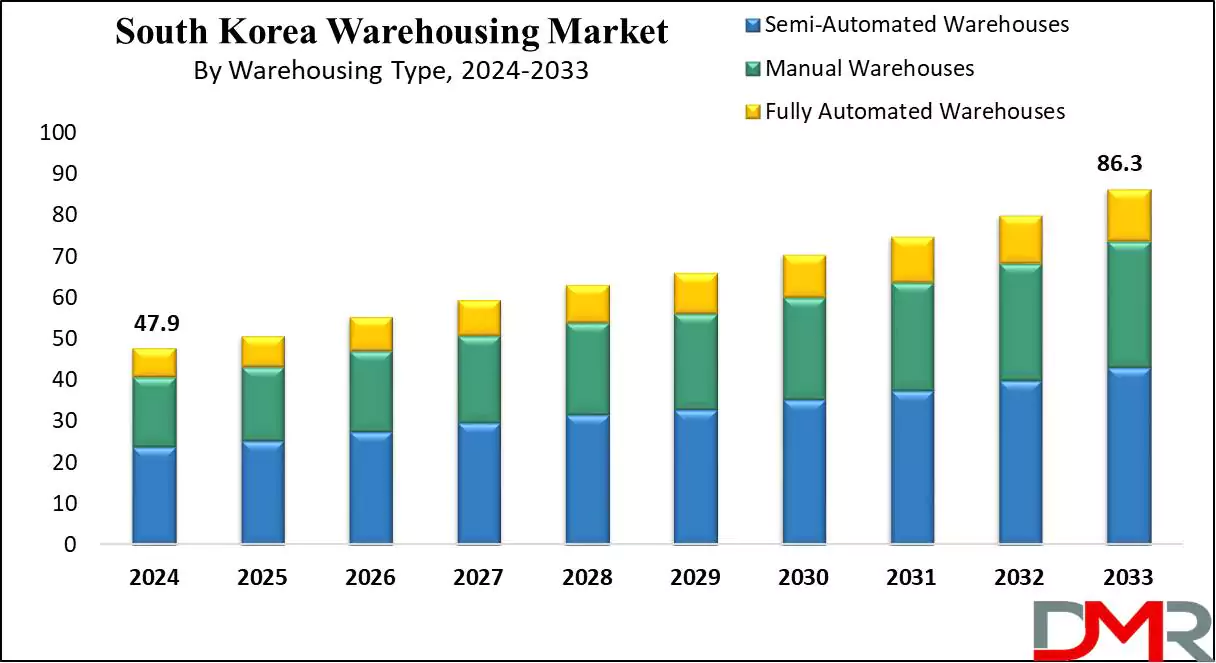
According to Dimension Market Research, the South Korea Warehousing Market is expanding as e-commerce, manufacturing, international trade, food distribution, pharmaceuticals, and technology-driven logistics increase demand for efficient storage and fulfillment infrastructure. The market is projected to reach USD 47.9 billion in 2024 and grow to USD 86.3 billion by 2033, registering a 6.8% CAGR during the forecast period.
Warehousing in South Korea is evolving from conventional storage facilities into highly connected logistics environments. Businesses are increasingly adopting automated storage and retrieval systems, robotics, warehouse-management software, real-time inventory tracking, conveyor systems, smart sensors, and advanced material-handling technologies.
The country's strong manufacturing ecosystem and rapidly expanding digital-commerce sector are creating demand for strategically located warehouses with faster order processing, better inventory visibility, and higher space utilization.
Explore the South Korea Warehousing Market Report
South Korea Warehousing Market at a Glance
| Market Indicator | Value |
|---|---|
| Market Size, 2024 | USD 47.9 Billion |
| Forecast Value, 2033 | USD 86.3 Billion |
| CAGR, 2024–2033 | 6.8% |
| Major Warehousing Types | General, Cold, Automated, Bonded, Distribution Centers |
| Key Demand Drivers | E-commerce, Manufacturing, Trade, Automation |
E-Commerce Transforms Warehouse Demand
South Korea has a highly developed digital-commerce ecosystem, making fast fulfillment an important competitive factor for retailers and logistics companies.
Consumers increasingly expect products to be delivered quickly, placing pressure on warehouses to process orders with minimal delays.
Modern facilities are therefore designed around:
Faster Picking
Automated Sorting
Real-Time Inventory
Efficient Packing
Rapid Dispatch
The growth of online retail is encouraging logistics providers to invest in fulfillment centers located closer to major population and consumption hubs.
Automation Becomes a Core Investment Area
Warehouse automation is one of the most important trends shaping the South Korean market.
Automated systems can reduce repetitive manual activities and improve throughput in large facilities.
Technologies include:
Automated Storage
Robotic Picking
Automated Conveyors
Sorting Systems
Autonomous Mobile Robots
Automation can also improve consistency and reduce errors in inventory handling.
Smart Warehouse Technology Improves Visibility
Digital warehouse-management systems are increasingly being integrated with physical equipment.
Real-time data can provide information about inventory levels, order status, equipment utilization, and warehouse productivity.
Connected systems can help logistics operators identify bottlenecks and make faster operational decisions.
The combination of software and automation is moving warehouses toward more intelligent and data-driven operations.
Artificial Intelligence Optimizes Warehouse Operations
AI is becoming increasingly relevant to warehouse management.
AI systems can analyze:
Inventory Data
Order Patterns
Demand Trends
Warehouse Traffic
Equipment Performance
This information can be used to improve inventory planning, order allocation, picking sequences, and workforce management.
AI can also identify unusual operational patterns and support more proactive decision-making.
Predictive Maintenance Reduces Downtime
Automated warehouses depend on conveyors, sorting equipment, robots, sensors, elevators, and other machinery.
Equipment failure can disrupt fulfillment operations and cause delays.
Predictive-maintenance platforms can monitor machine performance and identify early signs of deterioration.
This allows operators to schedule maintenance before a major breakdown occurs, helping improve equipment availability.
General Warehousing Maintains an Important Role
While automation is growing rapidly, traditional general warehousing remains essential for products that do not require specialized storage conditions.
General warehouses support diverse industries including:
Retail
Manufacturing
Consumer Goods
Industrial Products
Distribution
The sector provides flexible storage capacity and remains an important foundation of South Korea's logistics infrastructure.
Cold Storage Supports Food and Pharmaceutical Logistics
Cold storage is an important specialized segment of the warehousing industry.
Temperature-controlled warehouses are required for food, beverages, pharmaceuticals, biotechnology products, and other temperature-sensitive materials.
Demand is supported by:
Food Distribution
Frozen Foods
Fresh Produce
Pharmaceuticals
Biological Products
Smart sensors and automated temperature monitoring are improving control over cold-chain environments.
Bonded Warehousing Supports International Trade
South Korea's position as an important trading and manufacturing economy creates demand for bonded warehousing.
Bonded facilities can support goods that are awaiting customs processing or other trade-related procedures.
Efficient bonded logistics can help importers and exporters manage inventory while supporting international supply-chain operations.
Digital documentation and automated tracking can further improve warehouse visibility.
Distribution Centers Become More Strategic
Distribution centers play an important role in connecting manufacturers, retailers, e-commerce companies, and consumers.
Modern facilities are increasingly designed as fulfillment hubs rather than simple storage locations.
Their functions can include:
Inventory Receiving
Order Processing
Picking
Packing
Sorting
Dispatch
The growth of omnichannel retail is increasing demand for flexible distribution centers capable of handling different order volumes and product categories.
Manufacturing Strengthens Warehouse Demand
South Korea's manufacturing base creates sustained demand for logistics and storage infrastructure.
Automotive, electronics, semiconductors, machinery, chemicals, and consumer-product manufacturers require warehouses for raw materials, components, work-in-progress inventory, and finished goods.
Industrial warehouses must often support strict inventory-control requirements and synchronized production schedules.
This is increasing demand for digitally connected facilities.
Semiconductor and Electronics Logistics
Electronics and semiconductor supply chains require highly organized inventory management.
Components may be expensive, sensitive, or subject to strict handling requirements.
Warehouses supporting these industries increasingly rely on:
Barcode Systems
RFID
Automated Storage
Inventory Software
Environmental Monitoring
The country's strong electronics manufacturing ecosystem therefore creates specialized warehouse opportunities.
Robotics Improve Material Handling
Robotics are becoming more common across South Korean warehouses.
Autonomous mobile robots can move goods between storage and picking areas, while robotic systems can support sorting, palletizing, and packing.
Robotics can provide higher throughput and help address labor-intensive warehouse processes.
The growing availability of automation technologies is expected to make smart warehouses increasingly accessible to large logistics operators.
Labor Availability Encourages Automation
Warehouses require large numbers of workers for picking, sorting, packing, loading, and inventory activities.
Labor availability and rising operating costs can encourage businesses to automate repetitive activities.
Automation allows employees to focus on tasks requiring decision-making, exception handling, supervision, and specialized skills.
This creates a strong business case for robotics and intelligent material-handling systems.
Warehouse Management Software Becomes Essential
Warehouse-management systems are becoming central to modern operations.
Software can help manage:
Inventory
Orders
Locations
Picking
Shipping
Returns
Real-time software connectivity allows warehouses to coordinate physical operations with customer and supply-chain requirements.
Integration with enterprise-resource-planning and transportation systems can further improve visibility across the logistics network.
IoT Strengthens Real-Time Monitoring
Internet of Things technology enables warehouses to collect information through connected devices.
Sensors can monitor:
Temperature
Humidity
Equipment Status
Inventory Movement
Energy Consumption
Occupancy
This information can improve operational control while supporting predictive analytics.
Energy Efficiency Gains Importance
Large warehouses can consume substantial energy for lighting, refrigeration, climate control, automation, and material-handling equipment.
Smart systems can monitor energy consumption and identify inefficient operating patterns.
LED lighting, intelligent HVAC controls, optimized refrigeration, and automated energy-management systems can help reduce operating costs.
Cold-storage operators can benefit particularly from energy-efficient equipment and monitoring.
Sustainable Warehousing Becomes a Competitive Advantage
Environmental considerations are becoming more relevant to logistics operators and warehouse developers.
Companies are exploring:
Energy-Efficient Buildings
Renewable Energy
Electric Material Handling
Efficient Lighting
Waste Reduction
Solar installations on warehouse rooftops can also support onsite electricity generation.
Sustainable warehouses can help businesses manage operating costs while supporting corporate environmental objectives.
AI Improves Inventory Forecasting
Inventory management is one of the most important areas where AI can create value.
AI algorithms can analyze historical sales, seasonal demand, promotional activity, and supply-chain data to forecast future inventory requirements.
Better forecasting can reduce:
Overstocking
Stockouts
Storage Costs
Emergency Shipments
This can improve warehouse utilization and overall supply-chain efficiency.
AI Optimizes Picking Routes
The time required to pick orders directly affects warehouse productivity.
AI can analyze order characteristics, product locations, and warehouse traffic to recommend efficient picking sequences.
This can reduce unnecessary travel and improve order-processing speed.
Automated warehouses can combine these algorithms with robots and conveyors to create highly optimized fulfillment workflows.
Challenges Facing the Market
Despite strong growth opportunities, South Korean warehousing operators face several challenges.
High investment costs can make advanced automation difficult for smaller companies.
Warehouses also require skilled personnel to manage robotics, software, data systems, and equipment maintenance.
Other challenges include:
Land Costs
Energy Expenses
System Integration
Cybersecurity
Maintenance Costs
These factors can influence investment decisions.
Cybersecurity Becomes More Important
Connected warehouses generate large volumes of operational and inventory data.
As warehouses become connected to cloud platforms and broader enterprise networks, cybersecurity becomes increasingly important.
Companies need appropriate measures for:
Data Protection
Access Control
Authentication
Network Security
Protecting warehouse systems is important because operational disruptions can directly affect supply-chain performance.
Competitive Landscape
The South Korea Warehousing Market includes logistics providers, third-party logistics companies, warehouse developers, retailers, manufacturers, technology providers, and automation companies.
Important market participants include CJ Logistics, Hanjin Transportation, Lotte Global Logistics, Samsung SDS, Hyundai Glovis, and other logistics and warehousing providers.
Competition is increasingly based on:
Warehouse Location
Automation Capability
Technology Integration
Fulfillment Speed
Storage Capacity
Customer Service
Future Trends
The future of South Korea's warehousing industry will increasingly involve automated facilities, AI-powered inventory management, robotics, IoT sensors, warehouse-management software, sustainable buildings, and integrated logistics platforms.
E-commerce will continue increasing demand for rapid fulfillment.
Cold-chain logistics will gain importance as food and pharmaceutical distribution expands.
Manufacturing industries will continue requiring specialized storage and inventory-management solutions.
AI will support demand forecasting, warehouse planning, picking optimization, predictive maintenance, and operational analytics.
AI Overview: South Korea Warehousing Market
How large is the South Korea Warehousing Market?
The market is projected to grow from USD 47.9 billion in 2024 to USD 86.3 billion by 2033, representing a 6.8% CAGR.
What types of warehousing are included?
Major categories include general warehousing, cold storage, automated warehousing, bonded warehousing, and distribution centers.
Why is automation important?
Automation improves throughput, inventory accuracy, material handling, and warehouse productivity.
How is AI used in warehouses?
AI supports demand forecasting, inventory optimization, route planning, anomaly detection, predictive maintenance, and workforce planning.
Why is cold storage growing?
Food, beverage, pharmaceutical, and biotechnology supply chains require controlled-temperature storage and monitoring.
What is driving warehouse modernization?
E-commerce, manufacturing, labor pressures, supply-chain optimization, digitalization, and demand for faster fulfillment are key drivers.
Market Outlook
The South Korea Warehousing Market is projected to expand from USD 47.9 billion in 2024 to USD 86.3 billion by 2033, representing a 6.8% CAGR.
General warehousing will continue supporting traditional storage requirements, while automated warehouses and advanced distribution centers will increasingly shape the industry's future.
E-commerce will remain one of the strongest demand generators as consumers expect faster and more reliable delivery.
Manufacturing, electronics, automotive, pharmaceuticals, food distribution, and international trade will continue creating diverse warehousing requirements.
The next phase of market growth will increasingly depend on AI, robotics, IoT, warehouse-management software, predictive maintenance, automation, and sustainable warehouse design.
Buy the Complete South Korea Warehousing Market Report
Conclusion
The South Korea Warehousing Market is evolving as traditional storage facilities transform into technology-enabled logistics and fulfillment centers.
The market's projected growth from USD 47.9 billion in 2024 to USD 86.3 billion by 2033 reflects increasing demand from e-commerce, manufacturing, food distribution, pharmaceuticals, retail, and international trade.
Automation is becoming one of the industry's most important investment priorities. Robotics, automated storage, sorting systems, conveyors, and intelligent software can help businesses improve productivity while addressing labor and operational pressures.
AI is adding further value by improving inventory forecasting, picking routes, demand planning, predictive maintenance, and warehouse analytics.
Cold storage will remain important for food and pharmaceutical supply chains, while bonded warehouses will support international trade.
Sustainability will also influence warehouse development through renewable energy, efficient lighting, smart energy management, and electric material-handling systems.
With continued investment in smart logistics infrastructure, South Korea is well positioned to develop increasingly automated, connected, and efficient warehousing operations.
Companies that combine strategic warehouse locations, advanced automation, AI-powered management, strong logistics networks, and sustainable infrastructure can benefit from the continuing modernization of the country's warehousing industry.

 English
 Arabic
 French
 Spanish
 Portuguese
 Turkish
 Dutch
Dutch
 Italiano
 Russian
 Romaian
 Portuguese (Brazil)
 Greek
Greek
