
Can a Free Zone Company Sell in Mainland Dubai?
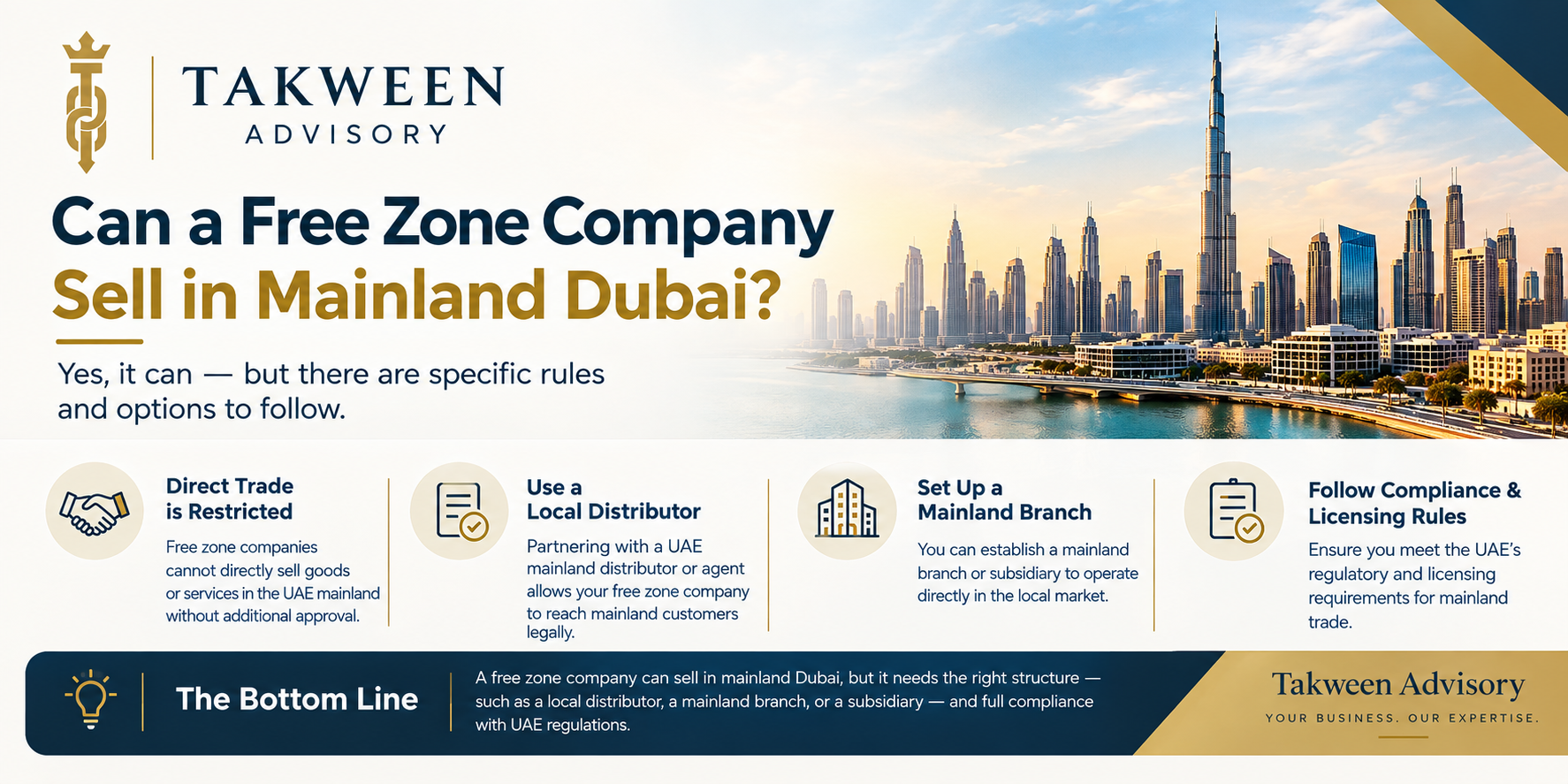
It is one of the most common questions asked by entrepreneurs during free zone company setup in Dubai: once your business is licensed and running, can you actually sell to customers based on the mainland, or are you restricted to trading within your free zone and internationally? For years, the honest answer was "not directly." Today, thanks to a major regulatory update, the answer has changed in a way that affects almost every free zone business owner in Dubai.
This article explains exactly what a free zone company can and cannot do on the mainland, what changed in 2025 and 2026, and the practical routes available if you want to serve mainland clients without starting an entirely new company.
The Short Answer
No, a free zone company cannot automatically sell directly to mainland customers, deliver physical goods across the UAE, or open a retail location outside its free zone using its standard free zone license alone. A free zone license is territorially limited to operations within that free zone and international markets. However, free zone companies now have several legitimate pathways to reach the mainland market without forming a completely separate legal entity, and understanding these options is now essential knowledge for anyone going through free zone company setup in Dubai.
Why the Restriction Exists in the First Place
Free zones were originally designed as self-contained economic areas, each governed by its own authority, offering benefits like 100% foreign ownership, streamlined licensing, and customs advantages. In exchange for these benefits, free zone companies were historically confined to operating within their zone, trading with other free zone entities, or exporting internationally. Selling directly to mainland UAE customers required a separate license issued by the Department of Economy and Tourism (DET), the same authority that regulates mainland businesses.
This distinction protected the mainland market's regulatory framework while still allowing free zones to offer a lighter, more flexible setup process. It also meant that a huge number of businesses that started in a free zone eventually hit a wall the moment a mainland client wanted to sign a contract directly with them.
What Changed: Executive Council Resolution No. 11 of 2025
In March 2025, Dubai introduced Executive Council Resolution No. 11 of 2025, a rule that fundamentally reshaped how free zone companies can access the mainland market. Rather than forcing every free zone business that wants mainland clients to incorporate a second, entirely separate mainland company, the resolution created formal, authorized pathways for a single free zone entity to legally operate on the mainland.
Under this resolution, free zone companies in Dubai now have three main routes to mainland access:
-
A dual license issued by DET. This allows the free zone company to obtain an additional permit that authorizes mainland activity while the original free zone license remains fully intact.
-
A mainland branch of the free zone entity. Rather than forming a new company, the free zone business registers a branch on the mainland, which operates as an extension of the same legal entity.
-
A temporary operating permit. Designed for short-term projects, this permit is valid for up to six months and is useful for one-off contracts or time-limited mainland engagements.
Notably, the resolution also closed a compliance loophole. Free zone companies that had been informally operating on the mainland without proper authorization were given until March 2026 to regularize their status through one of these three routes. That deadline has now passed, which means any free zone company conducting unauthorized mainland activity is now at risk of fines and penalties. If your business has been quietly invoicing mainland clients without one of these approvals in place, addressing that gap should be a priority.
How Dual Licensing Actually Works
A dual license is the option most free zone business owners gravitate toward, since it keeps the company structure simplest. Here is what it means in practice:
-
Your original free zone company stays exactly as it is, under the same ownership, the same free zone authority, and the same regulatory framework.
-
DET issues an additional license or permit that extends your operating scope to the mainland.
-
You remain a single legal entity, but you can now sign contracts with mainland clients, invoice them directly, and, depending on your activity, bid on government tenders.
-
There is no need to form, register, or maintain a second company, which saves on both setup costs and ongoing compliance overhead.
Eligibility for dual licensing depends on your free zone authority, your specific business activity, and whether DET approves that activity for dual licensing. Not every free zone or every activity qualifies, so this is a step worth confirming early rather than assuming it automatically applies to your business.
When a Distributor Might Still Be the Right Route
For product-based businesses, particularly those selling physical goods that require local delivery, customs clearance, and domestic logistics, working through an authorized mainland distributor can sometimes still be the more practical option, even with dual licensing available. A distributor already holds the relevant mainland trading license and logistics infrastructure, meaning your free zone company can continue exporting or supplying goods to the distributor, who then handles the final sale to UAE consumers. This route avoids the need for any additional mainland registration on your end, though it does mean sharing margin with the distributor and relying on their compliance and delivery standards.
What This Means If You Are Planning Free Zone Company Setup in Dubai
If mainland access matters to your business, whether now or down the line, it is worth factoring this into your planning from day one rather than treating it as an afterthought. A few practical takeaways:
-
Free zone company setup in Dubai still makes sense for most founders. The 100% foreign ownership, tax advantages, and streamlined licensing that make free zones attractive have not changed. What has changed is that mainland access is no longer an all-or-nothing decision that forces you into a separate incorporation.
-
Choose your free zone and activity with mainland eligibility in mind. Since dual licensing eligibility depends on your specific free zone and business activity, confirming this during setup can save you from restructuring later.
-
Budget for the additional permit, not a second company. Whether you choose a dual license, a mainland branch, or a temporary permit, the cost and administrative burden is generally far lower than incorporating an entirely new mainland entity.
-
Stay ahead of compliance deadlines. With the March 2026 regularization deadline now behind us, any free zone company already active on the mainland without proper authorization should resolve that gap as soon as possible to avoid penalties.
Why Work With a Business Setup Advisory Firm
Between choosing the right free zone, confirming dual licensing eligibility for your specific activity, and managing the DET application process, there are enough moving parts that most founders find it far more efficient to work with an experienced advisory partner rather than navigating the regulations alone.
This is exactly where Takween Advisory comes in. Takween Advisory guides entrepreneurs and established companies through every stage of free zone company setup in Dubai, including advising on which free zone and activity classification best supports your long-term mainland ambitions, managing dual license and mainland branch applications, and ensuring your business stays fully compliant with the latest DET requirements. Rather than discovering a mainland restriction after you have already signed a client contract, working with Takween Advisory from the outset means your structure is built to grow with your business, not against it.
Final Thoughts
The old rule that free zone companies simply cannot sell on the mainland is no longer the full picture. With Executive Council Resolution No. 11 of 2025 in place, free zone businesses now have clear, legitimate pathways, a dual license, a mainland branch, or a temporary permit, to reach mainland customers without duplicating their entire corporate structure. If you are considering free zone company setup in Dubai and expect to serve mainland clients at any point, planning for that access early will save you significant time, cost, and administrative headaches later on.
If you would like guidance on which free zone and licensing structure best fits your mainland ambitions, the team at Takween Advisory can walk you through your options and manage the entire process on your behalf.

 English
 Arabic
 French
 Spanish
 Deutsch
 Turkish
 Dutch
Dutch
 Italiano
 Russian
 Romaian
 Portuguese (Brazil)
 Greek
Greek
