
Unit Dose Packaging Market Outlook Strengthened by Demand for Medication Safety and Dose Accuracy
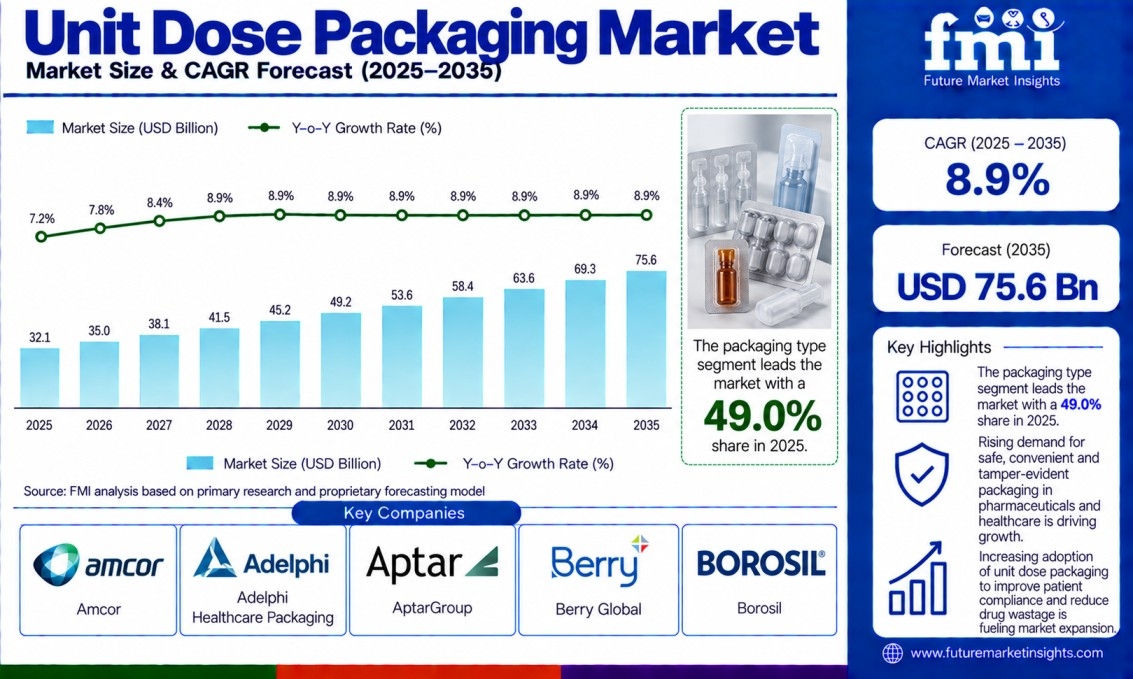
NEWARK, Del., September 9, 2026 — The global Unit Dose Packaging Market is projected to grow from USD 32.2 billion in 2025 to USD 75.6 billion by 2035, expanding at a CAGR of 8.9%, as pharmaceutical manufacturers, healthcare providers and packaging suppliers increase adoption of precise, tamper-evident and convenient single-dose formats.
Recent product developments illustrate how the market is moving beyond conventional dose containment. In January 2023, Amcor introduced Amcor Prodose, a unit-dose packaging solution designed to support medication safety across healthcare settings. In February 2024, West Pharmaceutical Services introduced its NovaGuard SX elastomeric closure for unit-dose vials, addressing protection and drug-stability requirements for sensitive pharmaceutical applications.
These developments are part of a broader market transition in which packaging increasingly needs to combine dose accuracy, patient convenience, product protection and digital traceability.
👉 Get Detailed Market Forecasts, Competitive Benchmarking, and Pricing Trends: https://www.futuremarketinsights.com/reports/brochure/rep-gb-23323
Why is unit dose packaging becoming more important across healthcare?
The market's growth is closely connected to the need for controlled medication delivery. Blister packs are projected to account for 49.0% of market share in 2025, while oral drugs are expected to represent 46.0% of application demand.
Unit-dose formats can separate individual doses, simplify administration and support inventory control. For pharmaceuticals, these characteristics are particularly relevant to chronic therapies, elderly care, pediatric medicines and situations where medication errors or contamination need to be minimized.
The broader supplier landscape includes Amcor, AptarGroup, Berry Global, Catalent, Constantia Flexibles, Gerresheimer, Nipro, Schott, SGD Pharma, Stevanato Group and West Pharmaceutical Services, alongside specialized companies such as Adelphi Healthcare Packaging, Borosil, Corning, DWK Life Sciences, Glenroy and Unit Pack Company.
The competitive dynamic is therefore extending across multiple packaging technologies rather than a single format. Blisters, sachets, pouches, ampoules, vials and pre-filled syringes each address different combinations of dose, sterility, barrier and administration requirements.
How are materials and packaging formats changing?
Plastic is projected to remain the leading material, accounting for 43.0% of market revenue in 2025. Its lightweight characteristics, processability and compatibility with automated filling and forming equipment support broad adoption.
However, the material landscape is becoming more complex. Recyclable plastics, mono-material structures and lower-material-use designs are being developed alongside conventional pharmaceutical packaging systems. This creates a balancing act between sustainability and the stringent barrier, sterility and compatibility requirements of pharmaceutical products.
Pre-filled syringes and other ready-to-administer formats are also expanding the addressable opportunity. These systems can combine dose precision with simplified administration, particularly for injectable therapies and specialty medicines.
Why are digital features entering unit dose packaging?
Traceability and patient engagement are becoming increasingly relevant to packaging design. QR codes, serialization technologies and connected labels can provide authentication, product information and dose-related data while supporting supply-chain visibility.
For healthcare applications, digital features can complement rather than replace the physical safety functions of unit-dose packaging. Tamper evidence, child resistance, barrier protection and accurate dose separation remain fundamental requirements.
This convergence creates opportunities for packaging suppliers that can integrate digital identification into existing high-speed manufacturing processes without compromising production economics or regulatory compliance.
Where is the strongest geographic growth emerging?
Asia-Pacific is expected to remain a major growth engine. China is forecast to grow at 12.0% CAGR through 2035, followed by India at 11.1% and Germany at 10.2%. France is projected at 9.3%, the United Kingdom at 8.5%, the United States at 7.6% and Brazil at 6.7%.
China's growth reflects pharmaceutical manufacturing scale and expanding adoption of automated unit-dose systems. India's opportunity is supported by generic medicines, expanding healthcare access and demand for cost-efficient packaging.
In Europe and North America, growth is more closely associated with medication safety, healthcare digitization, sustainability and advanced drug-delivery formats.
The geographic divergence suggests that suppliers will need to balance high-volume, cost-efficient manufacturing in emerging markets with highly specialized and compliance-intensive solutions in mature pharmaceutical markets.
Unit Dose Packaging Market Snapshot
- 2025 market value: USD 32.2 billion
- 2035 projected value: USD 75.6 billion
- 2025–2035 CAGR: 8.9%
- Leading material: Plastic — 43.0%
- Leading packaging type: Blister packs — 49.0%
- Leading application: Oral drugs — 46.0%
- China CAGR: 12.0%
- India CAGR: 11.1%
- Germany CAGR: 10.2%
👉 Get Detailed Market Forecasts, Competitive Benchmarking, and Pricing Trends: https://www.futuremarketinsights.com/reports/brochure/rep-gb-23323
What will shape competition through 2035?
The next phase of competition is likely to center on the ability to combine manufacturing efficiency with pharmaceutical-grade performance.
High-speed packaging equipment, precision forming, automated inspection and serialization can help manufacturers manage growing demand while meeting increasingly complex compliance requirements. At the same time, material innovation will remain important as pharmaceutical packaging companies attempt to reduce environmental impact without compromising drug stability or patient safety.
The market's projected addition of USD 43.4 billion between 2025 and 2035 also creates room for suppliers across several technology categories. Companies specializing in blister films, pre-filled devices, elastomeric closures, sterile containers, flexible packaging and smart identification systems can all participate in different portions of this expansion.
The central competitive question is therefore shifting from simply producing a unit-dose package to providing a complete solution that connects dose accuracy, protection, automation, traceability and sustainability.
FMI Research Methodology: https://www.futuremarketinsights.com/methodology
Unit Dose Packaging Market: https://www.futuremarketinsights.com/reports/unit-dose-packaging-market
Fragrance Jewellery Pods Market: https://www.futuremarketinsights.com/reports/fragrance-jewellery-pods-market
Stand-Up Pouch Valves Market: https://www.futuremarketinsights.com/reports/stand-up-pouch-valves-market
Seam Tapes Market: https://www.futuremarketinsights.com/reports/seam-tapes-market
Disclosure: This press release is based on Future Market Insights' syndicated research. Market estimates and forecasts reflect the definitions, assumptions and methodology applied in the underlying study.
Media Contact
Future Market Insights, Inc.
Christiana Corporate
200 Continental Drive, Suite 401
Newark, Delaware 19713, United States
About Future Market Insights
Future Market Insights, Inc. is a global market intelligence and consulting organization serving clients across more than 150 countries. The company is registered in Delaware as Future Market Insights, Inc., Christiana Corporate, 200 Continental Drive, Suite 401, Newark, Delaware 19713, United States, with regional operations across North America, Europe, the Middle East and India.

 English
 Arabic
 French
 Spanish
 Portuguese
 Deutsch
 Turkish
 Dutch
Dutch
 Italiano
 Russian
 Romaian
 Portuguese (Brazil)
