
How E-Invoice Software Can Reduce Manual Billing Work
Invoicing is a routine business activity, but preparing invoices manually can consume considerable time. Employees may need to enter customer and product details, calculate taxes, verify totals, generate documents, and maintain records for every transaction. As the number of invoices increases, these repetitive tasks can become difficult to manage efficiently.
E invoice software can help businesses digitize the invoicing process and reduce repetitive billing work. By connecting invoice generation with accounting, inventory, and other business processes, solutions such as Busy can help businesses create a more organized and efficient billing workflow.
What Is E-Invoice Software?
E-invoice software is a digital solution that helps businesses create and manage invoices electronically. Depending on the business and applicable GST requirements, it may also support processes associated with India's e-invoicing framework.
It can help businesses maintain customer and product information, calculate applicable taxes, generate invoice documents, and organize transaction records digitally.
Businesses should distinguish between a simple electronic invoice and an e-invoice generated and reported under the applicable government e-invoicing framework. Not every digital invoice is necessarily an e-invoice for GST compliance purposes.
Reduces Repetitive Data Entry
Manual billing often requires employees to enter the same customer, product, and business information repeatedly. This takes time and can introduce typing errors.
With e invoice software, frequently used information can be stored in the system and retrieved while preparing new invoices. This reduces repetitive data entry and allows employees to complete routine billing tasks more efficiently.
Automates Invoice Calculations
Invoices may include quantities, prices, discounts, taxable values, and GST components. Calculating these values manually for every transaction can increase workload.
Digital invoicing software can automate many calculations based on the information and tax settings configured in the system. This can reduce common arithmetic errors and speed up invoice preparation.
Businesses should still verify their product classifications, tax rates, and other settings regularly because software accuracy depends on correct configuration and data.
Makes Invoice Generation Faster
Creating an invoice manually can involve several steps, from entering transaction information to calculating totals and formatting the final document.
An electronic invoicing system can standardize these steps. Once the required transaction information is entered, the system can generate an invoice using predefined formats and stored information.
This can be particularly useful for businesses that generate a large number of invoices every day.
Simplifies Digital Invoice Sharing
Once an invoice has been generated, it can be shared electronically through appropriate digital channels. This removes some of the administrative steps associated with printing, physically filing, or manually delivering invoices.
Faster invoice delivery can also help customers receive billing information sooner, potentially supporting more timely payment processing.
Keeps Invoice Records Organized
Managing paper invoices can become difficult as transaction volumes increase. Businesses may need to maintain physical files and spend time searching for older documents.
E-invoice software stores transaction information digitally, making records easier to organize and retrieve. Employees can search for previous invoices when responding to customer queries or reviewing business transactions.
Helps With GST-Related Processes
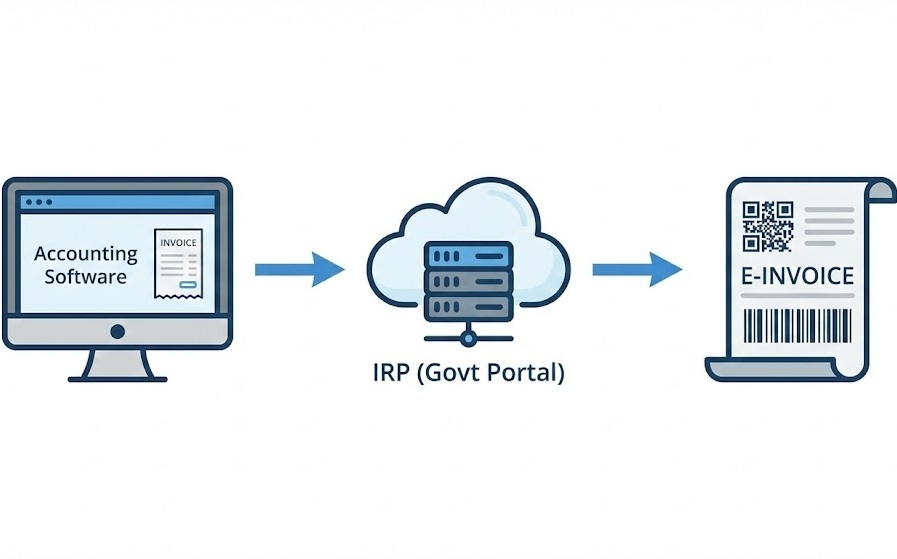
For businesses covered by India's e-invoicing requirements, the invoicing process may involve reporting eligible invoices through the prescribed system and obtaining the relevant Invoice Reference Number and QR code.
Suitable e invoice software can help streamline the applicable digital workflow when properly integrated and configured. Businesses should always verify the latest GST and e-invoicing rules to determine whether the requirements apply to them.
Connects Billing With Accounting
When billing and accounting are maintained separately, employees may have to enter the same transaction information into multiple systems. This increases workload and can create inconsistencies.
An integrated business management solution can connect invoice transactions with accounting records. Busy provides accounting and business management capabilities that can help businesses manage billing, inventory, and financial transactions through a centralized digital workflow.
Improves Payment Tracking
Generating invoices quickly is useful, but businesses also need to monitor whether customers have paid. Digital invoice records can help businesses organize information about issued invoices and outstanding amounts.
This can make it easier for finance teams to review receivables and follow up on pending payments according to their normal collection processes.
Reduces Paper-Based Administration
Manual billing often involves printing invoices, maintaining physical copies, and organizing paperwork. Moving to digital invoicing can reduce dependence on these paper-based processes.
Electronic records also make it easier for authorized employees to access invoice information without physically locating a document.
Supports Growing Transaction Volumes
As a business grows, its number of customers and invoices can increase significantly. A manual billing process may require additional administrative effort as transaction volumes rise.
Digital invoicing provides a more scalable workflow. Businesses can standardize billing procedures and automate repetitive tasks without increasing manual work at the same rate as transaction volume.
Software Does Not Replace Human Review
Automation can reduce manual effort, but businesses should not assume that software makes invoices automatically correct. Incorrect customer information, product details, tax settings, or transaction values can still produce errors.
Businesses should establish review procedures and ensure that employees understand how to use the software correctly. Regularly checking system settings is also important when tax or business requirements change.
Conclusion
E invoice software can reduce manual billing work by automating calculations, minimizing repetitive data entry, speeding up invoice generation, organizing digital records, and supporting applicable e-invoicing processes.
For businesses looking to connect invoicing with their broader financial operations, Busy can help integrate billing with accounting and inventory activities. By moving routine billing tasks into a structured digital workflow, businesses can save administrative time, improve record organization, and manage growing invoice volumes more efficiently.

 English
 Arabic
 French
 Spanish
 Portuguese
 Deutsch
 Turkish
 Dutch
Dutch
 Russian
 Romaian
 Portuguese (Brazil)
 Greek
Greek
