
Saudi Arabia Paraffin Inhibitor Market: Segmentation, Applications and Strategic Opportunities
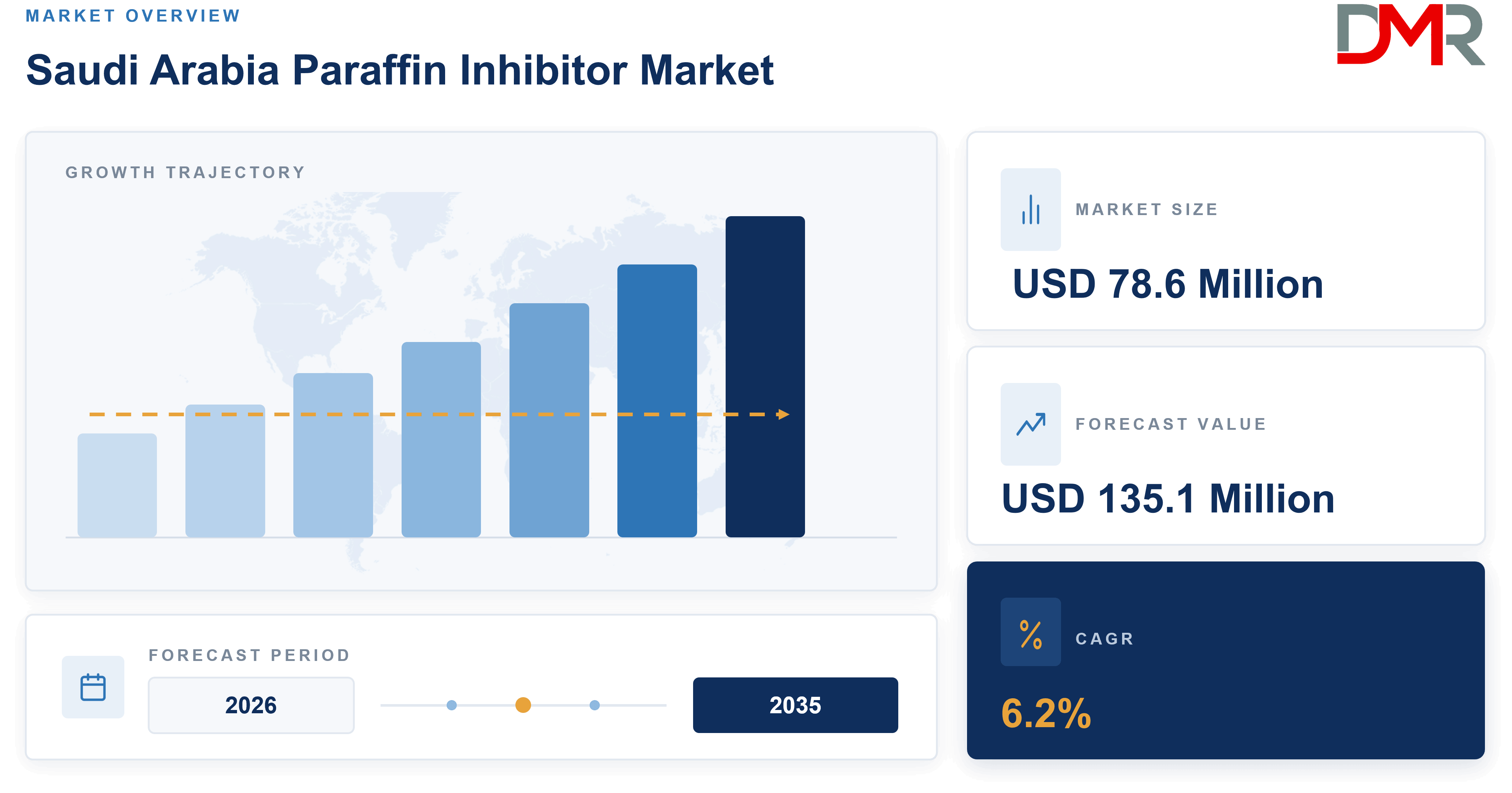
The Saudi Arabia Paraffin Inhibitor Market is emerging as an important specialty chemical segment supporting crude oil production, pipeline transportation, storage, terminal operations, and refinery feed handling. Paraffin inhibitors are used to control wax crystal formation and reduce the accumulation of deposits that can restrict hydrocarbon flow. According to Dimension Market Research, the market is estimated at USD 78.6 million in 2026 and is projected to reach USD 135.1 million by 2035, expanding at a CAGR of 6.2% from 2026 to 2035.
The market includes crystal modifiers, pour point depressants, paraffin dispersants, paraffin dissolvers, and other preventive wax-control chemistries. Demand is closely associated with Saudi Arabia's large oil and gas infrastructure, where maintaining reliable flow through production systems, gathering networks, pipelines, storage facilities, and export infrastructure is important for operational efficiency.
Unlike standardized industrial chemicals, paraffin inhibitors require careful selection according to crude composition and field conditions. Wax appearance temperature, fluid temperature, pressure, shear, residence time, wax distribution, and chemical dosage can all influence product performance. As a result, laboratory testing and field qualification have become important elements of the purchasing process.
Saudi Arabia Paraffin Inhibitor Market Size and Forecast
The Saudi Arabia Paraffin Inhibitor Market is projected to experience steady growth throughout the forecast period.
| Market Indicator | Value |
|---|---|
| Market Size, 2026 | USD 78.6 Million |
| Forecast Revenue, 2035 | USD 135.1 Million |
| CAGR, 2026–2035 | 6.2% |
| Leading Type, 2026 | Crystal Modifiers |
| Leading Type Share | Approximately 38% |
| Leading Chemistry, 2026 | Ethylene Vinyl Acetate Copolymers |
| Leading Chemistry Share | Around 29% |
| Leading End User | National Oil Companies |
The market scope covers domestic paraffin inhibitor consumption across upstream production, pipelines, storage, terminals, workover activities, and refinery feed handling. It measures demand within Saudi Arabia rather than revenue generated globally by Saudi-based companies.
Recurring chemical consumption is an important feature of the market. Once an effective treatment program is established, operators may continue using inhibitors periodically or continuously to prevent wax deposition and reduce the need for more disruptive remediation activities.
Get the Free Sample Report
Businesses evaluating Saudi Arabia's oilfield chemical industry, product development opportunities, procurement strategies, or flow-assurance technologies can request the sample report:
https://dimensionmarketresearch.com/request-sample/saudi-arabia-paraffin-inhibitor-market/
Why Paraffin Control Matters in Saudi Oil and Gas Operations
Paraffin consists primarily of heavier hydrocarbon components that can crystallize when crude oil experiences cooling or changes in pressure.
As crude travels from reservoir conditions toward surface facilities, production tubing and flowlines can experience temperature reductions. Similar conditions can occur in gathering systems and long-distance pipelines.
If wax crystals grow and adhere to equipment surfaces, they can cause:
- Reduced internal pipeline diameter
- Increased pressure drop
- Restricted production tubing
- Lower flow efficiency
- Storage tank deposits
- Pumping difficulties
- Increased cleaning requirements
- More frequent intervention
Paraffin inhibitors address these challenges by modifying wax crystal formation, crystal growth, dispersion, or adhesion.
The economic rationale for chemical treatment is particularly strong when the cost of continuous or periodic inhibition is lower than lost production, mechanical cleaning, solvent treatment, thermal remediation, or other intervention activities.
Market Segmentation Analysis
The Saudi Arabia Paraffin Inhibitor Market is segmented by type, chemical composition, form, application, and end user.
By Type
The market includes:
- Crystal Modifiers
- Pour Point Depressants
- Paraffin Dispersants
- Paraffin Dissolvers
- Others
Crystal Modifiers
Crystal Modifiers are projected to lead the market in 2026, accounting for approximately 38% of revenue.
These products work by influencing wax crystal growth and morphology. By modifying the way crystals develop, inhibitors can reduce the formation of large, strongly interconnected wax structures.
Crystal modifiers are particularly suitable for preventive treatment because they can be introduced before extensive deposition develops.
Pour Point Depressants
Pour point depressants influence the low-temperature flow characteristics of crude oil. They are useful in applications where temperature reduction increases the risk of restricted flow.
Their effectiveness depends on crude composition and the interaction between the chemical and wax-forming hydrocarbons.
Paraffin Dispersants
Paraffin Dispersants are an important growth opportunity in the Saudi market. DMR forecasts this segment to expand at a 7.4% CAGR from 2026 to 2035.
Dispersants help maintain wax particles in suspension and reduce their tendency to adhere to internal surfaces. This can complement mechanical or thermal flow-assurance methods.
Paraffin Dissolvers
Dissolvers are primarily useful for remedial applications where wax has already accumulated.
Oilfield service providers can combine dissolvers with preventive inhibitors to restore flow and then establish an ongoing wax-management program.
By Chemical Composition
The market is segmented into:
- Ethylene Vinyl Acetate Copolymers
- Polyacrylates and Methacrylates
- Polyethylene-Based Polymers
- Surfactant-Based Blends
- Bio-Based and Low-Toxicity Chemistry
- Others
Ethylene Vinyl Acetate Copolymers
Ethylene Vinyl Acetate Copolymers are projected to hold approximately 29% of market revenue in 2026, making them the leading chemical composition.
Their established role in wax-management formulations comes from their ability to interact with paraffin crystals and influence crystal structure and low-temperature flow behavior.
Bio-Based and Low-Toxicity Chemistry
Bio-Based and Low-Toxicity Chemistry is forecast to grow at an 8.3% CAGR between 2026 and 2035, making it the fastest-growing chemistry category.
Growth is supported by interest in lower-solvent formulations, safer handling, and lower-impact production chemicals. However, commercial adoption remains dependent on achieving comparable field performance and dosage efficiency.
By Form
The Saudi Arabia market includes:
- Liquid
- Concentrated Blend
- Emulsion
- Others
Liquid Products
Liquid formulations are expected to account for nearly 79% of 2026 revenue.
Their leading position is supported by compatibility with existing chemical injection equipment and their ability to be continuously dosed into hydrocarbon streams.
Concentrated Blends
Concentrated Blend products are projected to grow at a 7.6% CAGR through 2035.
Concentrates can reduce transportation and storage requirements and may allow products to be diluted or customized closer to the point of use.
This creates an important connection between product formulation and Saudi localization strategies.
By Application
The market is divided into:
- Crude Oil Production
- Pipeline Flow Assurance
- Storage and Terminal Operations
- Well Stimulation and Workover
- Refinery Feed Handling
- Others
Crude Oil Production
Crude Oil Production is expected to account for approximately 51% of 2026 application revenue.
Paraffin-control chemistry is frequently introduced into wax-prone crude streams before temperature and pressure changes create significant deposition.
Preventive treatment can help reduce restrictions in production tubing, flowlines, separators, and surface equipment.
Pipeline Flow Assurance
Pipeline Flow Assurance is forecast to grow at a 7.5% CAGR from 2026 to 2035.
Long-distance transportation can expose crude to changing thermal conditions. As the fluid approaches its wax appearance range, the risk of crystal formation and deposition increases.
Chemical treatment can help maintain hydraulic capacity and reduce the likelihood of significant wax accumulation.
Storage and Terminal Operations
Storage systems can face wax-related problems because crude may remain stationary for extended periods.
Cooling and long residence times can encourage wax formation and sludge accumulation. Paraffin-control chemistry can help improve tank drainage, transfer efficiency, and pumping reliability.
Well Stimulation and Workover
During workover operations, service providers may use dissolvers to remove existing wax deposits and then apply preventive inhibitors.
This integrated approach can restore production while reducing the probability of rapid re-deposition.
Refinery Feed Handling
Wax-related flow issues can also influence the movement and handling of refinery feedstocks.
Paraffin-control chemistry can support more reliable transfer and handling where wax formation creates operational challenges.
By End User
The market is segmented into:
- National Oil Companies
- Oilfield Service Companies
- Pipeline and Terminal Operators
- Refineries
- Independent Operators and Contractors
- Others
National Oil Companies
National Oil Companies are expected to represent approximately 61% of 2026 demand.
The concentration reflects Saudi Arabia's large upstream production and associated gathering and export infrastructure. Procurement requirements also place significant importance on supplier qualification, local availability, and technical support.
Oilfield Service Companies
Oilfield Service Companies are forecast to expand at a 7.2% CAGR from 2026 to 2035.
Service companies increasingly integrate chemical treatment with production optimization, well intervention, and broader flow-assurance services.
This creates an opportunity for paraffin inhibitor suppliers to move toward service-based commercial models rather than relying only on chemical sales.
Major Growth Drivers
Large Upstream Production Base
Saudi Arabia's extensive crude production infrastructure creates recurring demand for flow-assurance chemicals.
The continuous or periodic nature of inhibitor treatment can support stable chemical consumption even when drilling or new field development activity changes.
Increasing Pipeline Flow-Assurance Requirements
As crude moves through gathering systems and pipelines, changes in temperature can increase the risk of wax deposition.
Pipeline Flow Assurance is therefore one of the most important growth areas identified in the DMR analysis.
Production Efficiency
Wax deposits can increase pressure drop and restrict production. Preventive treatment can help operators avoid disruptions and reduce the need for frequent intervention.
The economic benefit is ultimately determined by the relationship between inhibitor cost and the value of maintaining uninterrupted production.
Saudi Localization
Local-content requirements are influencing supplier strategies.
The DMR report highlights increasing importance of in-Kingdom blending, technical service, inventory, and customization.
Suppliers with domestic capabilities can potentially respond faster to changing field requirements than import-only suppliers.
Key Market Trends
Customized Wax-Control Programs
The market is moving toward field-specific chemical treatment rather than generic formulations.
Suppliers increasingly use laboratory techniques such as cold-finger testing, microscopy, rheology, and flow-loop evaluation to understand wax behavior and identify appropriate formulations.
Integrated Technical Services
Chemical suppliers are increasingly expected to provide more than product delivery.
Technical service can include:
- Laboratory testing
- Dosage recommendations
- Field trials
- Performance monitoring
- Troubleshooting
- Treatment optimization
This creates stronger customer relationships and can improve product qualification.
Lower-Toxicity Chemistry
The faster growth of Bio-Based and Low-Toxicity Chemistry reflects increasing interest in alternative formulation approaches.
However, performance remains the primary qualification factor. New formulations must provide effective wax control while maintaining commercially acceptable dosage and cost.
Local Supply Resilience
National Oil Companies account for a substantial share of demand, increasing the importance of domestic inventory and technical capabilities.
Local stockholding can reduce lead times and support faster treatment changes when operating conditions shift.
AI and Digitalization in Paraffin Inhibitor Management
Digital technologies are creating new opportunities for more responsive wax-control programs.
AI models can connect:
- Crude properties
- Wax appearance temperature
- Pipeline temperature
- Pressure
- Flow rate
- Historical treatment data
- Chemical dosage
- Deposition observations
with potential wax-deposition risk.
Predictive Deposit Monitoring
Predictive models can help identify operating conditions associated with higher deposition risk.
This can allow field teams to modify treatment before significant production restrictions occur.
Dosage Optimization
Chemical overdosing increases cost, while underdosing can allow deposition.
Data-driven dosage optimization can help balance treatment effectiveness with chemical consumption.
Technical Knowledge Management
Generative AI can assist engineers in organizing laboratory results and historical field trials.
Controlled AI systems can help compare bottle tests, cold-finger results, and flow-loop studies while keeping final chemical selection under engineering review.
Inventory Forecasting
Predictive analytics can also support local inventory planning by connecting chemical consumption with field schedules, production levels, and intervention requirements.
Pricing Analysis
Paraffin inhibitor pricing depends on several factors:
- Polymer type
- Active concentration
- Solvent system
- Product form
- Order volume
- Dosage efficiency
- Field performance
- Technical support
Buyers typically evaluate the total cost per treated barrel rather than focusing only on the product's unit price.
A premium formulation can remain commercially attractive when it requires lower dosage, extends cleaning intervals, reduces intervention frequency, or preserves production throughput.
Local blending can reduce freight and storage expenses, while proven imported formulations may command premium pricing when they have strong field qualification histories.
Competitive Landscape
The Saudi Arabia Paraffin Inhibitor Market includes international oilfield service companies, specialty chemical manufacturers, polymer suppliers, Saudi-based chemical companies, regional distributors, and local blending organizations.
Major participants identified by DMR include:
- SLB
- Halliburton Company
- Baker Hughes Company
- ChampionX Corporation
- Clariant AG
- BASF SE
- The Dow Chemical Company
- Croda International Plc
- Innospec Inc.
- Dorf Ketal Chemicals
- Nouryon
- Evonik Industries AG
- Arkema S.A.
- Solvay SA
- The Lubrizol Corporation
- Stepan Company
- Italmatch Chemicals S.p.A.
- Nalco Water, an Ecolab company
- Weatherford International plc
- SNF Group
- REDA Chemicals
- Meta Solutions Company
- Modern National Chemicals
- Saudi Chemical Company Limited
- SABIC
- Brenntag Saudi Arabia
- Azelis Middle East
- Sipchem
Competition is influenced by formulation performance, field qualification, laboratory capabilities, local inventory, technical expertise, and customization.
Strategic Opportunities for Suppliers
Develop Local Blending Capabilities
Localized blending can reduce transportation requirements and support field-specific customization.
Expand Lower-Toxicity Product Portfolios
Bio-Based and Low-Toxicity Chemistry offers a significant growth opportunity through 2035.
Invest in Laboratory Testing
Strong laboratory capabilities can shorten qualification cycles and help suppliers develop crude-specific treatment programs.
Build Integrated Service Models
Combining chemical supply with flow-assurance consulting, testing, monitoring, and dosage optimization can create additional value.
Develop Concentrated Products
Concentrated blends can reduce storage and transportation requirements while supporting local customization.
Use Digital Treatment Optimization
Data analytics and AI can support predictive deposition monitoring, dosage optimization, and inventory planning.
Challenges and Market Restraints
Crude-Specific Qualification
No single inhibitor formulation is optimal for every crude.
Suppliers must evaluate wax characteristics and operating conditions before recommending treatment, increasing qualification time and development costs.
Competition from Alternative Methods
Operators may use pigging, hot-oil treatment, solvent washing, or thermal management depending on the application.
Chemical treatment must therefore demonstrate sufficient economic value compared with alternative approaches.
Performance Risk
A poorly performing inhibitor can lead to wax accumulation, increased pressure, and production disruption.
This makes field qualification and supplier track record particularly important.
Future Outlook
The Saudi Arabia Paraffin Inhibitor Market is expected to expand steadily through 2035, with revenue increasing from USD 78.6 million in 2026 to USD 135.1 million in 2035 at a 6.2% CAGR.
Future growth will increasingly be shaped by the interaction of chemical innovation, field-specific formulation, localization, and digital flow-assurance technologies.
Crystal Modifiers are expected to remain an important product category, while Bio-Based and Low-Toxicity Chemistry is positioned for faster growth. Concentrated blends can benefit from logistics and localization advantages, while Pipeline Flow Assurance represents an important application growth area.
The market is also likely to move further toward integrated service models. Instead of purchasing a chemical independently, operators can increasingly evaluate suppliers according to their ability to provide testing, formulation, monitoring, dosage optimization, local inventory, and technical support.
Purchase the Complete Report
Companies seeking detailed market sizing, segmentation, pricing analysis, technology assessment, competitive intelligence, and strategic opportunities can access the complete report:
https://dimensionmarketresearch.com/checkout/saudi-arabia-paraffin-inhibitor-market/
Frequently Asked Questions
1. What is the Saudi Arabia Paraffin Inhibitor Market size in 2026?
The market is estimated at USD 78.6 million in 2026 and is projected to reach USD 135.1 million by 2035.
2. What is the CAGR of the Saudi Arabia Paraffin Inhibitor Market?
The market is forecast to grow at a 6.2% CAGR from 2026 to 2035.
3. Which type dominates the market?
Crystal Modifiers are projected to lead the market in 2026, accounting for approximately 38% of revenue.
4. Which chemistry segment is growing fastest?
Bio-Based and Low-Toxicity Chemistry is forecast to grow at an 8.3% CAGR between 2026 and 2035.
5. Which application is expected to grow fastest?
Pipeline Flow Assurance is forecast to expand at a 7.5% CAGR through 2035, making it an important growth application.
Conclusion
The Saudi Arabia Paraffin Inhibitor Market is positioned for steady expansion as oil and gas operators continue to prioritize reliable crude flow, production efficiency, and effective wax management.
The market's growth from USD 78.6 million in 2026 to USD 135.1 million by 2035 is supported by recurring demand from crude production and transportation systems. Crystal Modifiers currently represent the leading product type, while Bio-Based and Low-Toxicity Chemistry provides an important emerging opportunity.
Pipeline Flow Assurance, concentrated formulations, local blending, and digital dosage optimization are expected to create additional opportunities for market participants.
For suppliers, future competitiveness will depend not only on chemical performance but also on laboratory capabilities, field qualification, Saudi-based inventory, formulation customization, technical support, and the ability to integrate digital technologies into flow-assurance programs.
View the complete Saudi Arabia Paraffin Inhibitor Market report:
https://dimensionmarketresearch.com/report/saudi-arabia-paraffin-inhibitor-market/

 English
 Arabic
 French
 Spanish
 Portuguese
 Deutsch
 Turkish
 Dutch
Dutch
 Italiano
 Russian
 Portuguese (Brazil)
 Greek
Greek
