
Global Paper-Based Frozen Food Packaging Market Set for 6.3% CAGR Growth Through 2036
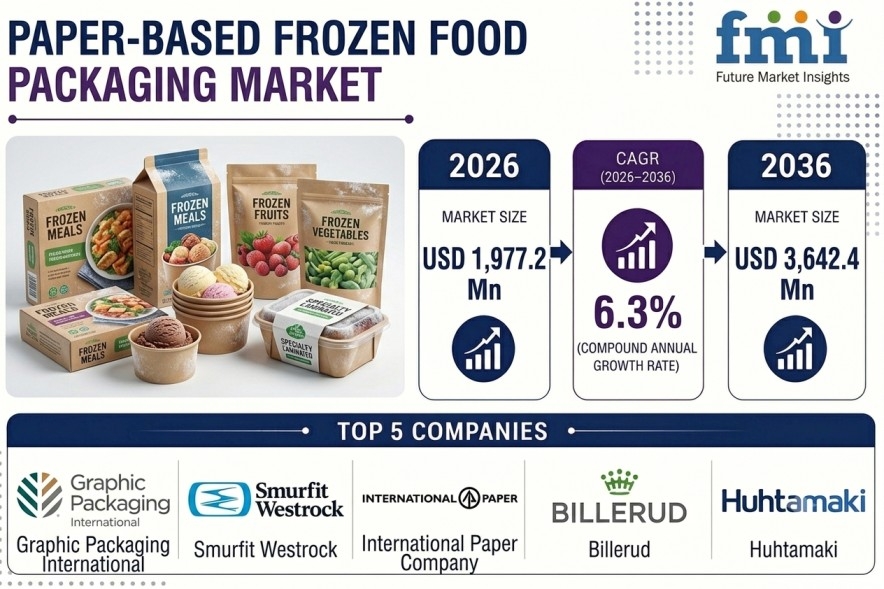
The global paper-based frozen food packaging market is valued at USD 1.98 billion in 2026 and is projected to reach USD 3.64 billion by 2036, advancing at a 6.3% CAGR, as frozen-food producers evaluate paperboard formats against freezer durability, food-contact requirements, machine performance and increasingly important recyclability criteria. The European Union's Regulation (EU) 2025/40 on packaging and packaging waste, which entered into force in February 2025, is adding further pressure to demonstrate packaging recyclability and resource efficiency as the regulation is phased into application.
The regulatory shift comes as suppliers expand paper-based packaging capabilities across frozen and refrigerated food applications. Graphic Packaging, Smurfit Westrock, International Paper, Billerud, Mondi, Sonoco, Cascades and Huhtamaki are among the companies competing across paperboard, converted packaging and barrier technologies.
👉 Get Detailed Market Forecasts, Competitive Benchmarking, and Pricing Trends: https://www.futuremarketinsights.com/reports/sample/rep-gb-34700
Why is paper-based packaging gaining importance in frozen foods?
The paper-based frozen food packaging market is forecast to increase from USD 1.98 billion in 2026 to USD 3.64 billion by 2036, adding approximately USD 1.67 billion in market value over the period.
Folding cartons are projected to account for 38.0% of the product-type segment in 2026, supported by established blank-fed converting equipment, efficient storage and strong printable surfaces. Food processors lead the end-use category with a 52.0% share, reflecting their direct role in validating package performance against recipes, freezing conditions and production-line settings.
The material landscape remains more complicated. SBS paperboard is expected to hold 30.0% of the material segment, while PE-coated formats lead barrier technology with 34.0%. The combination illustrates the central trade-off facing frozen-food packaging: paper must provide the stiffness, printability and recyclability advantages expected from fiber-based packaging while maintaining resistance to moisture and temperature cycling.
This makes the finished construction more important than the paperboard specification alone. Board strength, coating chemistry, scoring, folding, sealing and recovery compatibility increasingly need to be evaluated as one package system.
How are packaging suppliers adapting to the changing specification?
The competitive market includes Graphic Packaging, Smurfit Westrock, International Paper, Billerud, Mondi, Sonoco, Cascades and Huhtamaki, with participants spanning paperboard production, carton converting and food-packaging systems.
Billerud's July 2025 launch of Voyager Pts SB provides an example of continued development in SBS board for folding-carton and foodservice applications. Mondi has also expanded its food-packaging portfolio, including solid-board solutions for frozen and deep-freeze applications.
Smurfit Westrock's work with frozen-food contract packer Sivafrost offers another indication of how recovery is becoming part of the commercial discussion. The processor was reported to recycle approximately 75 tonnes of paper and cardboard per month, connecting package selection with a measurable recovery operation.
Meanwhile, Huhtamaki's July 2025 launch of ice-cream cups using paperboard with a bio-based coating and less than 10% plastic content illustrates a parallel route: reducing conventional plastic content while maintaining the barrier functionality required for frozen applications.
The common thread is that sustainability claims increasingly need to survive operational testing. A paper-based format must protect the product through filling, freezing, distribution and retail handling before recyclability becomes a meaningful commercial advantage.
What does the barrier challenge mean for frozen-food packaging?
PE-coated structures remain important because frozen foods experience moisture exposure, condensation and temperature changes that can weaken uncoated paperboard.
At the same time, regulatory and sustainability pressure is encouraging suppliers to examine dispersion-coated, bio-coated and lower-polymer structures. FDA actions concerning PFAS food-contact uses have also increased attention on alternative grease and moisture barriers.
This creates a qualification pathway in which converters cannot evaluate coating performance separately from recovery performance. A coating that delivers strong moisture resistance but creates difficulty during repulping may face different commercial prospects from a structure that balances freezer protection with an accepted recovery route.
Analyst Perspective
Nandini Roy Choudhury, Principal Consultant, Future Market Insights, said:
“Frozen-food formats qualify once board strength and barrier chemistry remain stable during filling and freezing. Repeat programs depend on line performance plus compatibility with paper-recovery systems across processor networks.”
Market Snapshot
- 2026 Market Value: USD 1.98 billion
- 2036 Forecast Value: USD 3.64 billion
- 2026–2036 CAGR: 6.3%
- Leading Product Type: Folding cartons — 38.0%
- Leading Material: SBS paperboard — 30.0%
- Leading Barrier Technology: PE-coated — 34.0%
- Leading End Use: Food processors — 52.0%
- Fastest-Growing Profiled Market: Brazil — 6.7% CAGR
Where are the strongest country opportunities?
Brazil is forecast to record the highest CAGR among the five profiled countries at 6.7% through 2036, followed by the United Kingdom at 6.2%, Germany at 6.1%, the United States at 5.7% and Japan at 4.9%.
The difference between markets is driven by more than frozen-food consumption. Recovery systems, producer-responsibility costs, food-contact requirements and local converting capabilities can materially influence the speed at which new paper structures move from trials to recurring orders.
The UK provides a strong example of cost and recovery considerations entering packaging decisions. Germany's mature recycling infrastructure raises expectations around material documentation, while US processors place substantial weight on food-contact authorization and repeat production validation.
Brazil combines relatively fast projected growth with a large food-processing base, while Japan's mature frozen-food sector favors consistency and controlled specification changes.
👉 Access the Complete Report in PDF Format: https://www.futuremarketinsights.com/reports/brochure/rep-gb-34700
What are the main drivers and constraints?
Producer-responsibility requirements are strengthening the business case for recyclable paper formats, particularly where packaging fees or retailer specifications increasingly distinguish between material structures.
The principal constraint is qualification. Frozen-food packaging must withstand low temperatures, moisture and mechanical handling while remaining compatible with existing filling, folding and sealing equipment. Any change in barrier chemistry can therefore trigger new food-contact, line-performance and recovery assessments.
The opportunity lies in coating innovation. Dispersion and bio-based coatings can potentially reduce dependence on conventional plastic layers, but commercial adoption depends on reproducing barrier performance at production scale and documenting compatibility with the recovery system available in each market.
About the Paper-Based Frozen Food Packaging Market Report
The Paper-Based Frozen Food Packaging Market research analyzes the market by product type, material, barrier technology, application, end use, sales channel and region. Coverage includes folding cartons, paper bags and pouches, paperboard trays, sleeves and wraps across frozen ready meals, frozen pizza and bakery, frozen meat and seafood, frozen vegetables and other applications.
The report provides country-level analysis for Brazil, the United Kingdom, Germany, the United States and Japan, alongside broader regional forecasts.
FMI Research Methodology: https://www.futuremarketinsights.com/methodology
Paper-Based Frozen Food Packaging Market: https://www.futuremarketinsights.com/reports/paper-based-frozen-food-packaging-market
Paper-Based Can Carriers Market: https://www.futuremarketinsights.com/reports/paper-based-can-carriers-market
Wine Shippers Molded Pulp Market: https://www.futuremarketinsights.com/reports/wine-shippers-molded-pulp-market
Butter Wraps Market: https://www.futuremarketinsights.com/reports/butter-wraps-market
About Future Market Insights
Future Market Insights, Inc. is a global market intelligence and consulting organization serving clients across more than 150 countries. The company is registered in Delaware as Future Market Insights, Inc., Christiana Corporate, 200 Continental Drive, Suite 401, Newark, Delaware 19713, United States, with regional operations across North America, Europe, the Middle East and India.
Media Contact
Future Market Insights, Inc.
Christiana Corporate
200 Continental Drive, Suite 401
Newark, Delaware 19713, United States

 English
 Arabic
 French
 Spanish
 Portuguese
 Deutsch
 Turkish
 Dutch
Dutch
 Russian
 Romaian
 Portuguese (Brazil)
 Greek
Greek
