
Hydrogen and Fuel Cells Market Outlook 2026–2034: Growth, Innovation & Future Opportunities
Hydrogen and Fuel Cells Market Size, Share, Demand, Growth & Forecast 2026–2034
Market Overview
The Hydrogen and Fuel Cells Market is transitioning from a policy-led emerging energy segment toward a broader industrial, mobility, and distributed-power market. The market covers hydrogen production technologies, fuel cell systems, transportation, stationary power, industrial applications, and other emerging end uses. Existing hydrogen demand remains concentrated in refining, ammonia, methanol, and other industrial processes, while newer applications such as heavy transport, power generation, synthetic fuels, and low-emissions industrial feedstocks are developing from a smaller base.
The global hydrogen and fuel cells market was valued at USD 62.47 billion in 2025. Global hydrogen demand exceeded 100 million tonnes in 2025, while low-emissions hydrogen remained a small portion of total consumption. The supply side is also changing as electrolysis capacity expands, with global installed electrolysis capacity surpassing 4 GW in 2025 and more than 2.5 GW under construction for operation in 2026.
Request Sample Link:
https://reedintelligence.com/market-analysis/hydrogen-and-fuel-cells-market/request-sample
Market Size and Forecast
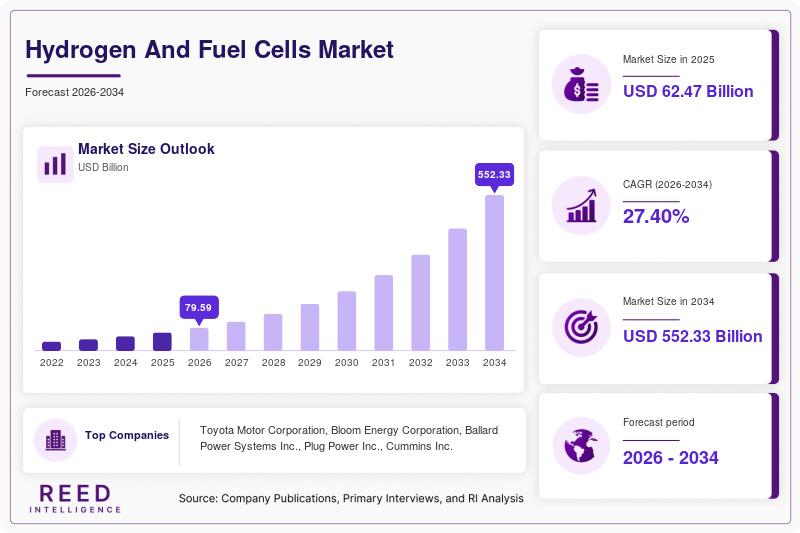
The global Hydrogen and Fuel Cells Market was valued at USD 62.47 billion in 2025 and is projected to grow from USD 79.59 billion in 2026 to USD 552.33 billion by 2034. The market is expected to register a CAGR of 27.40% during the forecast period from 2026 to 2034.
Market development is supported by industrial decarbonization, increasing electrolyzer deployment, fuel-cell applications, hydrogen infrastructure development, and expanding demand across mobility and stationary power. Electrolysis capacity surpassed 4 GW in 2025 after doubling during the year, while more than 2.5 GW was under construction for 2026 operation.
China has become particularly important in electrolyzer deployment and manufacturing, accounting for 65% of global installed electrolysis capacity and capacity that had reached final investment decision in the IEA's 2025 assessment.
Market Drivers
Industrial Decarbonization Is Expanding the Addressable Market
Industrial decarbonization is a major driver of the Hydrogen and Fuel Cells Market. Hydrogen already has established demand in refining and chemical production, creating an existing consumption base that can transition toward lower-emissions supply.
Refining, ammonia, methanol, and emerging hydrogen-based steel production are important demand channels. The IEA reports that more than 2 Mtpa of low-emissions hydrogen consumption could come from refineries and industrial facilities by 2030 based on projects that are operational, under construction, or have reached final investment decision.
Electrolyzer Deployment Is Creating New Equipment Demand
Electrolysis is becoming an increasingly important component of the hydrogen value chain as developers connect renewable or low-carbon electricity with hydrogen production. Installed water-electrolysis capacity surpassed 4 GW in 2025.
This expansion creates demand for electrolyzer stacks, power electronics, compression, water treatment, storage, and hydrogen-delivery infrastructure. China remains a major contributor to this equipment expansion.
Heavy-Duty Mobility and Distributed Power Are Expanding Applications
Fuel cells are gaining traction in applications where vehicle range, payload utilization, refueling time, or continuous power availability are important considerations. Heavy trucks represent the fastest-growing fuel-cell road-transport segment.
Stationary power is another important demand channel. Bloom Energy has expanded its relationships with data-center customers, including Oracle and Equinix, demonstrating the potential for fuel-cell-based onsite generation.
Market Challenges
High Hydrogen Production Costs and Uncertain Offtake
The gap between the economics of many low-emissions hydrogen projects and the price potential customers are willing to pay remains a major constraint. High costs, uncertain demand, regulatory uncertainty, and slow infrastructure development can delay project investment.
Developers require reliable offtake commitments to justify capital expenditure, while customers often require competitive delivered hydrogen prices before entering long-term contracts.
Hydrogen Infrastructure Gaps
Hydrogen requires dedicated or adapted production, storage, transport, and dispensing infrastructure. Infrastructure is not uniformly available, particularly for mobility applications.
This creates a relationship between infrastructure investment and demand. Industrial clusters can help concentrate production and consumption, but geographically dispersed applications require additional investment in pipelines, liquefaction, storage, or transportation.
Market Opportunities
Hydrogen Hubs
Regional hydrogen hubs provide an opportunity to connect production, infrastructure, and multiple offtakers within integrated industrial ecosystems. In the United States, regional clean hydrogen hubs are being developed for applications including industrial production, transportation, fertilizer, and power.
The commercial mechanism is improved asset utilization because a single hydrogen-production system can potentially supply several customers. This can support investment in electrolyzers, storage, pipelines, compression, and fuel-cell applications.
Hydrogen-Based Industrial Fuels
Hydrogen is increasingly being evaluated as an input for low-carbon ammonia, methanol, synthetic fuels, and direct-reduced iron. China's 2026 hydrogen demonstration program includes green ammonia and methanol, hydrogen-based chemical feedstock substitution, and hydrogen metallurgy.
These applications can consume hydrogen at industrial scale and create additional demand for electrolyzers, hydrogen storage, and related infrastructure.
Market Segmentation
The Hydrogen and Fuel Cells Market is segmented by Hydrogen Production Technology, Fuel Cell Type, Application, End Use, and Region.
By Hydrogen Production Technology
Steam Methane Reforming
Steam Methane Reforming accounted for approximately 48% of the hydrogen-production technology segment in 2025. Its position reflects the existing industrial hydrogen infrastructure serving refining and chemical applications.
Carbon-capture-equipped reforming can provide an alternative lower-emissions production pathway in regions with favorable natural-gas economics and carbon-storage infrastructure.
Electrolysis
Electrolysis accounted for approximately 18% of the hydrogen-production technology segment in 2025 and is projected to expand at approximately 31.2% CAGR through 2034. Its growth is linked to low-emissions hydrogen projects and increasing electrolyzer deployment.
Other Production Technologies
Coal Gasification is projected to grow at approximately 14.8% CAGR, while Other Production Technologies are projected to grow at approximately 22.0% CAGR through 2034.
By Fuel Cell Type
PEMFC
PEMFC accounted for approximately 42% of the fuel-cell segment in 2025. The technology is relevant to transportation and distributed-power applications and is particularly applicable to buses, commercial vehicles, material handling, and backup power.
SOFC
SOFC accounted for approximately 19% of the fuel-cell segment in 2025 and is projected to grow at about 29.5% CAGR through 2034. Growth is associated primarily with stationary power applications, including reliable onsite generation.
PAFC is projected to grow at approximately 20.7%, MCFC at 18.9%, and AFC at approximately 23.4% through 2034.
By Application
Industrial applications accounted for approximately 44% of the market in 2025. Transportation accounted for approximately 24% and is projected to grow at about 32.1% CAGR through 2034.
Stationary Power is projected to grow at approximately 28.6% CAGR, while Portable & Backup Power is projected to grow at approximately 24.2% CAGR through 2034.
By End Use
Refining & Chemicals accounted for approximately 38% of the market in 2025, supported by hydrogen's established role as an industrial feedstock.
Mobility accounted for approximately 23% of the market in 2025 and is projected to grow at about 32.6% CAGR through 2034. Power Generation is projected to grow at approximately 28.1%, Industrial Manufacturing at 25.8%, and Residential & Commercial at approximately 23.9% through 2034.
Regional Analysis
Asia-Pacific
Asia-Pacific accounted for approximately 43% of the global market in 2025 and is projected to grow at about 30.2% CAGR through 2034. The region combines large industrial hydrogen consumption with substantial electrolyzer manufacturing, fuel-cell vehicle deployment, and government-supported hydrogen programs.
China is a leading country in electrolyzer deployment and manufacturing. Japan and South Korea are also important markets for fuel-cell power and hydrogen applications.
North America
North America accounted for approximately 27% of the market in 2025 and is projected to grow at about 26.8% CAGR through 2034. The United States has established regional hydrogen hubs designed to connect production, storage, transportation, and end-use demand.
The region also presents opportunities in industrial hydrogen, heavy transportation, and stationary power, including fuel-cell applications for data centers and other facilities requiring reliable onsite generation.
Europe
Europe accounted for approximately 20% of the market in 2025 and is projected to grow at about 25.4% CAGR through 2034. European policy has focused on creating production incentives and demand mechanisms for renewable hydrogen.
The regional market is closely linked to industrial decarbonization, maritime fuels, renewable hydrogen production, and cross-border energy integration.
Latin America
Latin America accounted for approximately 6% of the market in 2025 and is projected to grow at about 24.1% CAGR through 2034. The region has potential for hydrogen production around renewable-energy resources and export-oriented industrial projects.
Potential applications include ammonia, methanol, refining, mining, and heavy transport.
Middle East & Africa
Middle East & Africa accounted for approximately 4% of the market in 2025 and is projected to grow at about 23.2% CAGR through 2034. The region has opportunities to combine existing energy infrastructure with hydrogen production and export projects.
Potential applications include refining, ammonia, methanol, steel, shipping fuels, and export-oriented hydrogen projects.
Key Players
-
Toyota Motor Corporation
-
Bloom Energy Corporation
-
Ballard Power Systems Inc.
-
Plug Power Inc.
-
Cummins Inc.
-
FuelCell Energy, Inc.
-
Air Liquide
-
Linde plc
Other companies included in the market landscape are Siemens Energy AG, Nel ASA, thyssenkrupp nucera AG & Co. KGaA, ITM Power plc, Shell plc, and Air Products and Chemicals, Inc.
Toyota announced its third-generation fuel-cell system in February 2025, with the system designed for commercial applications and planned for use in heavy-duty commercial vehicles. Bloom Energy also announced an expanded agreement with Equinix covering more than 100 MW of electricity capacity across 19 U.S. data centers.
Conclusion
The Hydrogen and Fuel Cells Market is projected to grow from USD 79.59 billion in 2026 to USD 552.33 billion by 2034, registering a CAGR of 27.40% during 2026–2034. Industrial decarbonization, electrolyzer deployment, heavy-duty mobility, stationary power, hydrogen hubs, and hydrogen-based industrial fuels are contributing to the market's development.
Electrolysis is projected to record approximately 31.2% CAGR through 2034, while transportation is projected to grow at about 32.1%. Asia-Pacific remains the largest regional market, accounting for approximately 43% in 2025, while the region is projected to grow at about 30.2% CAGR through 2034.
The Hydrogen and Fuel Cells Market continues to develop across industrial, transportation, stationary power, and emerging hydrogen-based fuel applications, with opportunities extending across production technologies, fuel-cell systems, infrastructure, and end-use industries.
Report Link:
https://reedintelligence.com/market-analysis/hydrogen-and-fuel-cells-market

 English
 Arabic
 French
 Spanish
 Portuguese
 Deutsch
 Turkish
 Italiano
 Russian
 Romaian
 Portuguese (Brazil)
 Greek
Greek
