
Best Fast Track Online Degree Programs for Working Professionals
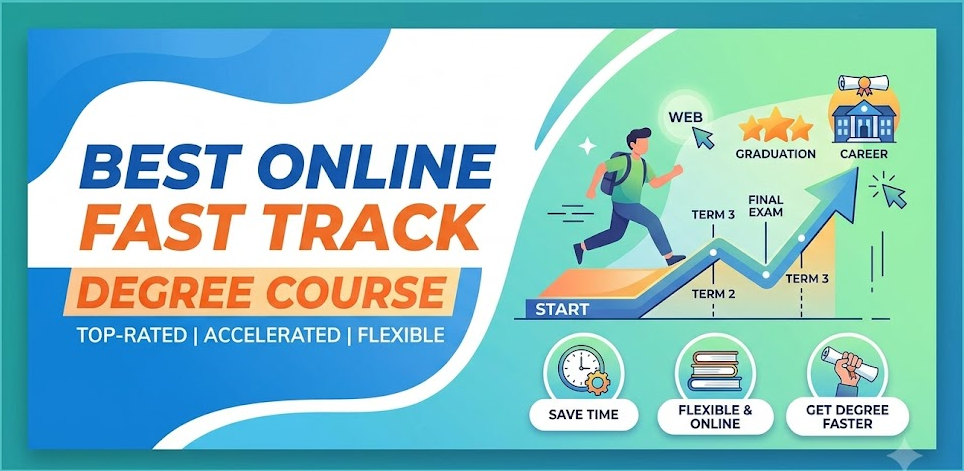
Balancing a full-time job with higher education can be challenging. Fixed classroom schedules, commuting, and professional responsibilities often make traditional degree programs difficult for working professionals. Fast Track Online Degree Programs can provide a more flexible way to continue higher education while managing career commitments.
However, the term “fast track” should be understood carefully. A legitimate online degree must follow the applicable academic and regulatory requirements. Students should always verify the university, program recognition, duration, eligibility, and examination process before admission.
What Are Fast Track Online Degree Programs?
Fast Track Online Degree Programs are generally marketed as flexible degree options that allow learners to pursue higher education through online learning. Depending on the university and applicable regulations, flexibility may come from digital study materials, recorded lectures, online academic support, flexible learning schedules, and other features.
These programs can be particularly useful for working professionals who cannot attend regular college every day.
Popular options may include:
-
Online MCA
-
Online MCom
-
Online MA
-
Online MSc
The exact course availability, duration, curriculum, and eligibility requirements vary by university.
Why Choose an Online Degree While Working?
Working professionals often pursue degrees for career development, higher qualifications, or preparation for a new career path. Online learning can make this easier by reducing the need for daily campus attendance.
1. Flexible Study Schedule
One of the biggest advantages of online education is flexibility. Students can often access learning resources digitally and organize their study time around their work schedule.
For professionals working shifts or managing demanding jobs, this can be more convenient than attending regular classroom sessions.
2. Continue Working While Studying
An online degree can allow professionals to continue their employment while pursuing higher education. This means learners do not necessarily have to take a career break to study.
3. Access Learning From Different Locations
Online programs can reduce the need for relocation or daily commuting. Students can access their academic resources from locations where the university's online learning facilities are available.
4. Develop New Skills
Higher education can help professionals strengthen their knowledge while developing skills relevant to their career goals.
For example, an MBA can support management knowledge, while an MCA can help learners develop advanced IT-related knowledge.
Best Fast Track Online Bachelor's Degree Programs
Working professionals who have completed Class 12 or an equivalent qualification may consider undergraduate online programs.
Online BBA
Bachelor of Business Administration (BBA) is suitable for learners interested in business and management. Subjects may cover marketing, finance, human resources, operations, business communication, and entrepreneurship.
It can be relevant for professionals who want to develop foundational management knowledge or eventually pursue an MBA.
Online BCom
Bachelor of Commerce (BCom) focuses on commerce, accounting, finance, economics, taxation, and business-related subjects.
It can be useful for professionals interested in accounting, banking, finance, business operations, or further postgraduate study.
Online BCA
Bachelor of Computer Applications (BCA) is a popular choice for learners interested in information technology. Depending on the curriculum, students may study programming, databases, computer networks, software development, and web technologies.
Professionals looking to transition toward IT-related roles may consider this option.
Online BA
An Online Bachelor of Arts (BA) can offer several subject combinations and specializations depending on the university. It may suit professionals interested in humanities, social sciences, communication, or related fields.
Best Fast Track Online Master's Degree Programs
Professionals who already hold a bachelor's degree may explore online postgraduate programs.
Online MBA
The Online MBA is one of the most popular choices among working professionals. It can provide advanced knowledge of business and management.
Common areas of study include:
-
Finance
-
Marketing
-
Human Resources
-
Operations
-
Business Analytics
-
International Business
-
Entrepreneurship
An MBA may be useful for professionals targeting managerial responsibilities or looking to strengthen their business knowledge.
Online MCA
The Online MCA can be considered by graduates interested in advanced computer applications and IT. Depending on the university, the curriculum may include programming, software engineering, database management, cloud technologies, data analytics, and related subjects.
Online MCom
Professionals from commerce backgrounds may consider an Online MCom to deepen their knowledge of accounting, finance, taxation, economics, and commerce.
It can also provide a foundation for further academic or professional development.
Online MA
An Online MA can be suitable for graduates seeking postgraduate education in humanities, social sciences, languages, or other available disciplines.
Online MSc
Professionals with relevant bachelor's degrees may consider an Online MSc in disciplines offered by recognized institutions. The suitability of the program depends on the student's academic background and career objectives.
How to Choose the Right Online Degree?
Choosing the right program requires more than comparing course names. Working professionals should consider their current qualifications, career goals, available study time, and long-term plans.
Consider Your Career Objective
Start by asking what you want to achieve.
If you want to move into management, an MBA may be appropriate. If your goal is to develop IT expertise, BCA or MCA may be worth exploring depending on your existing qualification.
Check Eligibility
Every program has specific eligibility requirements. Undergraduate courses generally require completion of Class 12 or an equivalent qualification, while postgraduate courses generally require a bachelor's degree.
Some programs may have additional subject or qualification requirements.
Verify University Recognition
This is one of the most important steps.
Before admission, check the university's official information and verify whether the particular online program and mode of delivery have the required recognition or entitlement under applicable regulations.
Do not assume that every program advertised as a “fast track online degree” has the same recognition.
Review the Course Curriculum
Compare the curriculum of different universities. Look at subjects, electives, practical components, projects, assignments, and learning resources.
A strong curriculum should align with your career objectives rather than simply promising faster completion.
Understand the Examination Process
Find out how examinations are conducted and whether students need to appear at designated examination centres or follow other university-prescribed procedures.
Also check assignment submission, internal assessments, practical examinations, and project requirements where applicable.
Are Fast Track Online Degrees Valid?
The validity and recognition of an online degree depend on the institution, program, mode of education, and applicable regulatory requirements.
The phrase “fast track” itself does not guarantee recognition.
Students should be particularly careful with claims such as “guaranteed degree,” “one sitting degree,” or unusually short degree completion periods. Before paying fees, verify the official academic structure and recognition status.
Career Opportunities After an Online Degree
Career opportunities depend on the degree, specialization, skills, work experience, and employer requirements.
For example:
-
BBA/MBA: Management, sales, marketing, HR, operations, business development
-
BCA/MCA: Software, IT support, web development, databases, technology-related roles
-
BCom/MCom: Accounting, finance, banking, taxation, business operations
-
BA/MA: Communication, administration, education-related areas, research, content, and other discipline-specific careers
-
BSc/MSc: Opportunities related to the chosen scientific or technical specialization
An online degree should ideally be combined with practical skills and relevant professional experience.
Tips for Working Professionals Studying Online
Managing employment and education requires discipline. Consider these strategies:
Create a study schedule: Set aside specific hours during the week for lectures, reading, assignments, and revision.
Use digital resources effectively: Keep course materials organized and make use of recorded lectures, e-books, discussion forums, and other resources provided by the university.
Set realistic goals: Divide larger assignments and academic tasks into smaller milestones.
Stay consistent: Studying for a few hours regularly is generally easier than leaving everything until examination time.
Develop additional skills: Alongside your degree, consider industry certifications, software skills, communication skills, or other competencies relevant to your career.
Common Mistakes to Avoid
Working professionals should avoid selecting an online degree solely because it is advertised as fast or inexpensive.
Before admission, check:
-
University recognition
-
Program eligibility
-
Approved mode of education
-
Course duration
-
Curriculum
-
Examination process
-
Total fees
-
Academic support
-
Admission documentation
-
Career relevance
Also, avoid making payments based solely on claims made by third-party agents. Whenever possible, confirm important details through official university sources.
Conclusion
Fast Track Online Degree Programs for Working Professionals can offer a convenient way to pursue higher education while continuing a career. Programs such as Online BBA, BCom, BCA, BA, MBA, MCA, MCom, MA, and MSc can provide options for learners with different academic and professional goals.
The most important consideration, however, should not simply be how quickly a program can be completed. Working professionals should focus on recognition, eligibility, academic quality, approved mode of education, examination requirements, fees, and career relevance.
By carefully comparing programs and verifying information before admission, professionals can choose an online degree that fits their current responsibilities while supporting their long-term educational and career objectives.

 English
 Arabic
 French
 Spanish
 Portuguese
 Deutsch
 Turkish
 Dutch
Dutch
 Italiano
 Russian
 Romaian
 Portuguese (Brazil)
