
How Can IoT Cloud Platforms Help Chinese SMEs Accelerate Digital Transformation?
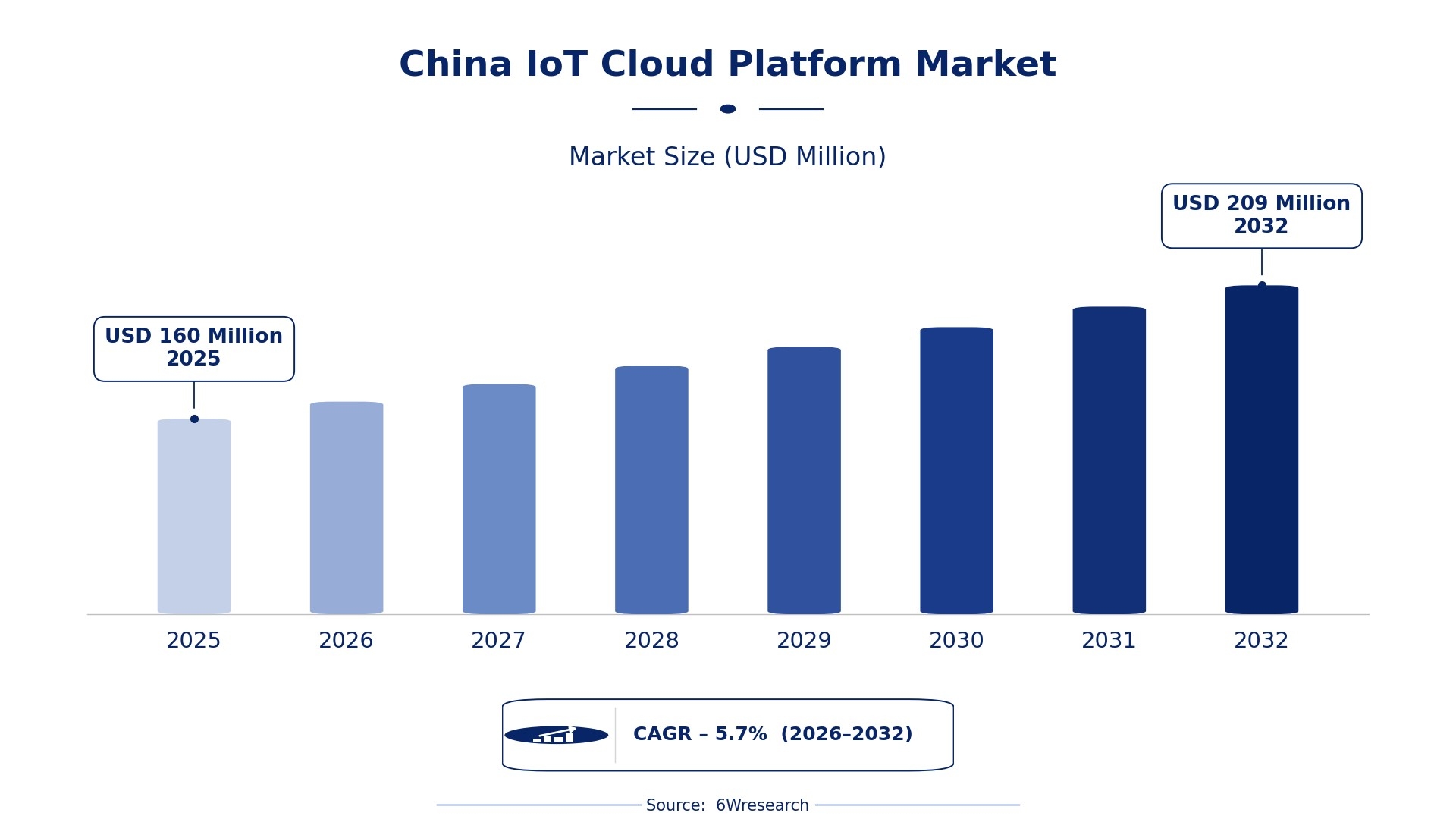
The China IoT Cloud Platform Market is creating opportunities for businesses of different sizes to improve efficiency, monitor connected assets, and make better use of operational information. Small and medium-sized enterprises (SMEs) may have fewer technology resources than large corporations, yet they face similar pressures to modernize equipment, control costs, and respond quickly to changing business needs. Cloud-based IoT solutions can make connected technology more accessible by reducing the need to build every component internally. According to 6Wresearch, the market is projected to grow from USD 160 million in 2025 to USD 209 million by 2032, at a CAGR of 5.7%.
Why Do SMEs Need Connected Technology?
Smaller businesses often rely on manual inspections, spreadsheets, and standalone monitoring tools. These methods may be sufficient for simple operations but can become inefficient as facilities, inventory, and equipment networks grow.
IoT cloud platforms connect compatible sensors and devices to a centralized environment. Business owners can use the resulting information to monitor machinery, review storage conditions, and identify potential operational problems.
The goal is not to digitize every activity immediately. Businesses can begin with a specific operational challenge and expand their systems when measurable benefits justify the investment.
Practical Applications for Smaller Businesses
Several use cases provide realistic starting points for IoT adoption.
-
Equipment monitoring: Sensors can track machine conditions and generate alerts when readings become unusual.
-
Inventory management: Connected systems can monitor selected storage conditions and support asset visibility.
-
Energy management: Smart meters can help identify consumption patterns and potential inefficiencies.
-
Retail operations: Sensors can monitor refrigeration, environmental conditions, and connected equipment.
-
Fleet management: Tracking devices can provide visibility into vehicle location, operating hours, and selected performance indicators.
The most appropriate application depends on the business model, equipment, and financial impact of the problem being addressed.
How Can Cloud Services Reduce Barriers?
Traditional infrastructure may require servers, software licences, maintenance, and specialized employees. Cloud-based services can allow SMEs to access device management, data storage, monitoring, and analytics through managed environments.
This approach can support gradual expansion as the business adds devices or facilities. Depending on the service, organizations may also benefit from managed updates and infrastructure maintenance.
However, cloud technology does not eliminate every expense. Compatible sensors, connectivity, integration, training, and security controls still require investment. Subscription and data-transfer charges should be reviewed before deployment.
Turning Operational Information into Results
Connected devices create value when their information leads to useful action. A warehouse temperature sensor, for example, may report continuously, but staff need a clear process for responding when conditions exceed acceptable limits.
Similarly, a machine-monitoring system may detect abnormal vibration, but a maintenance team must determine whether inspection is necessary.
SMEs should establish measurable indicators such as equipment downtime, energy consumption, maintenance response time, inventory losses, and operating expenditure. Comparing results before and after deployment helps determine whether the investment is worthwhile.
What Challenges Could Slow Adoption?
Smaller businesses may face limited technical expertise, uncertainty about return on investment, and difficulties integrating older equipment. Different devices may use incompatible communication protocols, while limited IT resources can make security management challenging.
Businesses also need to understand where information is stored, who can access it, and which data-protection obligations apply.
A phased strategy can help manage these risks:
-
Identify a high-priority operational problem.
-
Confirm device compatibility and connectivity.
-
Compare platform pricing and integration requirements.
-
Run a pilot and establish performance benchmarks.
-
Expand only after evaluating results and security needs.
How Can Providers Serve SMEs Better?
Providers can simplify adoption through straightforward setup, predictable pricing, industry-specific templates, clear documentation, and accessible technical support. Solutions that integrate with existing inventory, accounting, and operational software can further reduce complexity.
System integrators and technology partners can help businesses connect older equipment and train employees.
What Is the Outlook for SME Adoption?
SMEs may offer opportunities for providers that deliver practical, affordable, and scalable IoT solutions. The strongest offerings will focus on measurable improvements instead of unnecessary technical complexity.
For businesses, successful adoption means selecting a platform that solves a real problem, fits available resources, and supports future growth. For providers, the opportunity lies in making connected technology easier to deploy, operate, and justify financially.
About 6Wresearch
About 6Wresearch: 6Wresearch is a commercial strategy and growth advisory firm founded in 2011 and headquartered in New Delhi, India, with partners across Southeast Asia and the Middle East & Africa. The firm has delivered over 20,000 commercial engagements for over 2,000 organizations, including Fortune 500 companies, government agencies, and multilateral institutions such as the World Bank and the Asian Development Bank. Backed by proprietary market research and advanced analytics, 6Wresearch combines sector expertise with data-driven intelligence to help organizations navigate market complexity and drive sustainable growth. These capabilities explain why organizations trust 6Wresearch Global Market Research & Consulting Firm for reliable commercial insights and confident decision-making.
Our Proprietary Platform: 6W Export GTM
6W Export GTM is 6Wresearch's proprietary trade intelligence and go-to-market platform, built on UN Comtrade data and enhanced with 6Wresearch's in-house analytical and simulation models, including system dynamics-based forecasting. Unlike broad, sector-level market sizing tools, 6W Export GTM operates at the individual product level down to specific HS codes and micro-segments to identify precise, actionable export opportunities by country and product pair, including markets where trade currently does not exist. This granular, simulation-driven approach allows 6W Export GTM to surface opportunities that sector-wide analysis typically misses, positioning it among a small number of platforms globally offering this depth of product-and-country-specific export intelligence.

 English
 Arabic
 French
 Spanish
 Portuguese
 Deutsch
 Turkish
 Dutch
Dutch
 Italiano
 Romaian
 Portuguese (Brazil)
 Greek
Greek
