
Oxygen-Scavenger Paper Packaging Market Valued at USD 686.5 Mn by 2036, Indonesia - CAGR 7.0%, USA - 5.5%
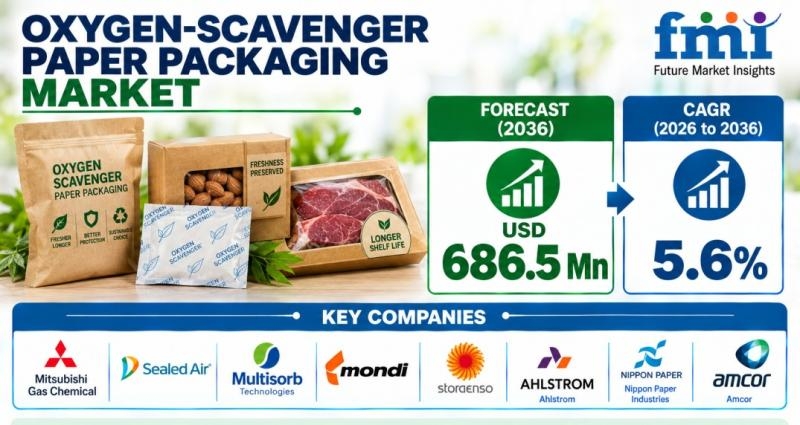
NEWARK, Del., October 13, 2026. The global oxygen-scavenger paper packaging market is projected to grow from USD 399.6 million in 2026 to USD 686.5 million by 2036, registering a compound annual growth rate (CAGR) of 5.6%, according to Future Market Insights (FMI). The market is expected to add USD 286.9 million in revenue over the forecast period as food manufacturers evaluate active paper formats designed to control oxygen inside sealed packs.
Food-loss reduction programmes are creating a commercial reason to assess packaging that can limit oxidation during storage and distribution. Indonesia’s National Food Agency identified a national food-rescue target of 3% to 5% per year for 2025–2029, according to the report. FMI also cites the agency’s June 19, 2025, publication on reducing food waste. For packaging buyers, the opportunity depends on whether added absorber and testing costs are justified by the product’s storage requirements and the ability to recover the paper packaging after use.
The American Forest & Paper Association reported that the US paper recycling rate reached 61% to 65% in 2025, according to the report. That recovery infrastructure highlights a central design challenge: oxygen scavenging must work alongside the paper structure’s collection and repulping requirements.
>> Get Detailed Market Forecasts, Competitive Benchmarking, and Pricing Trends: https://www.futuremarketinsights.com/reports/sample/rep-gb-35799
Where growth is fastest
Indonesia is projected to record the highest growth among the countries for which FMI provides a specific CAGR. The report forecasts these country-level rates from 2026 to 2036:
- Indonesia – 7.0%: Food-loss reduction programmes and longer domestic distribution routes support interest in packaging that controls oxygen during storage.
- Japan – 6.6%: Established paper recovery systems increase the importance of active packaging designs that can be separated or recovered after use.
- South Korea – 6.5%: Producer-responsibility and material-separation requirements influence development of fibre-based packaging.
- Mexico – 5.9%: Growth in packaged-food distribution supports demand for packaging formats designed to protect products during storage and transport.
- United States – 5.5%: Existing recovered-paper collection infrastructure supports fibre packaging, although coatings and inserts still need to meet recovery requirements.
- Canada – 5.3%: Provincial recycling programmes and scrutiny of environmental claims increase the importance of evidence for recyclability and compostability.
What leads the market
Iron-based scavengers, coated paper and sachet or pad inserts lead the market’s 2026 segment estimates. FMI reports the following shares:
- Iron-based systems – 45.1% of scavenger chemistry demand: These systems are used in absorber packets and pads, with capacity selected to suit the pack’s oxygen load.
- Coated paper – 36.0% of paper-substrate demand: Functional layers can be applied during established paper-converting operations.
- Sachet and pad inserts – 31.2% of integration-method demand: Insert formats allow packers to select absorber capacity without changing the complete carton or paper liner.
- Food and beverage – 48.0% of end-use demand: Oxygen control is relevant to products where oxidation can affect flavour, colour or other quality attributes.
The hurdle
Paper recovery is a key constraint. Coatings, adhesives and reactive layers may affect repulping performance, leaving packaging converters to balance oxygen-control performance with the requirements of paper mills and recovery systems.
FMI identifies coating recovery as a restraint and fibre-based active packaging as an opportunity. For buyers, the material claim needs to cover the complete packaging construction—not only the paper substrate. Evidence should address how the active layer behaves during the intended collection and recycling process.
Recent developments
The report’s cited developments reflect wider investment in fibre packaging and packaging platforms. They should not be read as announcements of specific oxygen-scavenger product launches.
- September 2025 – Stora Enso: The company completed its acquisition of Junnikkala Oy, adding sawmill integration to its renewable-materials platform, according to the report.
- June 2025 – Mondi: Mondi completed the acquisition of Schumacher Packaging assets, expanding its corrugated converting capacity in Western Europe.
- May 2025 – Amcor: Amcor completed its combination with Berry Global, creating a broader packaging platform with food and healthcare exposure.
Companies profiled by FMI include Mitsubishi Gas Chemical, Sealed Air, Multisorb Technologies, Mondi, Stora Enso, Ahlstrom, Nippon Paper Industries and Amcor. The report spans oxygen-control technology, paper substrates and finished packaging capabilities.
>> Access detailed market insights: https://www.futuremarketinsights.com/reports/brochure/rep-gb-35799
Analyst perspective
“Food brands will move first where longer shelf life recovers the added absorber and testing cost. Packs combining measurable oxygen control with paper recovery will receive the largest repeat orders from food brands.”
— Nandini Roy Choudhury, Principal Consultant, Future Market Insights.
What this means for food manufacturers and packaging buyers
- Test the business case on the actual product. Measure oxygen-control performance and assess whether the expected reduction in quality loss justifies absorber, validation and packaging costs. Requirements will vary by product, pack volume and distribution conditions.
- Check the complete pack’s recovery performance. Request evidence for the paper substrate, active layer, adhesives and other components together. Confirm that recyclability claims reflect the intended collection and repulping process.
- Choose the integration method around existing operations. Sachet and pad inserts may allow changes in absorber capacity without redesigning the full carton or liner. Compare inserts, coatings and embedded layers against filling-line compatibility, testing needs and recovery performance before committing to a format.
Report details
The Oxygen-Scavenger Paper Packaging Market report from Future Market Insights examines market size and forecasts, scavenger chemistry, paper substrate, integration method, end use, country-level growth and competitive activity through 2036.
Learn About the Methodology : https://www.futuremarketinsights.com/methodology
Read the Full Report
For detailed market sizing, segment analysis, country forecasts, competitive benchmarking, and market methodology: https://www.futuremarketinsights.com/reports/oxygen-scavenger-paper-packaging-market
Germany Returnable Bottle Systems Market: https://www.futuremarketinsights.com/reports/germany-returnable-bottle-systems-market
Paper-Based Chocolate Wrappers Market: https://www.futuremarketinsights.com/reports/paper-based-chocolate-wrappers-market
IML Containers Market: https://www.futuremarketinsights.com/reports/iml-containers-market
Contact Us:
Future Market Insights Inc.
Christiana Corporate, 200 Continental Drive,
Suite 401, Newark, Delaware - 19713, USA
T: +1-347-918-3531
For Sales Enquiries: sales@futuremarketinsights.com
About Future Market Insights
Future Market Insights (FMI) is a leading provider of market research and consulting services, offering syndicated and customized research across industries including Packaging, Consumer Product, and Food & Beverage.

 English
 Arabic
 Spanish
 Portuguese
 Deutsch
 Turkish
 Dutch
Dutch
 Italiano
 Russian
 Romaian
 Portuguese (Brazil)
 Greek
Greek
