
Modular Containment Systems: The Next Growth Opportunity in Data Centers
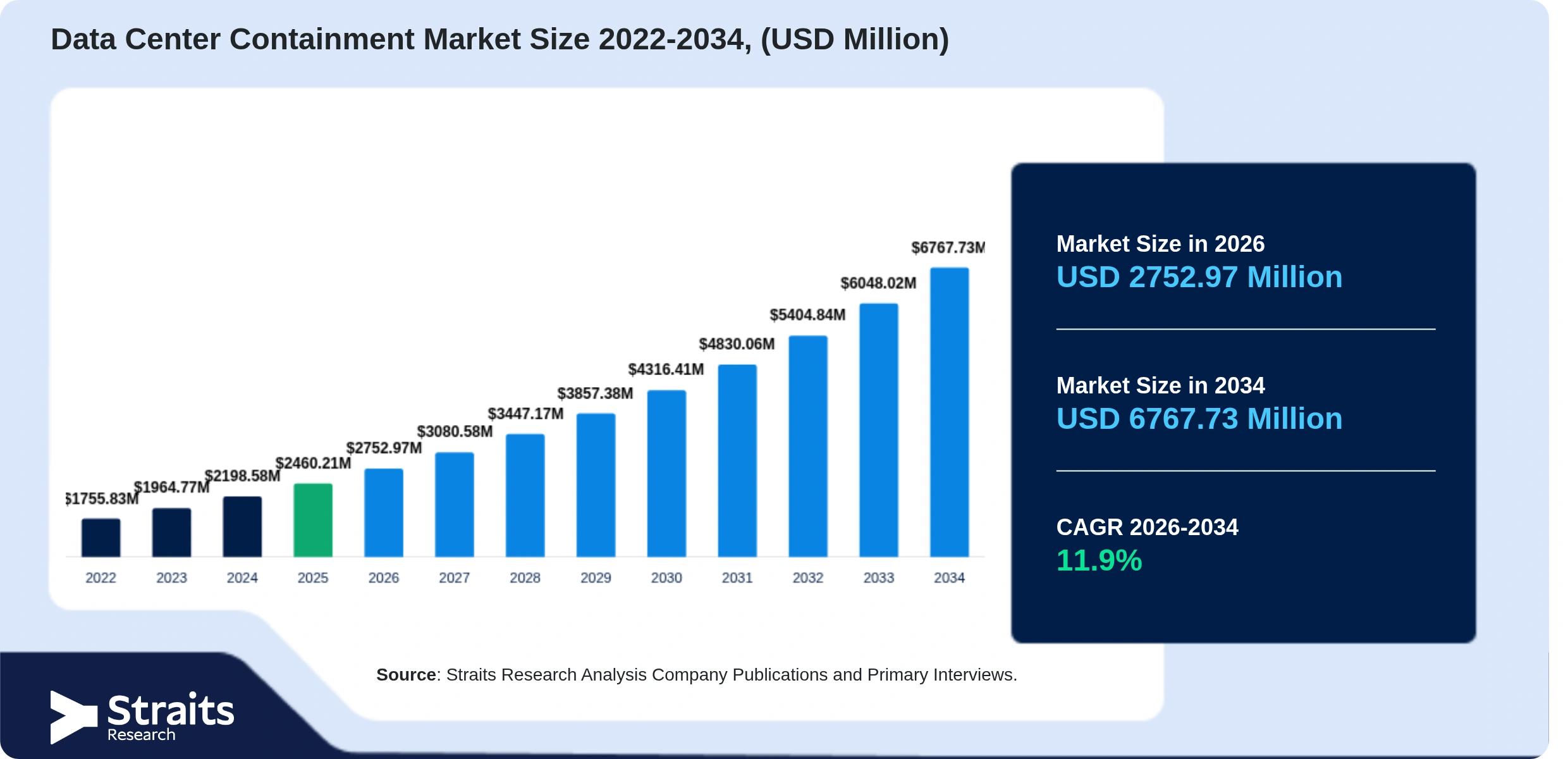
Data Center Containment Market Size, Share, Trends and Forecast to 2034
Market Overview
The global data center containment market is experiencing strong growth as rising server density, expanding cloud infrastructure, and increasing demand for energy-efficient cooling drive the adoption of advanced airflow management systems. Data center containment solutions separate hot and cold airflows to improve temperature control, reduce energy consumption, prevent equipment overheating, and enhance IT infrastructure performance. The growing deployment of AI workloads and high-performance computing is further increasing the need for effective thermal management across modern data centers.
According to Straits Research, the global data center containment market was valued at USD 2,460.21 million in 2025 and is projected to reach USD 6,767.73 million by 2034, growing at a CAGR of 11.9% during the forecast period (2026–2034). North America held the largest regional market share in 2025, while Asia Pacific is expected to record the fastest growth.
Request Sample: https://straitsresearch.com/report/data-center-containment-market/request-sample
Market Size and Forecast
The global data center containment market is projected to increase from USD 2,752.97 million in 2026 to USD 6,767.73 million by 2034, registering a CAGR of 11.9%. This growth reflects increasing investments in data center infrastructure and the need to manage rising heat loads generated by high-density computing environments.
Hot aisle containment represented the leading containment type, accounting for 34.6% of the market in 2025. Hyperscale data centers held the largest share among end-use applications at 33.9%. By cooling integration method, air-cooling integrated systems led with a 38.4% market share, while direct liquid-cooling is projected to grow at the highest CAGR of 15.4% through 2034.
Market Drivers
High-Density Computing Drives Containment Demand
Increasing server density generates higher heat loads within data centers, making effective airflow separation essential for stable operations. Poor airflow management can create localized hot spots around densely packed server racks and reduce cooling efficiency. AI computing facilities, which deploy high-performance servers, require effective thermal management to maintain operating conditions. Hot aisle and cold aisle containment systems help isolate airflow and manage heat around these installations. Rising demand for high-density computing is therefore supporting the adoption of data center containment solutions.
Energy Efficiency Goals Boost Adoption
Rising electricity costs and growing emphasis on energy efficiency are encouraging data center operators to reduce cooling-related power consumption. Containment systems prevent hot exhaust air from mixing with cold supply air, helping cooling equipment operate more efficiently. Colocation providers, for example, install aisle containment systems to reduce cooling waste across server halls. These potential energy savings support the adoption of containment solutions that improve cooling efficiency and help lower operating costs.
Market Challenges
Managing Heat from High-Density Computing
The increasing thermal demands of AI workloads and high-performance computing are creating more complex cooling requirements for data center operators. Conventional airflow management alone may not be sufficient for high-density GPU racks, increasing the need for containment systems that can accommodate advanced cooling configurations. Operators must also prevent exhaust heat from mixing with the cold air required by adjacent air-cooled networking and storage equipment. These requirements increase the importance of adaptable containment designs and effective integration with different cooling technologies.
Adapting to Changing Infrastructure Requirements
Data centers need infrastructure that can accommodate changing rack configurations, cooling requirements, and capacity expansion. Fixed containment layouts may offer limited flexibility when facilities introduce new server configurations or upgrade their cooling systems. Modular and prefabricated containment designs can help address these requirements, but operators still need solutions that integrate with existing infrastructure while minimizing installation disruption.
Market Opportunities
Growth in Liquid Cooling-Compatible Containment
The increasing deployment of AI infrastructure and high-density GPU servers is creating opportunities for containment systems compatible with liquid cooling. Hybrid cooling environments require containment designs that support liquid-cooled GPU servers while maintaining effective airflow management for adjacent air-cooled equipment. Modular systems with adaptable rack interfaces and sealed airflow paths can support direct-to-chip liquid cooling and mixed cooling configurations. The direct liquid-cooling integration segment is projected to grow at a CAGR of 15.4% through 2034, highlighting its growth potential.
Rising Demand for Modular and Prefabricated Systems
The need for flexible data center capacity is supporting demand for modular containment solutions. Prefabricated panels, adjustable doors, and scalable aisle structures allow operators to modify layouts as rack configurations and cooling requirements change. These systems can reduce installation complexity and support faster infrastructure deployment. The prefabricated containment systems segment is expected to register the highest CAGR of 13.6% among containment types during the forecast period.
Market Segmentation
The data center containment market is segmented by containment type, cooling integration method, and end-use application.
By Containment Type
Hot aisle containment dominated the market with a 34.6% share in 2025. Its ability to isolate hot exhaust air and improve cooling efficiency supports adoption across data centers, particularly in high-density computing environments. The prefabricated containment systems segment is projected to grow at the highest CAGR of 13.6%, supported by demand for faster deployment, modular scalability, and reduced installation complexity.
Other segments include cold aisle containment, cabinet containment, and aisle pod containment.
By Cooling Integration Method
Air-cooling integrated systems accounted for the largest market share of 38.4%, supported by established infrastructure, straightforward implementation, and compatibility with conventional data center cooling systems. Direct liquid-cooling is expected to record the highest CAGR of 15.4% from 2026 to 2034. Increasing rack densities and the thermal requirements of AI workloads and high-performance computing are supporting demand for this integration method.
Other segments include in-row cooling integrated systems, rear-door heat exchanger integrated systems, and economizer integrated systems.
By End-Use Application
Hyperscale data centers held the largest market share of 33.9% in 2025. Expanding cloud computing, large-scale data processing, and rising demand for digital services are increasing investments in hyperscale infrastructure and effective airflow management.
Edge data centers are projected to grow at the highest CAGR of 15.1%. Demand for low-latency processing, distributed computing, and real-time data delivery is supporting the expansion of localized computing infrastructure. Other applications include colocation data centers, enterprise data centers, and electronics compute facilities.
Regional Analysis
North America
North America dominated the data center containment market with a regional share of 37.2% in 2025. Growing data center infrastructure requirements and increasing attention to cooling efficiency are supporting regional demand. In the U.S., the Department of Energy estimates that data centers could consume 11.8% of total national electricity by 2030, with scenarios ranging from 9.5% to 15.3%. This outlook highlights the importance of airflow management and containment solutions that help reduce cooling inefficiencies.
Canada is also expected to offer growth opportunities. The Canada Energy Regulator projects an additional 1.5 GW of data center electricity demand by 2030 under its current-measures and net-zero scenarios, with a higher-growth scenario reaching 2.7 GW. Expanding electricity demand is increasing the importance of efficient thermal management and reliable data center operations.
Asia Pacific
Asia Pacific is expected to be the fastest-growing regional market, registering a CAGR of 13.8% from 2026 to 2034. Increasing data center investments and expanding digital infrastructure across major economies are supporting regional growth.
India is emerging as an important growth market, with the Economic Survey 2025–26 projecting data center capacity to increase from approximately 1.28 GW in June 2025 to 4 GW by 2030. China is also expected to see rising demand for efficient cooling infrastructure as its data center electricity consumption is projected to reach approximately 380 TWh by 2030. In Japan, planned data center infrastructure expansion and increasing electricity demand in the Tokyo area are supporting the need for improved cooling efficiency.
Europe
Europe accounted for 25.1% of the data center containment market in 2025. Expanding data center capacity and rising demand for AI infrastructure are supporting the adoption of advanced cooling and airflow management systems. The U.K. government forecasts a requirement for at least 6 GW of AI-capable data center capacity by 2030. Germany's data center IT capacity is projected to reach approximately 4,850 MW by 2030, up from more than 2,730 MW in 2024. These developments are expected to support demand for containment systems that improve thermal management and cooling efficiency.
Key Players
The data center containment market is moderately fragmented, with competition among data center infrastructure providers, cooling equipment manufacturers, specialized containment suppliers, and engineering companies. Leading companies compete through thermal management efficiency, system reliability, customization, installation expertise, and compatibility with existing data center infrastructure.
Key players include:
-
Schneider Electric SE (France)
-
Vertiv Holdings Co. (U.S.)
-
ABB Ltd. (Switzerland)
-
Rittal GmbH & Co. KG (Germany)
-
Huawei Technologies Co., Ltd. (China)
-
Siemens AG (Germany)
-
Mitsubishi Electric Corporation (Japan)
-
Delta Electronics, Inc. (Taiwan)
Conclusion
The data center containment market is positioned for substantial growth as rising computing density, expanding hyperscale infrastructure, and increasing energy efficiency requirements strengthen demand for advanced airflow management. Hot aisle containment currently leads by containment type, while direct liquid-cooling and prefabricated containment systems represent important growth areas. Asia Pacific is expected to record the fastest regional expansion through 2034, supported by increasing investments in data center capacity.
With the growing adoption of AI infrastructure and advanced cooling technologies, adaptable containment solutions are expected to remain important for improving thermal management and supporting the expansion of global data center facilities.
Report: https://straitsresearch.com/report/data-center-containment-market
 Spanish
 English
 Arabic
 French
 Portuguese
 Deutsch
 Turkish
 Dutch
 Italiano
 Russian
 Romaian
 Portuguese (Brazil)
 Greek
