
Wood Pallets Market to Gain Traction Through 2036 | Fueled by Rising Demand for Heavy-Duty Load-Bearing Solutions
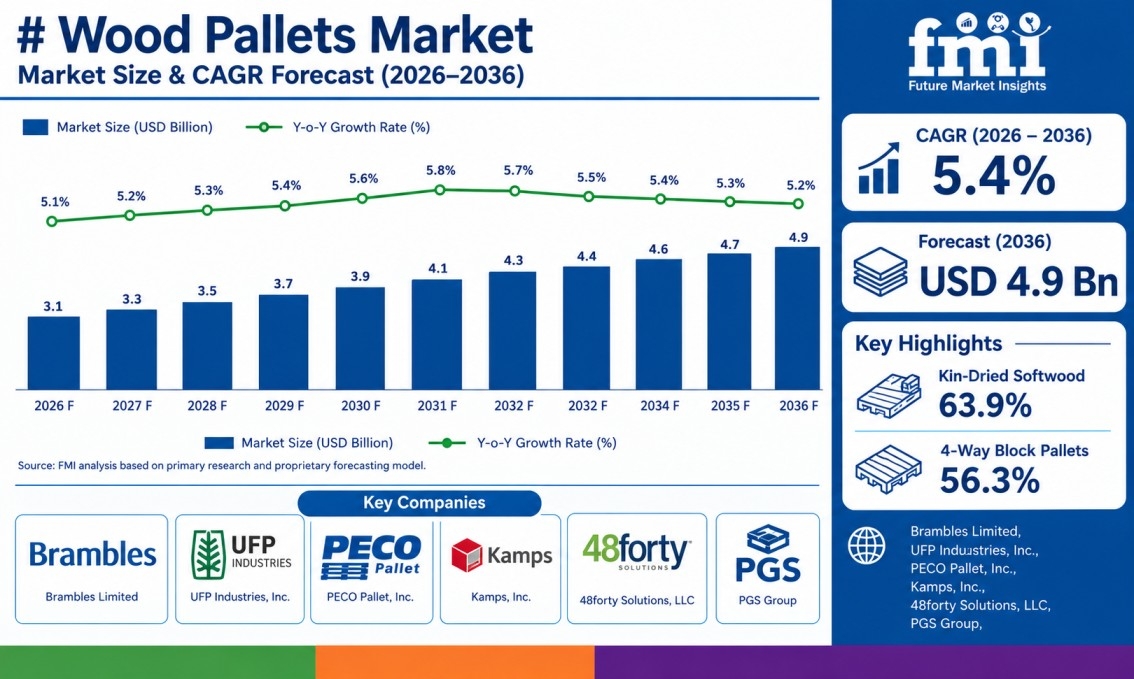
The global Wood Pallets Market is projected to grow from US$2.9 billion in 2026 to US$4.9 billion by 2036, registering a compound annual growth rate (CAGR) of 5.4%, according to Future Market Insights (FMI). The market was valued at US$2.8 billion in 2025, with the forecast indicating approximately US$2.0 billion in additional market value over the 2026–2036 period.
Wood pallets remain essential to the movement, storage and handling of goods across manufacturing, retail, food and beverage, and logistics networks. As distribution centers adopt automated handling systems and businesses seek greater supply chain efficiency, demand is increasingly shaped by pallet consistency, durability, standardized dimensions and the economics of reusable packaging.
>> Get Detailed Market Forecasts, Competitive Benchmarking, and Pricing Trends: https://www.futuremarketinsights.com/reports/sample/rep-gb-15589
Four-Way Block Pallets Lead Structural Design Demand
FMI projects 4-way block pallets to account for 56.3% of structural design demand in 2026. Their four-directional forklift entry makes them suitable for distribution operations that require standardized handling, automated conveyor integration and efficient warehouse movement.
Stringer pallets, engineered laminated veneer lumber (LVL) pallets and other designs serve different load, cost and handling requirements. Buyers must assess pallet dimensions, load-bearing performance, repairability and compatibility with existing equipment before selecting a format.
Kiln-dried softwood is expected to represent 63.9% of the timber species segment in 2026. Its strength-to-weight characteristics and suitability for automated manufacturing support its use in commercial pallet production. Heat treatment and other applicable phytosanitary requirements are also important for international shipping.
New white-wood pallets are projected to account for 53.7% of lifecycle-status demand, while closed-loop rental pooling is forecast to represent 54.9% of the operating-model segment. These figures reflect demand across newly manufactured pallets and reusable fleet systems.
Food and Beverage Demand Supports Pallet Consumption
The food and beverage sector is expected to account for 37.3% of wood pallet end-use demand in 2026, according to FMI. Beverage distribution, grocery replenishment, food processing and cold-chain logistics require reliable platforms for moving goods between production sites, warehouses and retail locations.
FMCG and e-commerce, chemicals and industrial applications also contribute to demand. Pallets used in these environments must meet different requirements for load stability, handling frequency, storage conditions and shipment distance.
For buyers, pallet selection involves more than the initial purchase price. Durability, repair costs, return rates, product damage and availability of replacement units all affect the total cost of ownership.
Automation and Reusable Pooling Shape Market Trends
Several developments are influencing the wood pallets market.
Warehouse automation: High-throughput distribution centers need consistent pallet dimensions and reliable structural performance. Warped boards, damaged deckboards or protruding fasteners can disrupt automated handling, making quality control and dimensional consistency important procurement criteria.
Closed-loop rental pooling: Shared pallet fleets allow businesses to access standardized pallets without managing every aspect of ownership, collection and repair. Pooling can improve asset utilization, although its economics depend on trip frequency, recovery rates and network coverage.
Phytosanitary compliance: Exporters must assess applicable wood packaging treatment and marking requirements. Compliance is particularly important for companies shipping goods across borders, where rejected or non-compliant packaging can disrupt deliveries.
Asset tracking and repair: Serialized identifiers, QR codes and other tracking tools can improve visibility of pallet movements and support repair or replacement planning. Their value depends on implementation costs and integration with existing warehouse systems.
For manufacturers, opportunities lie in improving production consistency, extending pallet service life and offering designs compatible with modern handling equipment. For logistics operators, standardized pallets and effective recovery processes can help reduce operational friction.
Mexico Leads Country-Level Growth Forecasts
FMI identifies Mexico as the fastest-growing market in its country outlook, with a projected CAGR of 6.6% from 2026 to 2036. Nearshoring, manufacturing activity and cross-border agricultural exports are important factors supporting its growth prospects.
Other country forecasts include:
- Poland: 6.4% CAGR
- China: 5.9% CAGR
- India: 5.6% CAGR
- United States: 4.8% CAGR
- Germany: 4.6% CAGR
- France: 4.5% CAGR
- United Kingdom: 4.4% CAGR
Mexico and Poland offer comparatively strong growth outlooks, while China and India provide opportunities linked to manufacturing, warehousing and logistics expansion. In the United States and Europe, pallet pooling, repair networks and standardized pallet exchange remain relevant considerations for companies evaluating investment.
Businesses should compare these forecasts with local timber availability, transportation costs, customer demand, regulatory requirements and the capacity to recover or repair pallets. Forecast growth is one input into market selection, not a guarantee of commercial performance.
Competitive Landscape: Key Companies Identified by FMI
The wood pallets market includes global pooling operators, integrated pallet manufacturers and regional repair and remanufacturing providers. FMI identifies the following key companies:
- Brambles Limited
- UFP Industries, Inc.
- PECO Pallet, Inc.
- Kamps, Inc.
- 48forty Solutions, LLC
- LOSCAM International Holdings Co., Ltd.
- PGS Group
- Falkenhahn AG
These companies participate in different parts of the commercial pallet supply chain. Pooling providers manage reusable pallet fleets and recovery networks, while manufacturers and remanufacturing businesses supply new pallets, custom designs and repaired units.
Competitive factors include geographic coverage, pallet quality, fleet availability, repair capabilities and customer service. The companies listed are not presented in ranked order, and no individual market shares are inferred.
Access Detailed Market Insights: https://www.futuremarketinsights.com/reports/wood-pallets-market
Strategic Priorities for Industry Decision-Makers
The market outlook highlights three priorities for businesses.
First, manufacturers and logistics operators should align pallet specifications with their warehouse equipment, load requirements and shipment routes. Standardization can help reduce handling issues and improve operational compatibility.
Second, businesses should compare one-way pallet purchasing with rental pooling based on actual usage, recovery rates, repair expenses and transportation requirements. The most suitable model will depend on the company's distribution network and shipment patterns.
Third, suppliers should evaluate growth opportunities in Mexico, Poland, China and India while strengthening quality assurance, phytosanitary compliance and customer support. Consistent product performance and dependable availability can help build long-term customer relationships
Realted Report Of Packaging Industry :
Cosmetic Jars Market: https://www.futuremarketinsights.com/reports/cosmetic-jars-market
Metal Packaging Market: https://www.futuremarketinsights.com/reports/metal-packaging-market
Packing Tape Market: https://www.futuremarketinsights.com/reports/packing-tape-market
MEDIA CONTACT
Contact Person: Media Relations Team
Designation: Corporate Communications
Email: sales@futuremarketinsights.com
Phone: +1-347-918-3531
Website: https://www.futuremarketinsights.com/
ABOUT FUTURE MARKET INSIGHTS
Future Market Insights, Inc. (FMI) is an ESOMAR-certified market research and consulting firm headquartered in Delaware, USA, with offices in the United Kingdom, the United Arab Emirates, and India. FMI delivers syndicated and custom research across food and beverage, healthcare, chemicals, technology, packaging, consumer goods, and industrial sectors. Its research helps organizations assess market opportunities, understand industry developments, and make informed strategic decisions.
 English
 Arabic
 French
 Spanish
 Portuguese
 Deutsch
 Turkish
 Dutch
 Italiano
 Russian
 Romaian
 Portuguese (Brazil)
 Greek
