
The Growing Role of LiDAR in Robotics, Infrastructure, and Autonomous Driving
LiDAR Market Size, Share, Trends and Forecast, 2026–2034
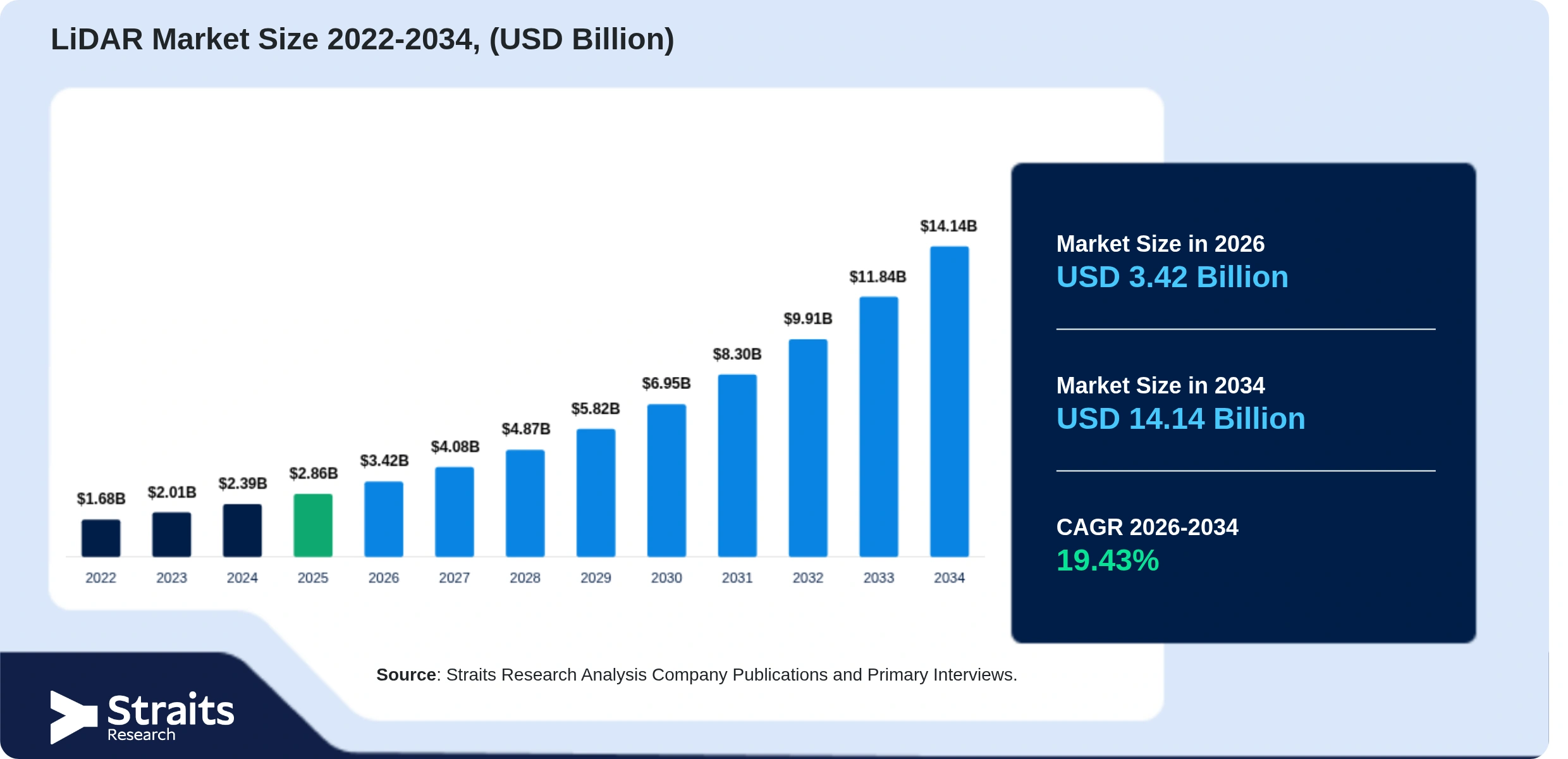
The global LiDAR market is experiencing strong growth as automotive manufacturers, infrastructure developers, surveying companies, and industrial automation providers increasingly adopt laser-based sensing technologies. The market was valued at USD 2.86 billion in 2025 and is projected to reach USD 14.14 billion by 2034, registering a CAGR of 19.43% during the 2026–2034 forecast period. Asia Pacific held the largest regional market share of 35.4% in 2025, supported by demand for advanced mobility and infrastructure mapping solutions.
LiDAR, or Light Detection and Ranging, uses laser pulses to measure distances and generate precise three-dimensional representations of objects and surroundings. Its applications include autonomous vehicles, surveying, construction, robotics, environmental monitoring, and geospatial data collection.
Request Sample: http://straitsresearch.com/report/lidar-market/request-sample
LiDAR Market Size and Forecast
The global LiDAR market was valued at USD 2.86 billion in 2025 and is expected to grow from USD 3.42 billion in 2026 to USD 14.14 billion by 2034. The market is projected to register a CAGR of 19.43% during the forecast period.
Growing adoption across automotive, infrastructure, surveying, and industrial applications is supporting demand for accurate spatial measurement and real-time environmental perception. LiDAR systems provide detailed distance measurements and three-dimensional data, making them valuable for autonomous navigation, terrain assessment, construction planning, and industrial sensing.
North America is projected to be the fastest-growing regional market, registering a CAGR of 21.6% during the forecast period.
LiDAR Market Trends
Transition Toward FMCW 4D LiDAR
Frequency-modulated continuous-wave (FMCW) LiDAR is gaining attention as automotive manufacturers seek precise object detection and real-time motion awareness. Unlike conventional time-of-flight systems, FMCW LiDAR measures both distance and radial velocity, helping identify moving vehicles, pedestrians, and other road users. This capability is supporting its adoption in autonomous driving and advanced driver-assistance systems (ADAS), while encouraging the development of more detailed vehicle-perception technologies.
Shift Toward Compact Solid-State LiDAR
Demand for smaller sensor packages and improved reliability is supporting the transition toward compact solid-state LiDAR architectures. Electronic beam steering, optical arrays, and vertical-cavity surface-emitting laser (VCSEL) arrays are helping manufacturers develop sensor designs with fewer moving mechanical components. These systems offer integration potential across vehicle bodies, robotics platforms, and industrial sensing equipment.
LiDAR Market Drivers
Expansion of Autonomous Vehicle Testing
Autonomous vehicle testing is creating demand for LiDAR systems that support accurate distance measurement and real-time environmental mapping. Automotive manufacturers and autonomous driving developers use these sensors to evaluate obstacle detection, pedestrian recognition, and vehicle navigation under different road conditions. LiDAR-based testing helps identify nearby vehicles, road boundaries, and unexpected obstacles, supporting demand for automotive-grade sensors and related equipment.
Growing Adoption in Infrastructure Mapping
Infrastructure mapping applications are supporting demand for precise three-dimensional spatial data across construction, transportation, and urban development projects. Government agencies and engineering firms use LiDAR surveys to assess terrain, monitor construction progress, and plan road networks. Aerial LiDAR surveys, for example, help map road corridors and identify elevation changes before highway construction, creating demand for airborne and terrestrial systems.
Additional Factors Supporting Market Growth
Other factors contributing to market expansion include the use of LiDAR in industrial automation, drone-based surveying, and advanced driver-assistance systems. Automated warehouses and manufacturing facilities use LiDAR sensors to support robotic navigation and obstacle detection. Drone-based LiDAR payloads provide terrain and vegetation measurements for agriculture, mining, forestry, and construction, while automotive suppliers use the technology for object recognition and distance measurement.
LiDAR Market Challenges
The supplied report information does not identify specific market restraints or challenges. Therefore, no additional challenge factors are included here to avoid introducing information beyond the provided market data.
LiDAR Market Opportunities
Automotive and Autonomous Mobility Applications
The ADAS and autonomous vehicles segment accounted for 24.8% of the LiDAR market in 2025. Autonomous vehicle development and the integration of advanced driving systems create opportunities for LiDAR sensors used in object detection, distance measurement, obstacle recognition, and environmental perception. FMCW technology, with a projected CAGR of 26.9%, also represents an important area of technological development.
Robotics and Industrial Automation
The robotics and industrial automation application segment is projected to grow at a CAGR of 24.1% during the forecast period. Automated navigation, warehouse robotics, industrial sensing, and precise object positioning are supporting demand for LiDAR-based perception systems. This creates opportunities for sensor manufacturers serving industrial automation providers and robotics developers.
Geospatial Mapping and Infrastructure Development
Government mapping initiatives and infrastructure projects across regions are creating opportunities for airborne, terrestrial, and spaceborne LiDAR systems. Applications include terrain modeling, road-condition monitoring, infrastructure planning, and environmental observation. India's nationwide high-resolution topographical mapping target for 2030 and Canada's expansion of LiDAR-derived elevation data illustrate the potential for geospatial applications.
LiDAR Market Segmentation
The LiDAR market is segmented by component, technology, product type, application, and region.
By Component
The laser scanners/source segment led the component category with a market share of 31.6% in 2025, reflecting its essential role in capturing distance measurements and generating spatial data. The software/data processing segment is projected to grow at a CAGR of 21.7%, supported by demand for real-time data analysis, point-cloud processing, and accurate 3D mapping.
By Technology
Time-of-flight (ToF) technology accounted for 67.8% of the market in 2025, supported by its established use in distance measurement and suitability across multiple applications. FMCW technology is projected to register the fastest growth, with a CAGR of 26.9%, owing to its ability to measure object velocity directly and support demanding sensing environments.
By Type
Mechanical rotating LiDAR held a market share of 28.7% in 2025 due to its established scanning capabilities and broad environmental coverage. The solid-state optical phased array (OPA) segment is projected to grow at a CAGR of 28.4%, supported by advances in beam steering, compact designs, and demand for durable sensing solutions.
By Installation Type
Airborne LiDAR accounted for 38.6% of the market in 2025, supported by its use in large-area mapping, terrain modeling, and extensive surveying projects. Spaceborne LiDAR is expected to grow at a CAGR of 22.6%, driven by satellite-based Earth observation, environmental monitoring, and large-scale geospatial data collection.
By Range
The short-range segment, covering distances below 200 meters, held a market share of 42.3% in 2025. Its adoption is supported by close-range detection and obstacle identification requirements across automotive, robotics, and industrial environments. The medium-range segment, covering 200–500 meters, is projected to grow at a CAGR of 18.1%.
By Application and End User
ADAS and autonomous vehicles accounted for 24.8% of the market in 2025, while robotics and industrial automation is projected to grow at a CAGR of 24.1%. By end user, automotive and transportation held a share of 27.9% in 2025. Utilities and energy is projected to grow at a CAGR of 18.6%, supported by infrastructure inspection, power-line monitoring, and energy asset management.
LiDAR Market Regional Analysis
Asia Pacific
Asia Pacific dominated the global LiDAR market with a share of 35.4% in 2025. Autonomous mobility initiatives and smart-infrastructure projects across China and Japan are supporting demand for high-precision sensing systems. India's high-resolution topographical mapping target and the deployment of 3D laser-based sensors in national-highway surveys are also creating opportunities for LiDAR in geospatial mapping and infrastructure planning.
North America
North America is projected to be the fastest-growing regional market, registering a CAGR of 21.6%. Automated vehicle development in the U.S. and high-resolution terrain mapping initiatives in Canada are supporting regional demand. LiDAR applications include vehicle perception, autonomous navigation, flood-risk assessment, forestry, and infrastructure planning.
Europe
Europe's market growth is supported by automated mobility initiatives and vehicle-safety requirements. The European Commission's ADACities initiative targets fleets of at least 100 autonomous vehicles in participating cities by 2030. These developments create opportunities for LiDAR sensors in autonomous driving, collision avoidance, and intelligent transportation systems.
Other Regions
The report also covers the Middle East and Africa and Latin America as part of the global regional analysis.
LiDAR Market Key Players
The LiDAR market includes established sensor manufacturers, specialized technology developers, automotive suppliers, robotics companies, and emerging startups. Ouster, Hesai Technology, and Luminar Technologies are identified as leading players, collectively accounting for an estimated 17% of the global market share.
Key companies operating in the market include:
-
Ouster, Inc.
-
Hesai Technology Co., Ltd.
-
Luminar Technologies, Inc.
-
Innoviz Technologies Ltd.
-
Aeva Technologies, Inc.
-
Cepton, Inc.
-
RoboSense Technology Co., Ltd.
-
Leica Geosystems AG
-
Hexagon AB
-
Trimble Inc.
-
Teledyne Technologies Incorporated
-
SICK AG
-
Velodyne Lidar, Inc.
-
RIEGL Laser Measurement Systems GmbH
-
Topcon Corporation
Companies compete through measurement accuracy, detection range, point-cloud resolution, product reliability, manufacturing scale, system integration, and relationships with automotive and industrial customers.
Recent Developments in the LiDAR Market
In January 2026, Aeva announced that its FMCW 4D LiDAR technology had been selected as a reference sensor for NVIDIA's DRIVE Hyperion autonomous vehicle platform. The collaboration targets production vehicle programs with a planned start of production in 2028.
In April 2026, Hesai Group introduced its EXT LiDAR sensor, combining spatial and colour detection in a single device using its proprietary Picasso chip. Mass production was planned for later in 2026, with initial deployment in flagship vehicles expected in 2027.
Conclusion
The global LiDAR market is projected to expand significantly, growing from USD 2.86 billion in 2025 to USD 14.14 billion by 2034 at a CAGR of 19.43%. Autonomous vehicle testing, infrastructure mapping, industrial automation, and geospatial applications are supporting market demand. FMCW and solid-state technologies, along with opportunities in robotics, automotive systems, and spaceborne mapping, are expected to remain important areas of market development.
Report: http://straitsresearch.com/report/lidar-market
 English
 Arabic
 French
 Spanish
 Portuguese
 Deutsch
 Turkish
 Dutch
 Italiano
 Russian
 Romaian
 Portuguese (Brazil)
 Greek
