
Global Auto Insurance Market Analysis: Key Players, Trends, and Forecast to 2034
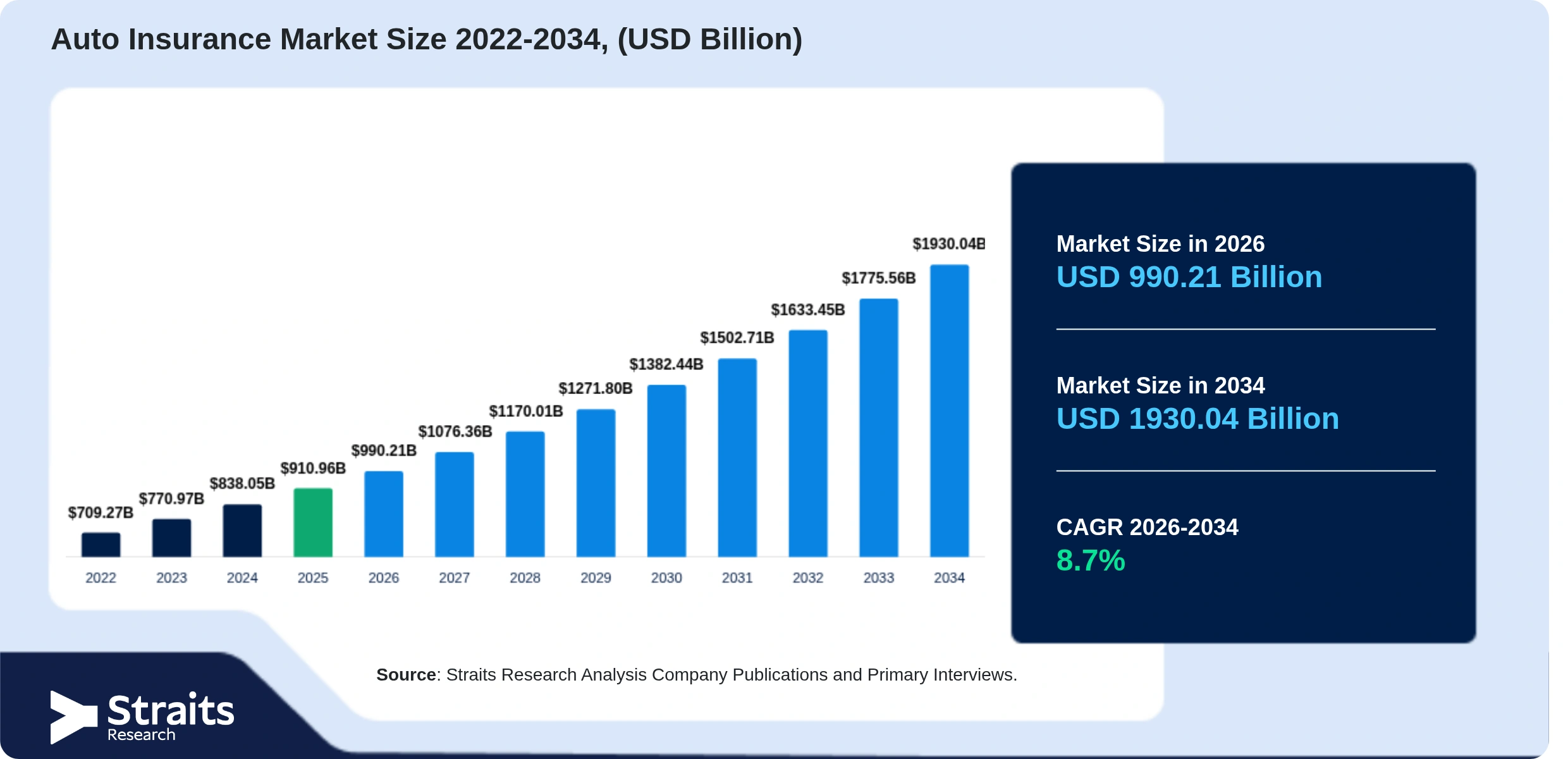
Auto Insurance Market Size, Share, Trends, and Forecast, 2026–2034
Market Overview
The global auto insurance market is experiencing significant expansion as vehicle ownership, mandatory insurance regulations, and demand for financial protection continue to support policy adoption. The market is also evolving through digital insurance platforms, telematics-based policies, and artificial intelligence (AI)-enabled claims assessment. These developments are encouraging insurers to improve risk evaluation, personalize premiums, and streamline customer services.
Auto insurance provides financial protection against losses arising from vehicle accidents, theft, damage, and third-party liabilities. Depending on policy terms, coverage can include vehicle repairs, medical expenses, property damage, and legal liabilities. Both individual vehicle owners and commercial fleet operators rely on insurance policies to manage financial risks associated with vehicle ownership and operation.
Request Sample: http://straitsresearch.com/report/auto-insurance-market/request-sample
Market Size and Forecast
The global auto insurance market size was valued at USD 910.96 billion in 2025 and is projected to grow from USD 990.21 billion in 2026 to USD 1,930.04 billion by 2034, registering a CAGR of 8.7% during the forecast period from 2026 to 2034. North America dominated the market with a 36.4% share in 2025, while Asia Pacific is projected to be the fastest-growing regional market at a CAGR of 8.35%.
Market expansion is supported by the growing number of insured vehicles, compulsory third-party liability requirements, and demand for broader coverage. Digital distribution, usage-based insurance models, and automated claims processing are also changing how insurers develop and deliver policies.
Market Drivers
Growth in Vehicle Ownership
Growth in passenger and commercial vehicle ownership expands the customer base for auto insurance providers. New vehicle purchases generate demand for insurance policies, while annual renewals provide recurring premium income. Vehicle buyers commonly obtain comprehensive insurance through dealerships before taking delivery, supporting demand for both third-party liability and broader vehicle protection.
Mandatory Insurance Regulations
Mandatory motor insurance regulations create consistent demand by requiring vehicle owners to maintain at least third-party liability coverage. These requirements encourage policy purchases during vehicle registration and renewal, while regulatory enforcement supports compliance. For example, vehicle owners in India must hold valid third-party insurance to legally operate vehicles on public roads.
Market Challenges
Higher Claims and Repair Costs
Increasing repair and vehicle replacement costs create financial pressure for insurers by raising the value of accident-related claims. Higher automotive parts, labor, and replacement vehicle expenses can affect claim settlement costs and insurance premiums. In Canada, the Financial Services Regulatory Authority of Ontario projects future loss trends of 3.1%–6.9% across private passenger auto coverages, with collision coverage losses projected to increase by 6.6%–10.6%.
Road Accident and Liability Exposure
Road accidents expose insurers to vehicle damage, medical expenses, and third-party compensation liabilities. These risks can increase claims frequency and settlement expenses, creating challenges for underwriting and profitability. Insurers therefore need effective risk assessment and coverage pricing to manage their exposure across personal and commercial vehicle categories.
Market Opportunities
Adoption of Usage-Based Insurance
Telematics-based usage-based insurance creates opportunities for insurers to offer premiums aligned with individual driving behavior. Devices and smartphone applications collect information such as mileage, acceleration, braking intensity, and driving duration, allowing insurers to assess driver risk more precisely. Pay-as-you-drive and pay-how-you-drive policies can support flexible coverage and potential premium discounts for safer drivers.
AI-Based Claims Assessment
Artificial intelligence and image recognition technologies offer opportunities to improve claims management. These tools can evaluate vehicle damage from photographs, estimate repair costs, and identify inconsistencies in submitted claims. Faster verification and automated processing can help insurers streamline settlement activities and improve customer service.
Specialized Electric Vehicle Coverage
Electric vehicle adoption creates opportunities for specialized auto insurance products covering electric vehicles and their associated components. Japan's electrification targets, China's new energy vehicle ambitions, and India's electric vehicle adoption objectives provide potential demand areas for EV-specific insurance and battery-related protection.
Market Segmentation
By Coverage
Third-party liability coverage held the largest market share at 58.7% in 2025, supported by mandatory insurance requirements and its role in covering damages or injuries caused to third parties. Its regulatory importance and affordability reinforce its leading position.
Collision/comprehensive/other optional coverage is projected to register a CAGR of 7.45%, driven by demand for broader financial protection against vehicle accidents, theft, and unexpected damage. Greater preference for enhanced vehicle protection supports adoption.
By Distribution Channel
Insurance agents/brokers accounted for the largest market share at 45.6% in 2025, supported by personalized policy recommendations, coverage comparisons, and claims assistance. Established customer relationships and advisory services reinforce their position.
Direct response is projected to record the highest CAGR of 8.25%, supported by online insurance platforms and digital policy purchasing. Convenient comparisons, faster quotations, and simplified purchasing processes encourage adoption.
By Vehicle Age
New vehicles are projected to register a CAGR of 7.35%, supported by vehicle sales and the need for insurance protection at the time of purchase. Financing requirements and dealership insurance partnerships further support policy adoption.
Used vehicles are projected to register a CAGR of 6.45%, driven by the substantial presence of pre-owned vehicles and continued insurance requirements throughout vehicle ownership. Their large installed base sustains demand for coverage.
By Application
Personal applications are projected to register a CAGR of 6.65%, supported by private vehicle ownership and the need for protection against accidents and third-party liabilities. Mandatory coverage requirements and individual vehicle ownership sustain demand.
Commercial applications are projected to record a CAGR of 7.4%, driven by logistics, transportation, and fleet operations. Demand for protection against operational risks and business-related liabilities supports adoption.
Regional Analysis
North America
North America dominated the auto insurance market with a 36.4% share in 2025. In the U.S., projected growth in vehicle miles traveled supports long-term demand for insurance coverage as vehicle usage expands. In Canada, projected increases in private passenger auto insurance losses, particularly collision coverage losses, indicate continued pressure on claims costs and premiums.
Asia Pacific
Asia Pacific is expected to be the fastest-growing regional market, registering a CAGR of 8.35% during 2026–2034. Japan's electrification and charging infrastructure targets, China's new energy vehicle adoption objectives, and India's electric vehicle penetration ambitions create opportunities for specialized EV insurance and battery-related coverage.
Europe
Europe accounted for 27.8% of the global auto insurance market in 2025. The U.K.'s zero-emission vehicle targets and Germany's objective of expanding its fully electric passenger vehicle fleet are encouraging opportunities for EV-specific coverage, battery protection, and specialized repair insurance.
Key Players
The global auto insurance market is fragmented, with established insurers, regional providers, digital insurance platforms, brokers, and insurtech companies competing across coverage and distribution categories. Competition primarily focuses on premium pricing, claims settlement efficiency, financial strength, policy coverage, distribution networks, and customer service.
Key companies operating in the market include:
-
Allianz SE
-
Allstate Insurance Company
-
Admiral Group plc
-
Berkshire Hathaway Inc.
-
China Pacific Insurance (Group) Co., Ltd.
-
GEICO
-
Ping An Insurance (Group) Company of China, Ltd.
-
State Farm Mutual Automobile Insurance Company
Conclusion
The auto insurance market is projected to expand steadily through 2034, supported by vehicle ownership, mandatory insurance regulations, and demand for financial protection. North America remains the largest regional market, while Asia Pacific offers strong growth potential. Third-party liability coverage and insurance agents/brokers maintain leading positions, while direct response distribution and comprehensive coverage support evolving market opportunities.
Technological developments such as telematics-based insurance and AI-powered claims assessment are changing risk evaluation, premium personalization, and claims processing. Electric vehicle adoption is also creating opportunities for specialized insurance products and battery protection.
Report: http://straitsresearch.com/report/auto-insurance-market

 English
 Arabic
 French
 Spanish
 Portuguese
 Deutsch
 Turkish
 Italiano
 Russian
 Romaian
 Portuguese (Brazil)
 Greek
