
The Rising Role of Plasmid DNA in Next-Generation Gene Therapies
Viral Vector Plasmid DNA Manufacturing Market: Size, Share, Trends and Forecast, 2026–2034
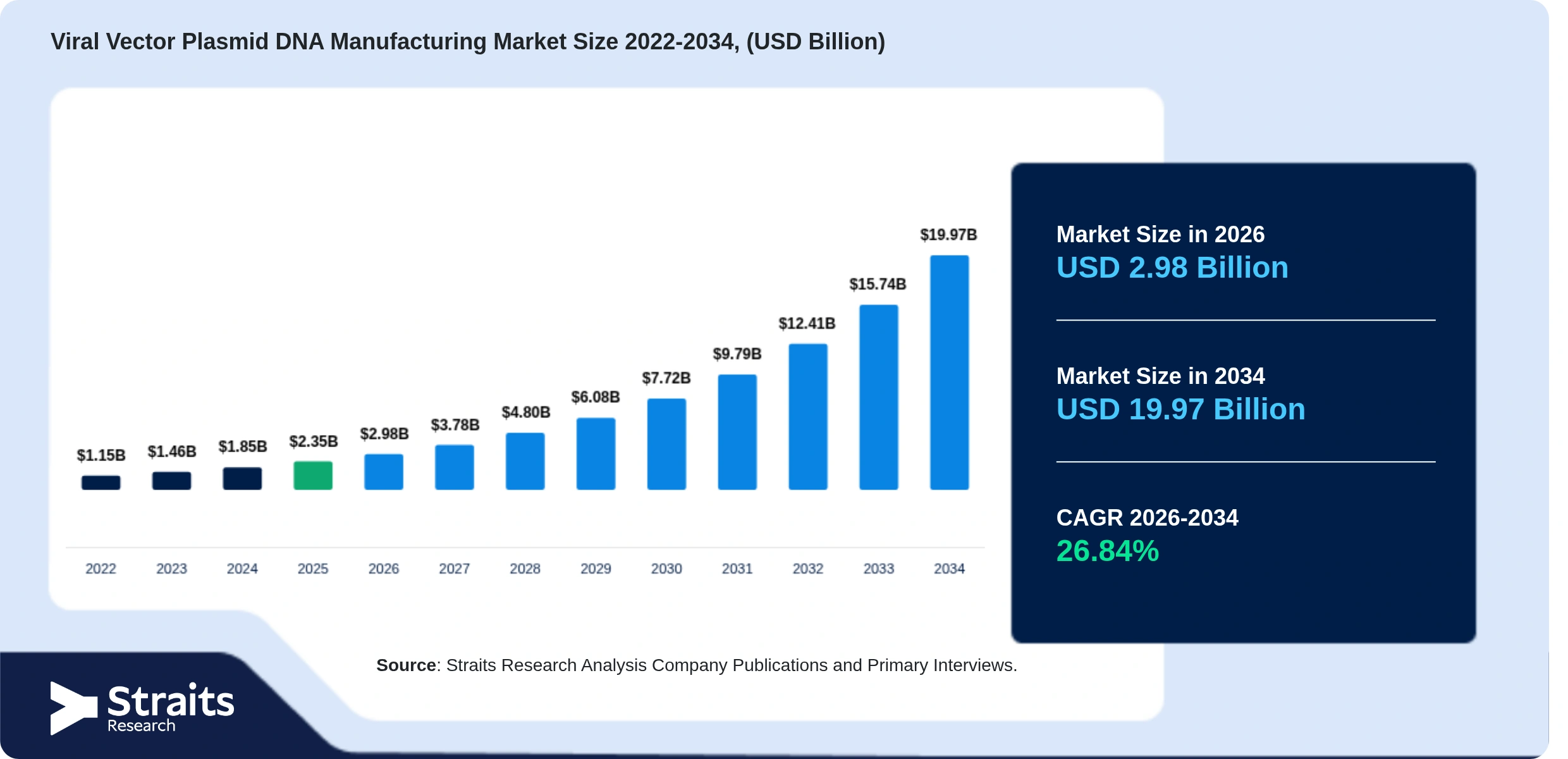
The global viral vector plasmid DNA manufacturing market is expanding as gene therapy, cell therapy, and viral vector-based vaccine development create demand for reliable plasmid DNA and viral vector production. The market was valued at USD 2.35 billion in 2025 and is projected to reach USD 19.97 billion by 2034, growing at a CAGR of 26.84% during 2026–2034. North America held the largest regional share at 41.5% in 2025, while Europe is expected to record the fastest regional growth.
Viral vector plasmid DNA manufacturing involves producing engineered viral vectors and plasmid DNA used in advanced therapies, vaccines, and genetic research. Specialized manufacturing processes, including genetic engineering, microbial fermentation, cell culture, purification, and quality testing, help supply the materials required for developing and producing these treatments.
Market Size and Forecast
The global viral vector plasmid DNA manufacturing market was valued at USD 2.35 billion in 2025. Its value is expected to increase from USD 2.98 billion in 2026 to USD 19.97 billion by 2034, registering a CAGR of 26.84% over the forecast period.
The expansion of gene therapy clinical pipelines, demand for viral vector-based vaccines, and investment in advanced biopharmaceutical research are supporting this growth. Pharmaceutical and biopharmaceutical companies represent a major end-user group, accounting for 72.6% of the market in 2025. Gene therapy was the leading application, with a 42.9% share, reflecting the importance of viral vectors in delivering therapeutic genetic material.
Market Drivers
Expansion of Gene Therapy Clinical Pipelines
The growing number of gene therapy candidates entering clinical trials is generating demand for plasmid DNA used in viral vector development and production. These materials are required during vector design, process development, clinical manufacturing, and production scale-up. AAV-based therapies for inherited retinal disorders and neuromuscular diseases are examples of applications that use plasmid DNA to produce therapeutic viral vectors. The expansion of clinical pipelines is encouraging specialized manufacturers to strengthen research-grade and clinical-grade plasmid DNA supply.
Growing Demand for Viral Vector-Based Vaccines
Viral vector-based vaccine development is creating additional demand for plasmid DNA used to generate recombinant viral vectors. Vaccine developers require consistent plasmid supplies for research, process development, and clinical or commercial manufacturing. Adenoviral vector vaccines, for example, use plasmid DNA to support the production of vectors carrying selected antigen genes. These requirements are creating opportunities for specialized manufacturing providers and contract development and manufacturing organizations (CDMOs).
Market Challenges
Viral vector plasmid DNA manufacturing requires specialized production infrastructure, technical expertise, and stringent quality control. Manufacturing processes must support plasmid identity, purity, integrity, and consistency to meet the requirements of advanced therapy development. Analytical methods such as capillary electrophoresis, next-generation sequencing, and advanced chromatography add important quality-characterization capabilities, while also increasing the technical demands placed on manufacturers.
The need for reliable production capacity across research, clinical, and commercial stages also places pressure on manufacturers to maintain consistent processes and supply partnerships. Companies must manage upstream activities such as vector amplification and recovery alongside downstream purification and fill-finish operations. These requirements make manufacturing scalability, process consistency, and quality assurance important considerations for market participants.
Market Opportunities
High-Throughput Plasmid DNA Production
High-throughput plasmid DNA production platforms offer opportunities for manufacturers seeking to supply larger and more consistent volumes of plasmid materials. Optimized microbial fermentation, automated cell harvesting, filtration, and chromatography can support the production of transfer, packaging, and helper plasmids used in viral vector development. These capabilities can help CDMOs scale batch production and strengthen their ability to serve expanding gene therapy manufacturing pipelines.
Advanced Plasmid Quality Characterization
Advanced analytical technologies create opportunities to improve plasmid DNA characterization and quality assurance. Capillary electrophoresis, next-generation sequencing, and advanced chromatography support the assessment of plasmid identity, purity, integrity, and residual impurities. Manufacturers that strengthen these capabilities can provide well-characterized plasmid DNA for viral vector production and support quality requirements across advanced therapy manufacturing.
Market Segmentation
By Vector Type
AAV held the largest share of the viral vector plasmid DNA manufacturing market at 29.4% in 2025. Its ability to deliver genetic material into target cells with relatively low immunogenicity and its widespread use in gene therapy development support its leading position, particularly in treatments for inherited and rare diseases.
Lentivirus is projected to register the highest CAGR of 22.4%. Its ability to deliver genetic material into dividing and non-dividing cells supports its use in cell and gene therapies, including CAR T-cell development.
By Workflow
Downstream activities accounted for the largest workflow share at 53.2% in 2025. Purification and fill-finish operations are important for achieving product quality, purity, and safety, supporting the segment's position in viral vector manufacturing.
Downstream activities are projected to grow at a CAGR of 19.9%, compared with 19.1% for upstream activities. Demand for effective purification and fill-finish processes, alongside manufacturing consistency and regulatory compliance requirements, is expected to support downstream growth.
By Application
Gene therapy represented the largest application segment, accounting for 42.9% of the market in 2025. Viral vectors are used to deliver therapeutic genetic material into target cells, supporting the development of treatments for inherited disorders and other serious diseases.
Gene therapy is also projected to record the highest application CAGR of 22.1%. Expanding clinical pipelines, advancements in genetic medicine, and investment in targeted treatments are expected to sustain demand for viral vector plasmid DNA manufacturing.
By End User
Pharmaceutical and biopharmaceutical companies accounted for the largest end-user share at 72.6% in 2025. Their extensive involvement in developing and commercializing viral vector-based therapies supports demand for plasmid DNA manufacturing services.
Research institutes are projected to grow at a CAGR of 17.2%, supported by their involvement in early-stage gene therapy research, vector development, and preclinical studies. Pharmaceutical and biopharmaceutical companies are expected to register a CAGR of 20.3%.
By Disease
Cancer held the largest disease-related market share at 38.7% in 2025. The use of viral vectors in gene therapies, engineered cell therapies, and targeted cancer treatments supports its leading position.
Genetic disorders are projected to record the highest CAGR of 22.6%. The development of therapies for inherited conditions and rare genetic diseases, alongside advances in gene delivery technologies, is expected to support demand.
Regional Analysis
North America
North America dominated the viral vector plasmid DNA manufacturing market with a 41.5% share in 2025. In the U.S., a 2026 study published in Drug Discovery Today projects approximately 79 additional durable cell and gene therapy product-indication approvals by 2034, potentially expanding demand for plasmid DNA used in viral vector development and manufacturing.
In Canada, government investment of CAD 2.2 billion across 38 biomanufacturing projects includes CAD 39.8 million to expand BIOVECTRA’s mRNA and plasmid DNA manufacturing capabilities. The National Research Council’s 2026–2027 plan also includes developing a national platform for viral vector-based gene therapies.
Europe
Europe is expected to be the fastest-growing regional market, registering a CAGR of 21.7% during 2026–2034. In the U.K., the Life Sciences Sector Plan commits up to £520 million through the Life Sciences Innovative Manufacturing Fund to strengthen domestic biopharmaceutical manufacturing. NHS Blood and Transplant also received a £9.43 million government grant to expand plasmid DNA and viral vector production capacity.
Germany’s 2025 National Strategy for Gene and Cell-Based Therapies recommends establishing a central national production facility for critical starting materials, including lentiviral and retroviral vectors. This initiative addresses supply delays and creates opportunities to expand domestic manufacturing capacity.
Asia Pacific
Asia Pacific accounted for 22.6% of the market in 2025. Japan’s regenerative medicine and gene therapy market is projected to reach approximately JPY 850.5 billion by 2030, while AMED supports domestic AAV production cell lines, viral vector manufacturing platforms, and CDMO capabilities.
China’s 2026–2030 pharmaceutical industry plan targets annual growth of at least 20% in the innovative drug sector. In India, the target of developing a USD 300 billion bioeconomy by 2030, including a projected USD 100 billion contribution from biopharmaceuticals, is supported by initiatives such as the National Biofoundry Network and BioE3 policy.
Middle East and Africa and Latin America
The Middle East and Africa and Latin America are also included in the market's regional coverage. The supplied report data does not provide specific market shares, growth rates, or country-level developments for these regions.
Key Players
The viral vector plasmid DNA manufacturing market includes biopharmaceutical manufacturers, CDMOs, gene therapy technology providers, and specialized plasmid DNA manufacturers. Competition is shaped by manufacturing capacity, plasmid purity, product quality, scalability, regulatory compliance, process consistency, and technical expertise.
The leading companies identified in the market include:
-
WuXi Biologics (Cayman) Inc.
-
Shanghai Chem Partner Co., Ltd.
-
GenScript Biotech Corporation
-
MabPlex International Co., Ltd.
-
WuXi AppTec Co., Ltd.
-
JHL Biotech, Inc.
-
Boehringer Ingelheim International GmbH
-
Thousand Oaks Biopharmaceuticals, Inc.
The five leading players are estimated to collectively account for approximately 10–15% of the global market, although this is an indicative estimate because their exact combined share in this specific market is not publicly disclosed.
Recent industry developments include Charles River Laboratories’ expansion of plasmid DNA and viral vector CDMO capabilities in April 2026, SK pharmteco’s additional viral vector manufacturing capacity in February 2026, and Aldevron’s expanded high-yield GMP plasmid DNA manufacturing platform in October 2025.
Conclusion
The viral vector plasmid DNA manufacturing market is positioned for substantial growth through 2034, supported by expanding gene therapy pipelines, viral vector-based vaccine development, and investment in advanced biopharmaceutical manufacturing. AAV remains the leading vector type, gene therapy dominates application demand, and North America holds the largest regional share. Meanwhile, Europe is expected to grow at the fastest regional pace.
Manufacturing scalability, advanced purification, and improved plasmid characterization are important areas shaping the competitive landscape. Companies with specialized production capabilities and reliable quality systems are positioned to address the material requirements of expanding cell and gene therapy programs.
Report: http://straitsresearch.com/report/viral-vector-plasmid-dna-manufacturing-market

 English
 Arabic
 French
 Spanish
 Portuguese
 Deutsch
 Turkish
 Italiano
 Russian
 Romaian
 Portuguese (Brazil)
 Greek
