
One Sitting Degree vs Regular Degree: Key Differences in 2026
Education plays an important role in building professional knowledge and creating better career opportunities. However, not every student completes their education according to the traditional academic schedule. Some students discontinue college because of financial problems, family responsibilities, employment, or personal circumstances. After taking a break, they often search for options such as a One Sitting Degree or flexible graduation programmes.
A regular degree and a One Sitting Degree are frequently discussed among students who want to complete their higher education. However, both terms have different meanings, academic structures, and recognition considerations.
Before choosing any graduation programme, students should understand the differences between these options, including eligibility, course duration, admission requirements, learning methods, and degree validity.
1. What Is a One Sitting Degree?
A One Sitting Degree is a commonly used term in the education market for programmes advertised as allowing students to complete graduation through a single examination session or a shortened academic process.
Such advertisements often attract college dropouts, working professionals, and graduates who have experienced a long study gap.
However, students must understand that a university cannot award a recognised degree simply through a single examination unless the programme follows an applicable and legally permitted academic framework.
A recognised bachelor's degree must meet the prescribed curriculum, duration, credit requirements, examination standards, and other applicable regulations.
Students interested in completing an incomplete graduation should explore legitimate options such as re-admission, credit transfer, academic credit recognition, or other university-approved completion pathways.
2. What Is a Regular Degree?
A regular degree is an undergraduate or postgraduate qualification pursued through a structured academic programme offered by a recognised university or college.
Students generally attend scheduled classes, complete assignments, participate in academic activities, and appear for examinations according to the prescribed academic calendar.
Popular undergraduate regular degree programmes include:
-
BA – Bachelor of Arts
-
BCom – Bachelor of Commerce
-
BBA – Bachelor of Business Administration
-
BCA – Bachelor of Computer Applications
-
BSc – Bachelor of Science
-
BTech – Bachelor of Technology
Most standard bachelor's degree programmes have a prescribed duration of three or four years, depending on the course and applicable academic framework.
A regular degree provides structured classroom learning, faculty interaction, practical activities, and opportunities for campus participation.
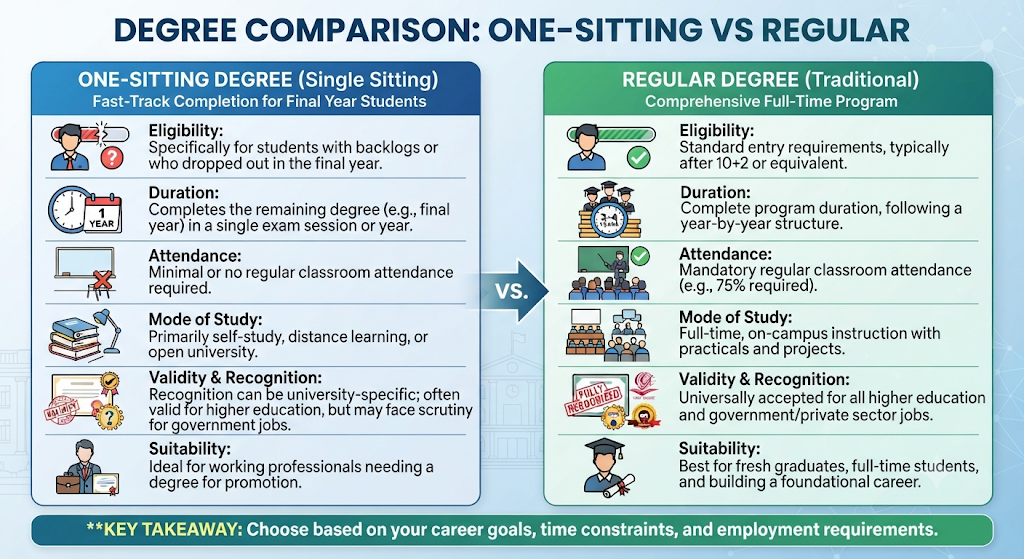
3. One Sitting Degree vs Regular Degree: Key Differences
Understanding the differences between these terms is important before making an educational decision.
|
Comparison |
One Sitting Degree |
Regular Degree |
|
Meaning |
Commonly marketed as accelerated or single-session completion |
Structured university degree programme |
|
Duration |
Often advertised as shorter; claims require verification |
Prescribed duration according to programme regulations |
|
Learning method |
Varies by advertised arrangement |
Scheduled classroom-based learning |
|
Admission |
Depends on the actual university-approved pathway |
Standard university admission procedure |
|
Examinations |
May be advertised as a single examination |
Examinations throughout the programme |
|
Recognition |
Must be independently verified |
Depends on university and programme recognition |
|
Academic structure |
May lack a clearly explained approved structure |
Follows a defined curriculum and credit framework |
|
Student interaction |
Varies by arrangement |
Regular interaction with teachers and classmates |
The most important difference is that a regular degree follows an established academic structure, while the term One Sitting Degree does not itself identify a recognised or approved degree pathway.
4. Eligibility Requirements for Regular Degree Courses
Students interested in regular graduation programmes generally need to meet the admission requirements of their selected university.
Common eligibility requirements include:
-
Completion of Class 12 from a recognised board.
-
Minimum qualifying marks as prescribed by the institution.
-
Required subject combinations for specialised programmes.
-
Entrance examination scores, where applicable.
-
Submission of academic certificates and identity documents.
For example, students interested in BSc programmes may need to meet specific science or mathematics requirements, depending on the specialisation.
Similarly, BBA, BA, BCom, and BCA programmes may have different eligibility conditions depending on the institution.
Students who have discontinued their education should check whether they qualify for fresh admission or an approved credit transfer arrangement.
5. What Are the Alternatives to One Sitting Graduation?
Students who have discontinued their studies do not necessarily need to restart their academic journey without considering their previous achievements.
Several legitimate education pathways may be available.
A. Re-Admission to Complete Graduation
Students who previously enrolled in a degree programme may contact their university to understand whether re-admission or continuation is permitted.
The university can explain the applicable academic rules, maximum completion period, examination requirements, and remaining credits.
B. Credit Transfer
Credit transfer may allow eligible academic credits earned from a recognised institution to be considered by another institution, subject to applicable regulations and university policies.
Students should verify course equivalence, credit validity, and the number of credits accepted before taking admission.
C. Online Degree Programmes
Online education offers digital learning opportunities for students who cannot attend regular classroom sessions.
Programmes such as online BA, BCom, BBA, BCA, and other eligible courses may provide flexible study arrangements.
D. Distance Education Programmes
Distance education is another option for students who prefer independent learning and flexible study schedules.
Students should select programmes offered by universities with the required UGC-DEB recognition or entitlement for the relevant academic session.
6. Which Option Is Better for Working Professionals?
Working professionals often find it difficult to attend daily college classes because of employment commitments, business responsibilities, or family obligations.
For these learners, online and distance education programmes may offer more flexibility than traditional classroom-based courses.
Some potential advantages include:
Flexible Learning: Students can access study materials and learning resources according to the programme's schedule.
Career Development: Completing a recognised graduation qualification may help professionals meet eligibility requirements for certain jobs and higher education programmes.
Work and Study Balance: Flexible learning arrangements can make it easier to manage professional and academic responsibilities.
Multiple Course Choices: Students can explore BA, BCom, BBA, BCA, and other undergraduate programmes according to their interests and eligibility.
However, working professionals should avoid choosing programmes solely because they promise graduation in a few months.
7. Is a One Sitting Degree Valid in India?
This is one of the most important questions students should consider before applying.
The validity of a degree depends on the university, programme, mode of education, academic structure, and applicable regulatory requirements.
A qualification advertised as a One Sitting Degree is not automatically recognised simply because an institution or admission agent offers it.
Before taking admission, students should:
-
Verify the university's recognition status.
-
Check the specific programme's approval or entitlement.
-
Review the officially prescribed course duration.
-
Confirm the examination and credit requirements.
-
Verify whether the university permits the proposed admission or credit transfer arrangement.
-
Obtain written information about the final qualification.
For online and distance programmes, students should check the University Grants Commission and Distance Education Bureau (UGC-DEB) website for the relevant academic session.
Choosing a recognised academic programme is important for further studies, employment, and other professional requirements.
8. How to Choose the Right Degree Programme?
Selecting the right graduation programme requires careful planning. Students should consider their academic background, professional goals, financial situation, and available study time.
Here are some useful points to evaluate:
Choose the Right Course: Select a subject that matches your interests and career plans.
Check University Recognition: Verify the institution and the programme's status before applying.
Understand Course Duration: Review the prescribed duration and academic requirements.
Compare Learning Modes: Decide whether regular, online, or distance education is more suitable.
Review Fees: Understand tuition fees, examination charges, and additional expenses.
Ask About Credit Transfer: If you have previously completed semesters or earned credits, check whether they can be considered.
A well-informed decision can help students avoid misleading admission offers and select a suitable educational pathway.
9. Career Opportunities After Completing a Recognised Degree
A recognised graduation qualification can provide access to several employment and higher education opportunities, depending on the student's subject, skills, and eligibility.
Some possible pathways include:
-
Government and private-sector employment, subject to recruitment rules.
-
Postgraduate education such as MBA, MA, MCom, MCA, or MSc, subject to eligibility.
-
Professional certifications and specialised training.
-
Banking and financial services.
-
Business administration and management.
-
IT and computer-related careers.
-
Entrepreneurship and self-employment.
The career opportunities available depend on the chosen degree, practical skills, experience, and employer requirements.
Conclusion
The comparison of One Sitting Degree vs Regular Degree highlights the importance of understanding recognised academic pathways before taking admission.
A regular degree follows a structured university curriculum with a prescribed duration, academic credits, and examinations. On the other hand, One Sitting Degree is a commonly marketed term that should be examined carefully because it does not automatically represent a recognised academic programme.
Students who have discontinued their studies can explore re-admission, credit transfer, online education, and distance learning through eligible universities.
Before selecting any programme, verify university recognition, programme entitlement, course duration, and applicable academic regulations. A legitimate degree qualification can help students continue their education and work towards their long-term career goals.

 English
 Arabic
 French
 Spanish
 Portuguese
 Deutsch
 Turkish
 Dutch
 Italiano
 Romaian
 Portuguese (Brazil)
 Greek
