
Green Hydrogen Market Expansion: From Industrial Fuel to Clean Energy Solution
Green Hydrogen Market Size, Share, Trends, and Forecast
Market Overview
The global green hydrogen market is gaining momentum as industries seek cleaner alternatives to conventional fossil-based fuels and feedstocks. Green hydrogen is produced by splitting water through electrolysis powered by renewable energy sources, including solar, wind, and hydropower. Its applications across steel manufacturing, chemicals, transportation, and energy storage make it an important solution for reducing industrial emissions and supporting the transition toward cleaner energy systems.
The market is benefiting from industrial decarbonization commitments, green ammonia production, and investments in renewable-powered hydrogen facilities. Europe currently represents the largest regional market, while Asia Pacific is positioned as the fastest-growing region. These developments are creating opportunities for electrolyzer manufacturers, energy companies, industrial gas producers, and hydrogen infrastructure providers.
Request Sample: http://straitsresearch.com/report/green-hydrogen-market/request-sample
Market Size and Forecast
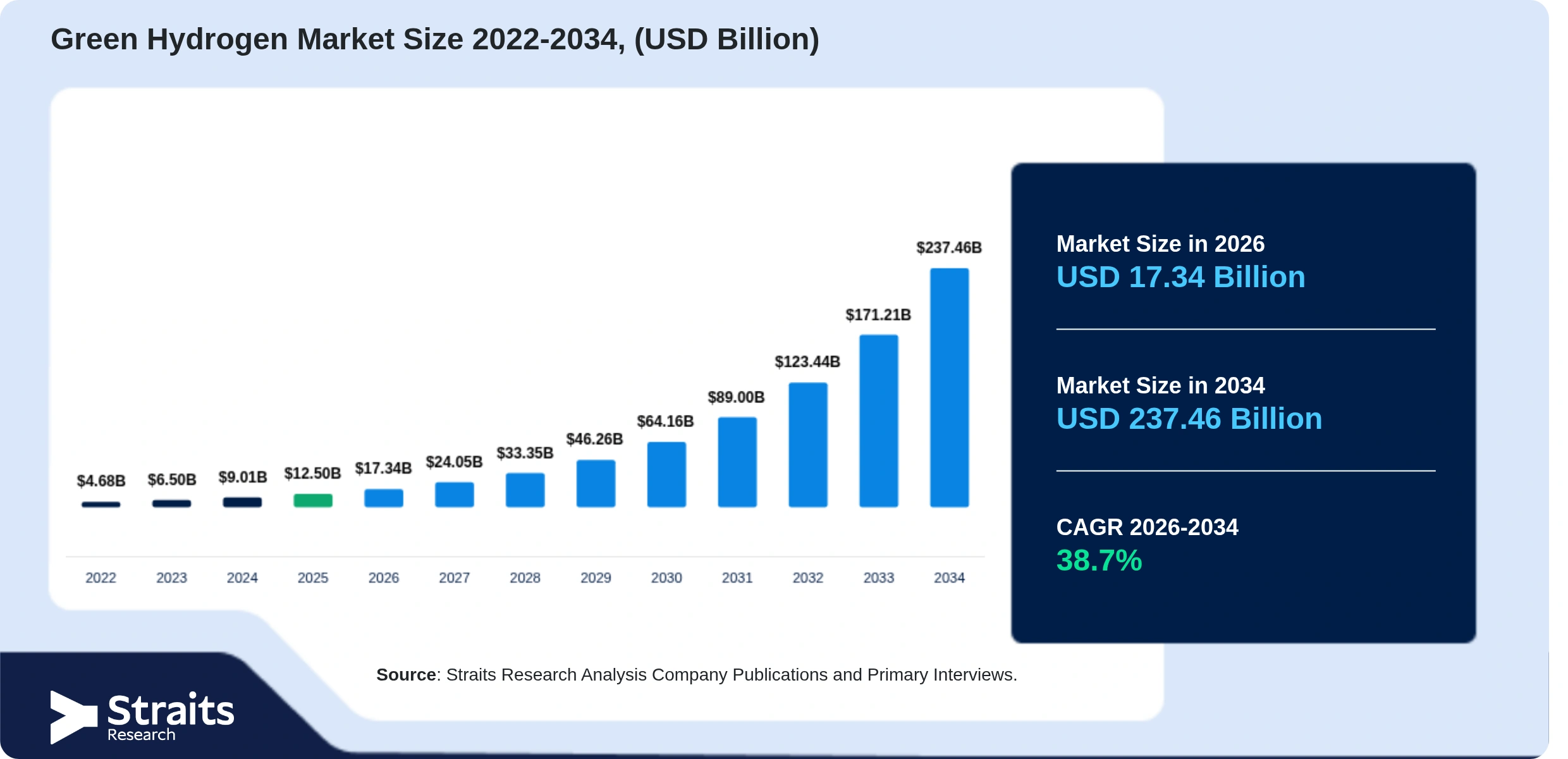
The global green hydrogen market was valued at USD 12.5 billion in 2025 and is projected to grow from USD 17.34 billion in 2026 to USD 237.46 billion by 2034. The market is expected to register a compound annual growth rate (CAGR) of 38.7% during the forecast period.
Europe dominated the global market with a share of 39.4% in 2025. Its established industrial base and hydrogen development initiatives support regional demand. Meanwhile, Asia Pacific is projected to record the fastest regional growth, with a CAGR of 42.36%, supported by national hydrogen production targets, electrolyzer manufacturing incentives, and investments in hydrogen supply chains.
Market Drivers
Industrial Decarbonization Commitments
Emission-reduction targets across steel, cement, and chemical industries are supporting the adoption of green hydrogen as an alternative to fossil-based fuels and feedstocks. Industrial manufacturers are seeking to reduce production-related emissions while maintaining operational efficiency, encouraging investment in dedicated hydrogen production facilities and long-term procurement agreements. In steel manufacturing, green hydrogen can replace coal-based methods in direct reduced iron processes, creating demand from producers transitioning toward lower-carbon production.
Green Ammonia and Fertilizer Production
Hydrogen is a primary feedstock in ammonia manufacturing, creating a significant demand opportunity for renewable-based hydrogen in the fertilizer industry. Fertilizer manufacturers are exploring green hydrogen to reduce emissions associated with conventional natural gas-based ammonia production. Investments in electrolyzer-linked hydrogen supply and green ammonia facilities are supporting this transition, with renewable hydrogen and nitrogen used to produce lower-carbon fertilizers.
Additional Demand from Refining and Infrastructure Development
Refineries use hydrogen in processes such as hydrocracking and desulfurization, creating opportunities to substitute conventional hydrogen with green alternatives. Government incentives, carbon pricing mechanisms, and production subsidies can also improve project economics by reducing the cost gap with conventional hydrogen. In parallel, the development of dedicated pipelines, storage terminals, and port facilities can connect production facilities with industrial consumers and support larger-scale distribution.
Market Challenges
High Green Hydrogen Production Costs
High production costs remain a significant challenge due to expensive electrolyzers, renewable electricity requirements, and energy-intensive production processes. These expenses make green hydrogen less competitive than conventional grey hydrogen, particularly in cost-sensitive industrial applications. The resulting price difference can limit buyer adoption, delay investment decisions, and restrict the expansion of production capacity.
Limited Storage and Transportation Infrastructure
The limited availability of dedicated pipelines, storage facilities, and distribution networks creates difficulties in transporting hydrogen from production sites to end users. Infrastructure development requires substantial capital investment, while hydrogen handling requirements add further supply chain complexity. These constraints can increase distribution costs and restrict access for industrial and mobility applications.
Market Opportunities
Green Hydrogen Certification and Carbon Accounting Services
Green hydrogen producers, industrial buyers, energy traders, and project developers require reliable certification to verify production pathways and assess emissions across the supply chain. This creates opportunities for certification audits, lifecycle emissions assessments, carbon accounting software, and compliance consulting. Companies such as TÜV SÜD, Bureau Veritas, and DNV offer relevant hydrogen certification and verification services.
Hydrogen-Based Industrial Equipment Retrofitting
Industrial facilities can create demand for equipment modifications that enable hydrogen use in existing production processes. Steel plants, refineries, chemical manufacturers, and glass producers may require burner conversions, furnace modifications, hydrogen-compatible components, and retrofit maintenance services. Companies such as thyssenkrupp Uhde, Bosch, and Siemens Energy are active in related hydrogen technology and industrial equipment solutions.
Market Segmentation
By Technology
The alkaline electrolyzer segment dominated the market with a share of 47.6%, supported by its established commercial use, relatively mature technology, and suitability for large-scale hydrogen production. Its comparatively lower capital costs and long operating history make it an attractive option for industrial projects.
The solid oxide electrolyzer segment is projected to grow at the fastest CAGR of 43.18%. Its high electrical efficiency and ability to utilize industrial waste heat support its potential to reduce electricity consumption and improve integration with energy-intensive industrial facilities.
By Application
The power generation segment accounted for the largest market share of 34.5%, supported by the role of green hydrogen in storing renewable electricity and balancing intermittent power supply. Its use in fuel cells, gas turbines, and energy storage systems supports renewable energy integration and electricity network flexibility.
The transport segment is projected to grow at a CAGR of 42.85%. Efforts to reduce emissions from heavy-duty vehicles, shipping, and other difficult-to-electrify transport sectors are supporting the adoption of hydrogen-powered fuel cells and hydrogen-based fuels.
By End Use Industry
The chemical segment held the leading market share of 31.8%, driven by its established requirement for hydrogen in ammonia, methanol, and other chemical production processes. Green hydrogen provides manufacturers with an alternative to fossil-based hydrogen and supports lower-emission production.
The chemical segment is also projected to record the fastest growth, with a CAGR of 40.46%. Industrial decarbonization targets and demand for green ammonia and methanol are encouraging chemical manufacturers to invest in renewable-powered hydrogen supply and production facility upgrades.
By Renewable Energy Source
The solar energy segment is projected to grow at a CAGR of 41.57%, supported by expanding solar power capacity and the integration of photovoltaic systems with electrolyzers. The wind energy segment is expected to register a CAGR of 39.18%, supported by utility-scale renewable electricity generation and opportunities to convert surplus power into storable hydrogen.
Regional Analysis
Europe
Europe dominated the global green hydrogen market with a share of 39.4% in 2025. The U.K. targets up to 10 GW of low-carbon hydrogen production capacity, including at least 5 GW from electrolytic hydrogen. Its projected low-carbon hydrogen demand of 85–125 TWh supports opportunities for production, storage, and distribution infrastructure.
Germany aims to establish at least 10 GW of domestic electrolysis capacity. Its hydrogen and hydrogen-derivative demand is projected to reach 95–130 TWh, with 50–70% expected to be met through imports. These targets create opportunities for electrolyzer manufacturing, hydrogen import terminals, pipelines, and distribution networks.
Asia Pacific
Asia Pacific is projected to be the fastest-growing regional market, registering a CAGR of 42.36%. Japan aims to increase its hydrogen and ammonia supply to approximately 12 million tonnes annually and plans to provide approximately ¥3 trillion in support for low-carbon hydrogen supply chains.
India targets annual green hydrogen production of at least 5 million tonnes, with potential production reaching 10 million tonnes when export demand is included. Incentives awarded for 3,000 MW per year of electrolyzer manufacturing capacity are also supporting domestic equipment production.
China's target to expand its hydrogen-powered vehicle fleet to 100,000 vehicles is creating opportunities for hydrogen refueling infrastructure and cleaner hydrogen supplies. Its hydrogen application pilot programs across five city clusters are also encouraging investment in production and supply chains.
North America
North America accounted for 22.6% of the global green hydrogen market in 2025. The U.S. Department of Energy projects clean hydrogen production potential of approximately 10 million metric tonnes annually and targets a production cost of USD 1 per kg. These initiatives support opportunities for electrolyzer manufacturers, renewable energy developers, and hydrogen infrastructure providers.
In Canada, low-emission hydrogen production could reach approximately 10 million tonnes under the net-zero scenario. The country could also export up to 4.5 million tonnes of hydrogen, creating opportunities for production facilities, export terminals, pipelines, and related supply chain infrastructure.
Key Players
The green hydrogen market is moderately fragmented, with established energy companies, industrial gas producers, electrolyzer manufacturers, renewable energy developers, and emerging technology providers competing across the value chain. Major companies include:
-
Nel ASA (Norway)
-
Plug Power Inc. (U.S.)
-
Siemens Energy AG (Germany)
-
thyssenkrupp nucera AG & Co. KGaA (Germany)
-
Air Liquide S.A. (France)
-
Linde plc (U.K.)
-
Cummins Inc. (U.S.)
-
ITM Power plc (U.K.)
Market participants compete through electrolyzer efficiency, production capacity, technological expertise, project execution, renewable energy access, infrastructure development, and long-term supply agreements. Emerging companies are also focusing on innovative electrolyzer technologies, modular hydrogen production systems, energy storage integration, and cost-effective production methods.
Conclusion
The green hydrogen market is positioned for substantial expansion as industrial manufacturers, energy companies, and transportation operators seek alternatives to conventional hydrogen and fossil-based fuels. Industrial decarbonization, green ammonia production, and renewable energy integration are creating demand across major applications. However, high production costs and limited storage and transportation infrastructure remain important challenges.
Europe currently leads the market, while Asia Pacific is expected to record the fastest growth. Investments in electrolyzer manufacturing, hydrogen infrastructure, certification services, and industrial equipment retrofitting are creating additional commercial opportunities. Companies that address production costs, improve electrolyzer efficiency, and strengthen hydrogen distribution capabilities are positioned to participate in the market's expansion.

 English
 Arabic
 French
 Spanish
 Deutsch
 Turkish
 Dutch
 Italiano
 Russian
 Romaian
 Portuguese (Brazil)
 Greek
