
Global Water Softener Market: The Shift Toward Efficient and Sustainable Water Conditioning
Water Softener Market Size, Share, Trends, and Forecast
Market Overview
The global water softener market is gaining momentum as households, commercial establishments, and industrial facilities seek effective solutions to manage hard water and prevent mineral deposits. Water softeners remove hardness-causing minerals, primarily calcium and magnesium, through ion-exchange technology and other treatment methods. These systems help reduce scale formation, protect plumbing networks and appliances, and improve water quality across residential, commercial, and industrial applications.
The market is supported by groundwater dependence in hard-water regions, expansion of commercial facilities, and growing demand for reliable water treatment systems. Technological developments in salt-free conditioning and high-efficiency regeneration are also shaping product innovation. North America remains the leading regional market, while Asia Pacific is expected to record the fastest growth during the forecast period.
Request Sample: http://straitsresearch.com/report/water-softener-market/request-sample
Market Size and Forecast
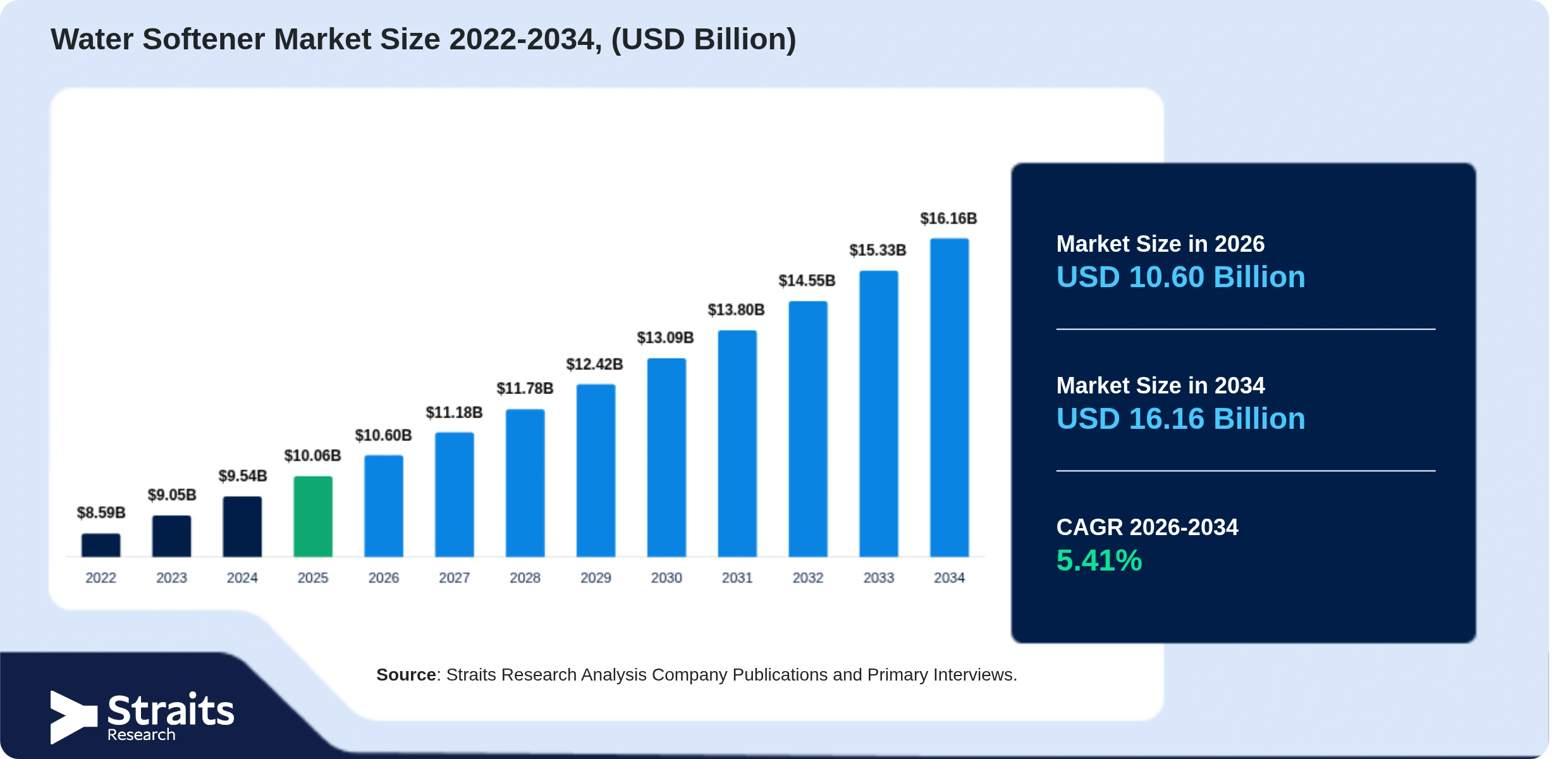
The global water softener market was valued at USD 10.06 billion in 2025. It is projected to grow from USD 10.60 billion in 2026 to USD 16.16 billion by 2034, registering a CAGR of 5.41% during the forecast period.
North America dominated the global market with a share of 38.4% in 2025. Its established demand for residential and commercial water treatment systems supports its leading position. Asia Pacific is projected to be the fastest-growing region, with a CAGR of 8.21%, supported by expanding water infrastructure and increasing demand for water treatment solutions.
Market Drivers
Growing Groundwater Dependence in Hard-Water Regions
Dependence on groundwater in regions with high mineral concentrations is generating demand for water softeners. Calcium and magnesium deposits can damage plumbing systems, water heaters, washing machines, and other household appliances. Residential and commercial users are therefore adopting water softening systems to reduce scale formation and maintenance requirements.
Households and apartment buildings that rely on borewell water represent an important application area. Point-of-entry and centralized water softeners help treat incoming water and protect plumbing networks across properties.
Expansion of Hospitality and Commercial Facilities
The expansion of hotels, hospitals, restaurants, and commercial laundries is supporting demand for commercial water softeners. These establishments depend on water-intensive equipment, including boilers, dishwashers, laundry machines, and heating systems. Hard water can cause mineral deposits that increase maintenance requirements and operating costs.
Commercial facilities are adopting centralized softening systems to maintain equipment performance and support consistent service quality. Hotel laundry operations and hot-water systems are examples of applications where softened water helps reduce scale-related problems.
Market Challenges
Salt Consumption and Regeneration Wastewater
Conventional salt-based water softeners require salt for the regeneration process and can generate wastewater containing concentrated brine. Environmental concerns over brine discharge and the need to manage salt consumption are encouraging interest in alternative water conditioning technologies.
These considerations may influence purchasing decisions among residential and commercial users seeking lower-maintenance treatment systems. They are also encouraging manufacturers to develop more efficient regeneration processes and salt-free alternatives.
Operating and Maintenance Requirements
Water softening systems require appropriate installation, servicing, and operating inputs to maintain performance. Salt handling and regeneration requirements can add to the maintenance responsibilities associated with conventional systems. These factors create interest in technologies that simplify servicing and reduce resource consumption.
Manufacturers are responding through demand-initiated regeneration controls and alternative conditioning technologies designed to improve operating efficiency.
Market Opportunities
Adoption of Salt-Free Water Conditioning Technologies
Growing interest in low-maintenance water treatment is creating opportunities for salt-free water conditioning systems. Technologies such as template-assisted crystallization treat water hardness without the traditional salt-regeneration process. This reduces salt-handling requirements and regeneration wastewater, making these systems relevant to residential and commercial users seeking alternative conditioning solutions.
Demand for Efficient and Smart Regeneration Systems
The development of high-efficiency regeneration systems presents another opportunity for market participants. Demand-initiated controls adjust regeneration according to actual water consumption, helping reduce unnecessary resource use. The report highlights that 3M reports up to 30% lower salt consumption and 20% lower water consumption under its stated laboratory conditions. Such developments create opportunities for manufacturers offering optimized control valves and resource-efficient systems.
Market Segmentation
By Type
The salt-based segment is expected to grow at a CAGR of 6.34%, supported by its established effectiveness in removing hardness-causing minerals. Its widespread use across residential, commercial, and industrial applications continues to sustain demand.
The salt-free segment is projected to register a CAGR of 7.78%. Growing interest in low-maintenance conditioning solutions, reduced salt consumption, and alternatives requiring less frequent servicing is expected to support adoption.
By Application
The residential segment accounted for the largest market share of 42.6%. Household awareness of hard water problems and the need to protect plumbing systems, appliances, and fixtures from mineral deposits support its leading position.
The residential segment is also projected to record the highest CAGR of 7.24%. Greater adoption of domestic water treatment systems and demand for solutions that help extend appliance lifespans are expected to support growth.
By Mobility
The fixed segment is expected to grow at a CAGR of 6.56%, supported by demand for permanently installed systems in homes, commercial buildings, and industrial facilities. Its suitability for continuous treatment and higher-volume requirements supports adoption.
The portable segment is projected to expand at a CAGR of 7.94%. Demand for flexible treatment solutions in temporary facilities, smaller spaces, and mobile applications is expected to encourage growth.
By Flow Rate
The below 1T/Hr segment held the largest market share of 36.7%, reflecting demand for systems designed for households and smaller establishments. Affordable installation and suitability for low-volume treatment requirements contribute to its leading position.
The below 1T/Hr segment is also anticipated to record the highest CAGR of 7.18%. Residential adoption and demand for compact, cost-effective systems are expected to support its expansion.
By Cylinder
The mono cylinder segment accounted for the largest market share of 52.8%. Its relatively simple configuration, cost-effectiveness, and suitability for residential and small-scale applications support widespread adoption.
The dual cylinder segment is projected to register the highest CAGR of 7.12%. Its ability to provide a continuous supply of softened water while one cylinder regenerates makes it suitable for commercial users requiring uninterrupted treatment.
By Distribution Channel
The indirect sales segment represented the largest market share of 56.1%. Distributors, dealers, retailers, and specialized water treatment providers improve product accessibility and offer localized purchasing and installation support.
The indirect sales segment is also expected to register the highest CAGR of 7.03%. Expanding distribution networks and wider product availability through regional dealers and retail channels are expected to sustain growth.
Regional Analysis
North America
North America dominated the water softener market with a regional share of 38.4% in 2025. Demand for residential and commercial water treatment systems supports its leading position. In the U.S., the EPA allocated USD 7.2 billion in FY2026 through the Clean Water and Drinking Water State Revolving Funds for drinking-water and wastewater projects. Canada’s Build Communities Strong Fund, with a planned investment of USD 51 billion over 10 years starting in 2026–27, includes funding for local infrastructure such as water systems.
Asia Pacific
Asia Pacific is projected to be the fastest-growing regional market, registering a CAGR of 8.21%. Water infrastructure development and greater attention to water conservation are creating opportunities for water treatment solutions.
In India, the Jal Jeevan Mission has been extended through December 2028, with a total outlay of ₹8.69 lakh crore and a goal of providing tap-water connections to all 19.36 crore rural households. China’s water conservation targets and Japan’s focus on reducing emissions from the water-supply sector are also strengthening attention toward efficient water infrastructure and treatment technologies.
Europe
Europe accounted for a regional market share of 27.4% in 2025. The region's focus on sustainable water-resource management and water efficiency supports demand for water treatment solutions. The U.K. government's water-use reduction targets and planned mandatory water-efficiency labelling scheme are encouraging greater attention to efficient water use. Germany's National Water Strategy, which includes 78 measures for implementation by 2030, further supports the focus on reliable water supplies and advanced water-management solutions.
Middle East and Africa
The Middle East and Africa is among the regions covered in the market assessment. The report identifies regional market coverage but does not provide specific country-level growth figures in the supplied data.
Latin America
Latin America is also included in the regional assessment of the global water softener market. The supplied report information does not specify a regional market share or CAGR for this region.
Key Players
The water softener market is moderately fragmented, with participation from large water treatment equipment manufacturers, specialized water conditioning companies, regional suppliers, and local providers. A.O. Smith Water Technologies, BWT Aktiengesellschaft, and Culligan International Company collectively account for approximately 45% of the global market share.
Key companies operating in the market include:
-
A. O. Smith Corporation
-
BWT Aktiengesellschaft
-
Culligan International Company
-
EcoWater Systems LLC
-
Pentair Residential Filtration LLC
-
Feedwater Limited
-
Kinetico Incorporated
-
Whirlpool Corporation
Market participants compete through water treatment efficiency, system reliability, product durability, technology integration, distribution reach, installation services, and maintenance support. Emerging competition also focuses on affordable systems, compact designs, smart monitoring features, and customized water treatment solutions.
Conclusion
The global water softener market is expected to maintain steady growth as residential, commercial, and industrial users seek solutions to manage hard water and protect water-dependent equipment. Groundwater dependence, commercial facility expansion, and residential water treatment adoption remain important demand drivers. Salt-free conditioning technologies and efficient regeneration systems are also creating opportunities for product innovation.
North America currently leads the market, while Asia Pacific is expected to register the fastest growth. Residential applications, salt-based systems, fixed installations, and indirect distribution channels remain important market segments. Manufacturers focusing on efficient technologies, reliable systems, and wider distribution networks are positioned to address evolving demand.
Report: http://straitsresearch.com/report/water-softener-market

 English
 Arabic
 French
 Spanish
 Portuguese
 Turkish
 Dutch
 Italiano
 Russian
 Romaian
 Portuguese (Brazil)
 Greek
