
Cloud Security and Cyber Risks: What's Next for the Threat Intelligence Market?
Threat Intelligence Market Size, Share, Trends, and Forecast to 2034
Market Overview
The global threat intelligence market is gaining importance as organizations face increasingly sophisticated cyber threats, ransomware attacks, data breaches, and credential theft. Threat intelligence involves collecting, analyzing, and interpreting information about potential or existing cyber threats, including malicious actors, attack methods, vulnerabilities, and indicators of compromise. These insights help organizations identify security risks, anticipate cyberattacks, strengthen defense strategies, and improve incident response across their IT infrastructure.
The adoption of threat intelligence solutions is supported by the expansion of cloud infrastructure, remote access systems, and digital business operations. Organizations across banking, healthcare, retail, telecommunications, and manufacturing are investing in advanced intelligence capabilities to improve threat visibility and protect sensitive information. Automated threat analysis and industry-specific intelligence are also shaping the market as businesses seek faster detection and more targeted cybersecurity strategies.
Request Sample: http://straitsresearch.com/report/threat-intelligence-market/request-sample
Market Size and Forecast
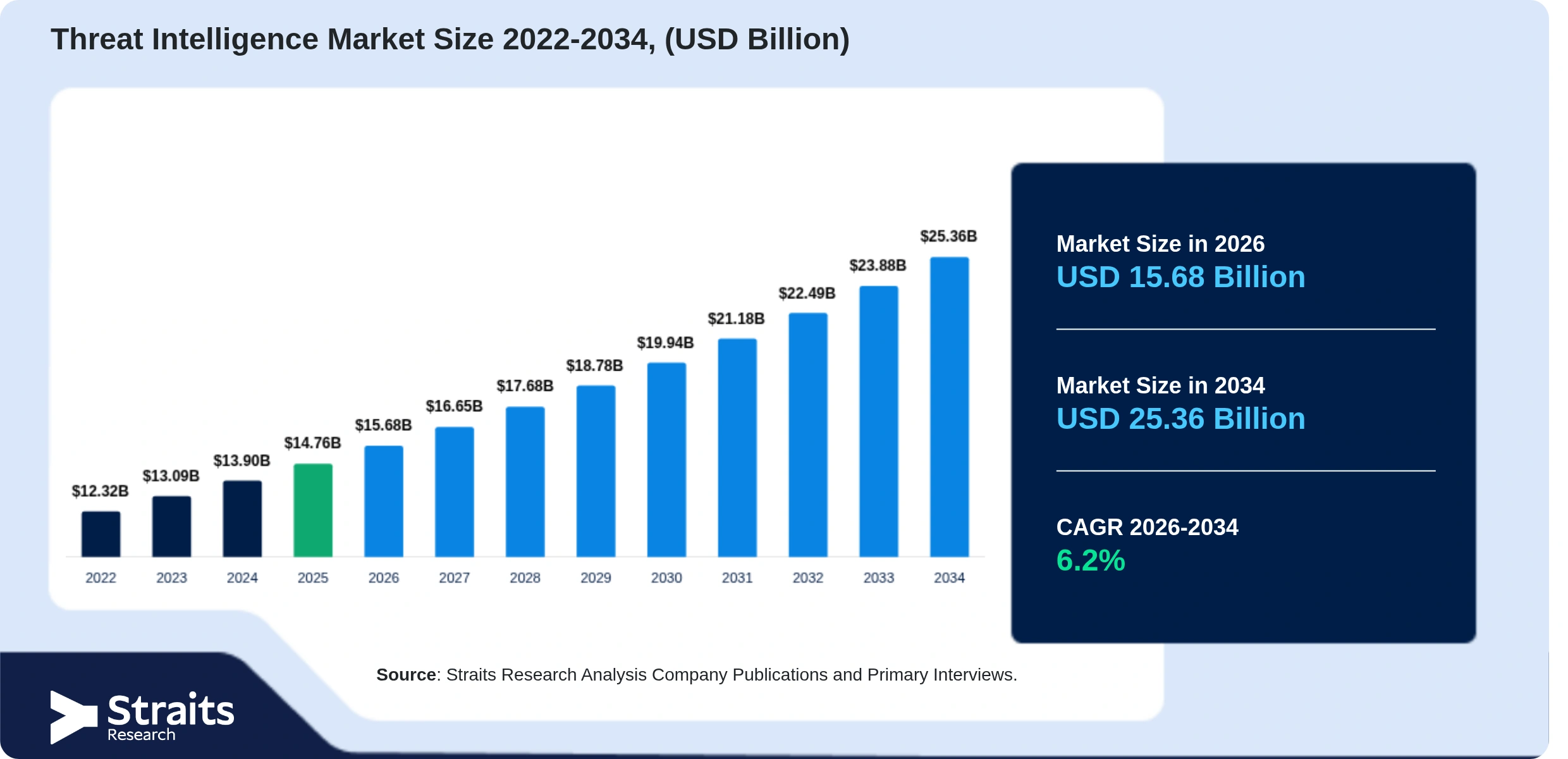
The global threat intelligence market was valued at USD 14.76 billion in 2025 and is projected to grow from USD 15.68 billion in 2026 to USD 25.36 billion by 2034, registering a CAGR of 6.2% during the forecast period. Market expansion is supported by the growing need to identify malicious activities, monitor emerging vulnerabilities, and strengthen organizational cybersecurity infrastructure.
Asia Pacific held the largest regional share of 36.4% in 2025, supported by demand for cybersecurity solutions across major digital economies. Europe is expected to be the fastest-growing regional market, registering a CAGR of 17.5% through 2034. Cloud deployment and specialized threat intelligence services are also expected to contribute to market expansion.
Market Drivers
Escalation of Ransomware and Data Breach Incidents
Frequent ransomware attacks and data breaches are strengthening demand for threat intelligence platforms and services. These incidents expose organizations to financial losses, operational disruptions, and unauthorized access to sensitive information. Businesses are increasingly using threat intelligence to identify malicious actors, understand attack methods, and detect early warning signs. Banks, for example, use intelligence solutions to monitor ransomware groups, identify compromised credentials, and prepare defenses against targeted attacks.
Expansion of Cloud Infrastructure and Remote Access
The wider adoption of cloud platforms and remote access systems is expanding the potential attack surface for cybercriminals. Distributed IT environments create demand for intelligence that identifies suspicious IP addresses, malicious domains, compromised credentials, and emerging vulnerabilities. Organizations using cloud platforms such as Microsoft Azure and Amazon Web Services require continuous threat monitoring to protect applications and connected infrastructure. This is supporting the adoption of scalable intelligence solutions and real-time security updates.
Market Challenges
Cybersecurity Skills Shortages
The shortage of specialized cybersecurity professionals creates challenges for organizations seeking to manage complex threat intelligence operations. Effective intelligence analysis requires expertise in identifying threat actors, interpreting attack patterns, assessing vulnerabilities, and coordinating incident responses. Limited internal capabilities can make it difficult for businesses to extract value from large volumes of threat information. This is encouraging organizations to seek managed security expertise and external threat analysis services.
Increasingly Sophisticated Cyberattacks
The evolving nature of cyberattacks creates an ongoing challenge for organizations and security providers. Threat actors use different attack methods, compromised credentials, and malicious infrastructure to target business networks. Organizations must continuously update their threat monitoring and response capabilities to address emerging risks. The need for accurate intelligence, timely updates, and integration with existing security systems adds to the complexity of cybersecurity management.
Market Opportunities
Growing Demand for Cloud-Based Threat Intelligence
Cloud-based deployment presents an opportunity for market participants as organizations seek scalable security infrastructure and faster access to intelligence updates. The cloud segment is projected to register a CAGR of 17.3% during the forecast period. Increasing cloud migration and reduced infrastructure management requirements are supporting demand for cloud-based threat intelligence platforms.
Expansion of Managed Intelligence and Industry-Specific Services
The demand for managed security expertise, incident response, and specialized threat analysis creates opportunities for service providers. The services segment is expected to register a CAGR of 16.6%, supported by cybersecurity skills shortages and increasingly sophisticated attacks. Industry-specific intelligence for banking, healthcare, energy, and telecommunications also creates opportunities for providers offering targeted threat feeds and sector-focused analysis.
Market Segmentation
By Component
The solution segment is projected to register a CAGR of 15.5% during the forecast period. Demand is supported by the need for advanced tools that identify, analyze, and mitigate emerging threats, alongside greater investment in real-time monitoring and automated threat detection.
The services segment is expected to grow at a CAGR of 16.6%. Demand for managed security expertise, incident response, and specialized threat analysis is supporting service adoption as organizations address cybersecurity skills shortages and increasingly complex attacks.
By Deployment Mode
The on-premise segment is forecast to expand at a CAGR of 13.9%. Organizations continue to adopt on-premise solutions to maintain direct control over sensitive threat data, security infrastructure, and compliance requirements.
The cloud segment is anticipated to record a CAGR of 17.3%. Scalable deployment, rapid access to threat intelligence, reduced infrastructure management, and real-time security updates are supporting its expansion.
By End User
Banking, financial services and insurance (BFSI) held the largest market share at 31.6% in 2025. Exposure to financial fraud, data breaches, and sophisticated cyberattacks, combined with strict regulatory obligations, reinforces the sector's investment in threat intelligence.
The healthcare segment is projected to register the highest CAGR of 17.1%. Growing ransomware incidents, expanding digital health platforms, and the increasing volume of sensitive patient data are strengthening demand for cyber threat monitoring.
Regional Analysis
Asia Pacific
Asia Pacific dominated the threat intelligence market with a share of 36.4% in 2025. Growing cybersecurity requirements across major digital economies are supporting regional demand. In India, the recording of 29.44 lakh cybersecurity incidents by CERT-In in 2025 and the expansion of AI-driven detection and automated threat-intelligence sharing are encouraging greater adoption of proactive monitoring and incident-response solutions.
In Japan, government initiatives focused on threat hunting, active cyber defense, and critical-infrastructure protection are creating demand for actionable intelligence. China's plans to strengthen network and data security capabilities are also supporting opportunities for threat monitoring, intelligence sharing, and advanced cyber-defense solutions.
Europe
Europe is projected to be the fastest-growing regional market, with a CAGR of 17.5% during the forecast period. Government cybersecurity initiatives and stronger attention to digital security are supporting demand for threat intelligence solutions. In the U.K., plans to strengthen government-wide cyber operations and improve cyber-risk visibility are creating opportunities for automated monitoring and incident-response services. Germany's cybersecurity reforms and emphasis on detecting targeted attacks are also supporting market development.
North America
North America accounted for 30.8% of the global market in 2025. In the U.S., federal initiatives focused on vulnerability discovery, validation, remediation, and post-quantum cryptography compliance are expected to support demand for advanced threat analysis and vulnerability intelligence. In Canada, government investment in an enterprise Security Information and Event Management solution and public-private intelligence-sharing initiatives are strengthening the regional cybersecurity landscape.
Key Players
The threat intelligence market is moderately fragmented, with participation from established cybersecurity companies, specialized intelligence providers, security software vendors, and emerging cybersecurity businesses. Competition is shaped by threat data coverage, intelligence accuracy, real-time detection, platform integration, research capabilities, and enterprise relationships.
Major companies operating in the market include:
-
Symantec Corporation
-
Dell Inc.
-
Anomali, Inc.
-
McAfee, LLC
-
Fortinet, Inc.
-
CrowdStrike, Inc.
-
Trellix
-
IBM Corporation
These companies compete through threat monitoring networks, automated intelligence capabilities, specialized research, and security solutions designed to address evolving organizational requirements.
Conclusion
The threat intelligence market is expected to expand as organizations strengthen their cybersecurity capabilities against ransomware, data breaches, compromised credentials, and increasingly sophisticated attacks. Growing cloud adoption, demand for managed intelligence services, and the need for industry-specific threat analysis are creating opportunities across components, deployment modes, and end-user industries. Asia Pacific currently leads the market, while Europe is expected to record the fastest regional growth.
The market's future development will depend on organizations' ability to improve threat visibility, adopt automated intelligence capabilities, and strengthen security responses across increasingly distributed digital environments.
Report: http://straitsresearch.com/report/threat-intelligence-market

 English
 Arabic
 French
 Spanish
 Portuguese
 Deutsch
 Turkish
 Italiano
 Russian
 Romaian
 Portuguese (Brazil)
 Greek
