
Crisis Management Software Market: The Next Wave of Emergency Management Innovation
Crisis Management Software Market: Size, Share, Trends, and Forecast
Market Overview
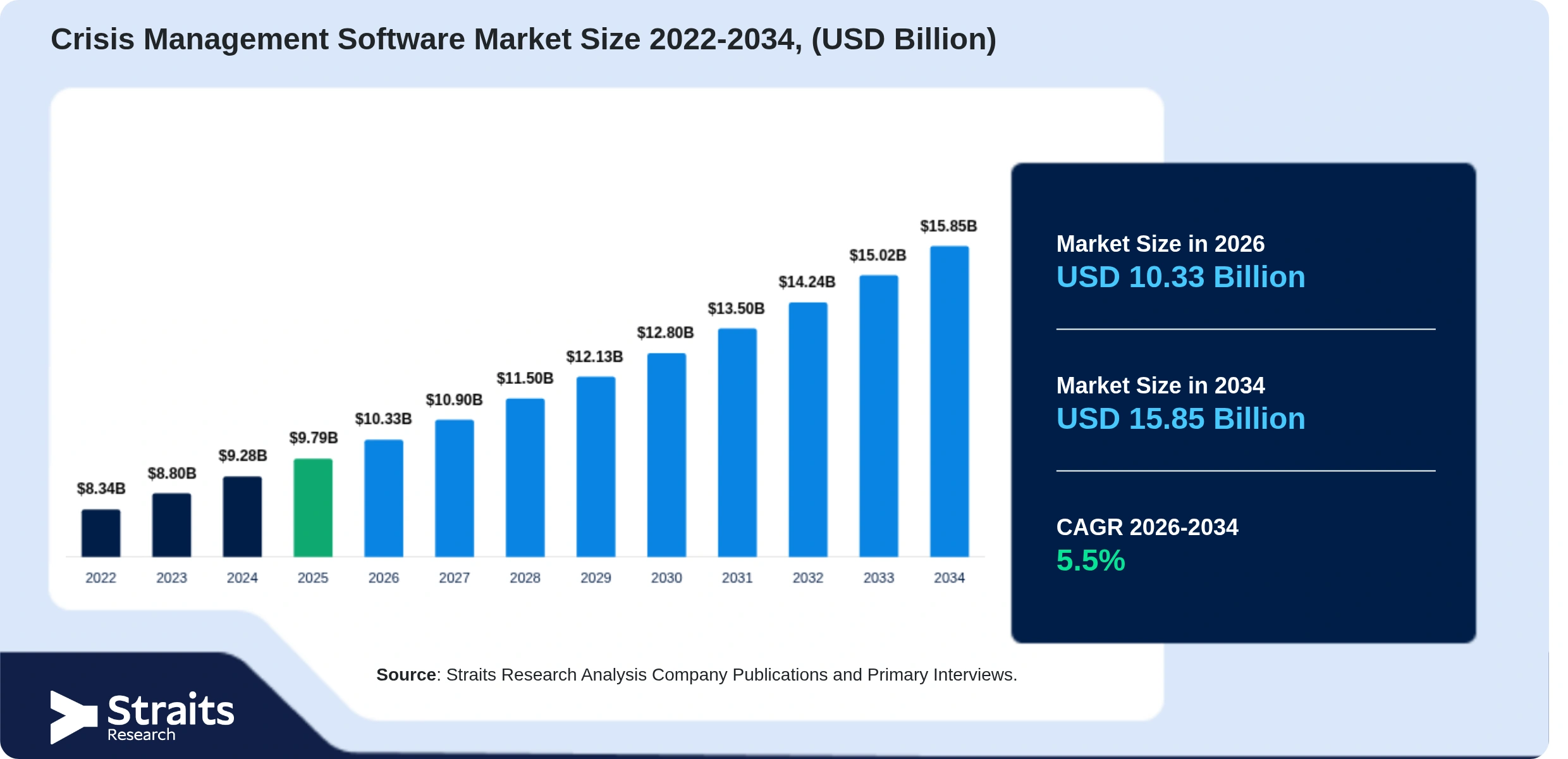
The global crisis management software market is witnessing steady growth as organizations increasingly prioritize emergency preparedness, operational resilience, and business continuity. The market was valued at USD 9.79 billion in 2025 and is projected to increase from USD 10.33 billion in 2026 to USD 15.85 billion by 2034, registering a CAGR of 5.5% during the forecast period. Growing exposure to natural disasters, operational disruptions, and digital infrastructure risks is encouraging organizations to adopt integrated platforms for crisis planning and response.
Crisis management software helps organizations prepare for, respond to, and recover from emergencies and unexpected incidents. These platforms provide capabilities for incident reporting, risk assessment, emergency communication, response coordination, resource management, and recovery planning. Their adoption supports faster decision-making, protects employees and critical assets, and reduces operational disruptions.
Request Sample: http://straitsresearch.com/report/crisis-management-software-market/request-sample
Market Size and Forecast
The crisis management software market is projected to reach USD 15.85 billion by 2034, growing at a CAGR of 5.5% from 2026 to 2034. Increasing requirements for structured emergency response and disaster recovery planning are supporting demand across government, healthcare, financial services, energy, and technology organizations.
North America held the largest regional market share of 38.6% in 2025. Meanwhile, Asia Pacific is expected to be the fastest-growing region, registering a CAGR of 14.26% during the forecast period. This growth reflects increasing investment in digital disaster preparedness, emergency response infrastructure, and integrated information-sharing systems.
Market Drivers
Stringent Business Continuity and Disaster Recovery Requirements
Strict business continuity and disaster recovery requirements are encouraging organizations to adopt structured crisis response systems. Companies need platforms that help document emergency procedures, assign responsibilities, monitor recovery activities, and maintain essential business functions during disruptions. These requirements are supporting demand across banking, healthcare, manufacturing, and telecommunications. For example, financial institutions use crisis management software to coordinate recovery activities during system outages and maintain access to critical banking services.
Growing Exposure to Natural Disasters and Extreme Weather
Frequent floods, cyclones, wildfires, and severe storms are increasing operational risks for businesses, government agencies, and infrastructure operators. Facility damage, service interruptions, and supply chain disruptions create demand for platforms that support emergency planning, incident tracking, and recovery coordination. Utility companies, for instance, use these systems to coordinate field teams, monitor infrastructure damage, and prioritize power restoration following severe weather events.
Expansion of Complex and Geographically Distributed Operations
Organizations operating across multiple facilities, regional offices, and international supply chains require coordinated crisis response capabilities. Managing incidents across different locations can create information gaps and delay recovery activities. Crisis management software centralizes incident records, response responsibilities, and recovery tracking, supporting adoption among multinational businesses and large industrial operators.
Rising Workplace Safety and Incident Reporting Requirements
Workplace safety requirements are increasing the need for structured incident documentation and emergency response procedures. Crisis management platforms support incident reporting, escalation workflows, compliance records, and corrective action tracking. These capabilities are relevant to industrial facilities, construction sites, hospitals, and corporate workplaces where coordinated emergency management is essential.
Market Challenges
The supplied report information does not identify specific market restraints or quantify their impact. However, the report highlights the importance of data security, system reliability, enterprise integration, scalability, and regulatory compliance in the competitive environment. These requirements make platform capabilities important considerations for organizations evaluating crisis management software.
Market Opportunities
Growing Adoption of Cloud-Based Platforms
Cloud deployment is expected to register a CAGR of 13.27%, supported by scalability, remote accessibility, and lower upfront infrastructure requirements. Cloud-based platforms allow geographically dispersed teams to share information and coordinate emergency responses in real time. This creates opportunities for providers offering flexible platforms that support centralized crisis management across multiple locations.
Increasing Demand for Training and Simulation
The training and simulation application segment is projected to grow at the highest CAGR of 13.18%. Organizations are placing greater emphasis on employee preparedness and emergency response exercises. Simulated crisis scenarios help identify procedural gaps and improve coordination before actual incidents occur, creating opportunities for providers developing advanced simulation and preparedness capabilities.
Rising Adoption Among SMEs
The SMEs segment is expected to record a CAGR of 13.49%. Growing awareness of operational risks and the availability of affordable, scalable software solutions are encouraging smaller organizations to strengthen emergency preparedness. Providers offering cost-effective subscription models and simplified implementation can address this expanding customer segment.
Market Segmentation
The crisis management software market is segmented by component, deployment mode, organization size, application, and vertical.
By Component
The solutions segment dominated the market, accounting for 68.5% of the share in 2025. Its leadership reflects demand for integrated platforms supporting emergency response, communication, disaster recovery, and business continuity. The services segment is projected to grow at a CAGR of 12.29%, supported by increasing demand for consulting, implementation, and training expertise.
By Deployment Mode
The cloud segment is expected to grow at a CAGR of 13.27%, driven by scalability, remote accessibility, and lower upfront infrastructure requirements. The on-premise segment is projected to register a CAGR of 9.42%, supported by organizations prioritizing direct control over sensitive data, system configurations, and security policies.
By Organization Size
The SMEs segment is projected to record a CAGR of 13.49%, supported by increasing risk awareness and the availability of affordable, scalable solutions. Large enterprises accounted for the largest share at 60.4% in 2025, reflecting their complex operational structures, geographically distributed teams, and need for coordinated crisis response across departments.
By Application
Business continuity held the largest application share at 25.8%, reflecting organizations' focus on maintaining essential operations and minimizing downtime during emergencies. Training and simulation is projected to register the highest CAGR of 13.18%, driven by increasing investment in employee preparedness, simulated emergency scenarios, and response coordination.
By Vertical
Government and defense accounted for the largest vertical share at 29.4%, supported by requirements for managing public emergencies, security threats, natural disasters, and large-scale incidents. Healthcare is expected to grow at the highest CAGR of 12.83%, driven by public health emergency preparedness, hospital incident management, and continuity of care.
Regional Analysis
North America
North America dominated the crisis management software market with a 38.6% share in 2025. In the United States, funding through FEMA's Emergency Management Performance Grant Program and the Homeland Security Grant Program supports preparedness, response, and recovery capabilities. These initiatives create opportunities for software supporting incident coordination, emergency communication, and situational awareness.
In Canada, the renewal of the Emergency Management Strategy and the transition toward a new National Public Alerting System model are expected to support demand for digital emergency alerts, inter-agency coordination, and incident response platforms.
Asia Pacific
Asia Pacific is projected to be the fastest-growing regional market, registering a CAGR of 14.26%. Japan's disaster-prevention digital transformation initiatives are supporting demand for improved information sharing and coordinated emergency response. China's emergency response modernization plans are encouraging investment in smart emergency management, disaster prevention, and emergency command capabilities.
In India, the government's Multi-Hazard Early Warning Decision Support System supports location-specific warnings and automated disaster forecasting. Continued development of these capabilities could increase demand for emergency communication, incident management, and response coordination platforms.
Europe
Europe accounted for 27.4% of the global market share in 2025. In the U.K., initiatives to strengthen national resilience and improve digital information sharing are creating opportunities for platforms supporting multi-agency coordination and emergency planning.
Germany's planned investment in civil protection, including modern warning and communication systems and a shared digital national situation picture, is expected to support demand for coordinated incident response and information-sharing software.
Key Players
The crisis management software market is moderately fragmented, with established enterprise software providers, emergency communication vendors, risk management companies, and specialized software developers. The leading players include:
-
Badger Software Ltd.
-
The Response Group, Inc.
-
Noggin Pty Ltd.
-
F24 AG
-
InstaPoint AS
-
RiskLogic
-
Risk Management Solutions, Inc. (RMS)
-
Everbridge, Inc.
Competition is based on platform reliability, risk assessment capabilities, real-time incident monitoring, enterprise integration, data security, scalability, regulatory compliance, and customer support. Emerging providers are also differentiating themselves through AI-powered incident analysis, automated alerts, flexible deployment options, and industry-specific solutions.
Conclusion
The crisis management software market is positioned for steady expansion as organizations strengthen business continuity, disaster recovery, workplace safety, and emergency response capabilities. Growing exposure to extreme weather, increasing operational complexity, and dependence on digital infrastructure are supporting demand across multiple industries. Cloud deployment, training and simulation, and SME adoption represent important growth areas, while Asia Pacific is expected to record the fastest regional expansion.
With organizations placing greater emphasis on preparedness and operational resilience, crisis management software providers are positioned to address evolving requirements through integrated communication, incident monitoring, and coordinated response capabilities.
Report: http://straitsresearch.com/report/crisis-management-software-market

 English
 Arabic
 French
 Spanish
 Portuguese
 Deutsch
 Turkish
 Dutch
 Italiano
 Russian
 Romaian
 Greek
