
Sustainable Materials and Innovation Reshape the Polyolefin Foam Market
Polyolefin Foam Market Size, Share, Trends, and Forecast
Market Overview
The global polyolefin foam market is experiencing steady growth, supported by increasing demand for lightweight, flexible, and durable materials across automotive, packaging, construction, and consumer applications. Polyolefin foam is a cellular material produced by expanding polymers such as polyethylene and polypropylene. Its cushioning, thermal insulation, moisture resistance, and impact absorption properties make it suitable for a wide range of industrial and commercial uses.
The growing adoption of lightweight materials in vehicle manufacturing, protective packaging, and building insulation is strengthening demand for polyolefin foam. Manufacturers are also focusing on recyclable formulations and advanced crosslinking technologies to improve product performance and support material sustainability.
Request Sample: http://straitsresearch.com/report/polyolefin-foam-market/request-sample
Market Size and Forecast
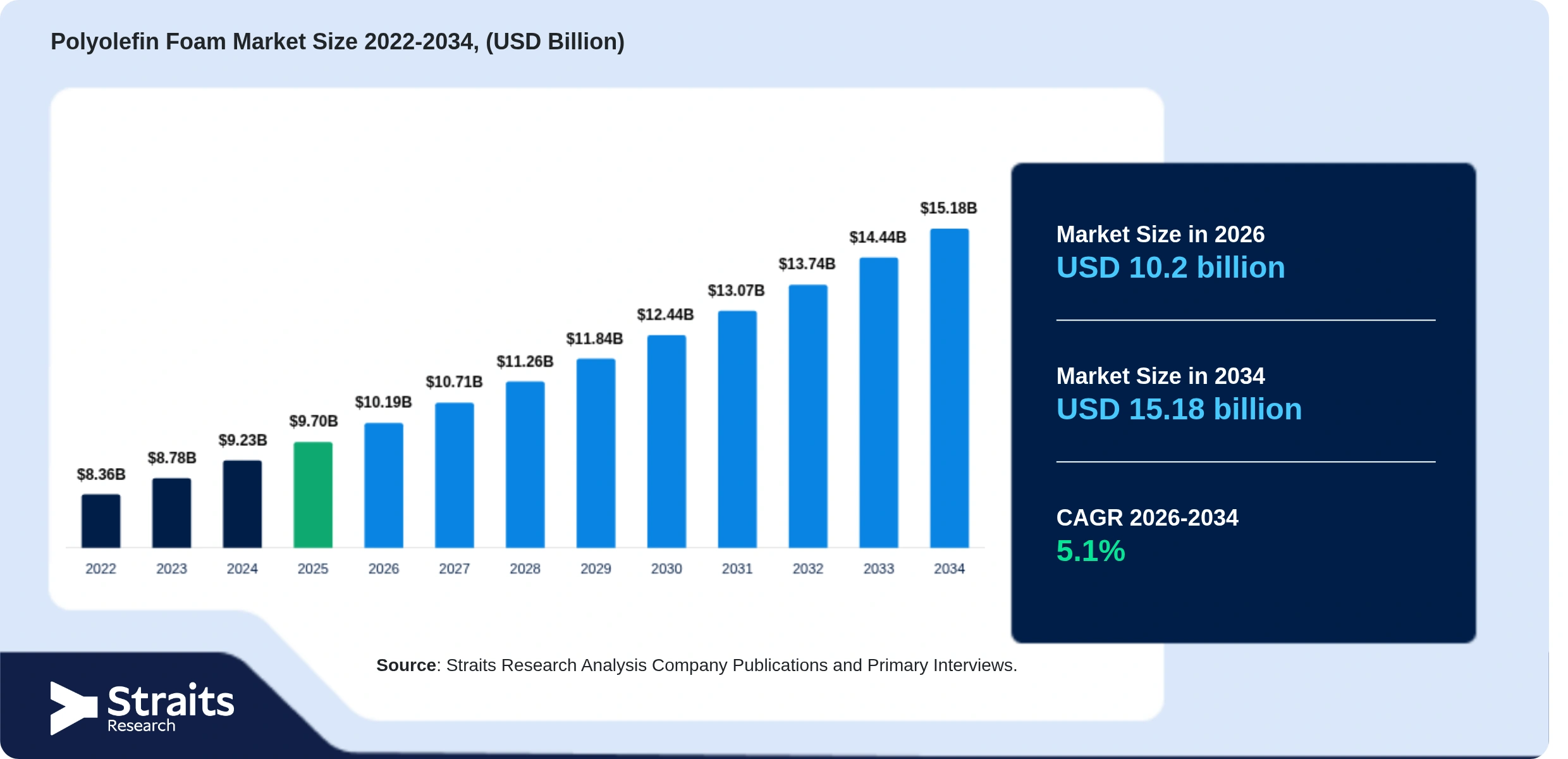
The global polyolefin foam market size was valued at USD 9.7 billion in 2025. The market is projected to increase from USD 10.19 billion in 2026 to USD 15.18 billion by 2034, registering a CAGR of 5.1% during the forecast period.
Market expansion is supported by the increasing use of polyethylene and polypropylene foams in automotive components, protective packaging, and construction insulation. Their lightweight structure, flexibility, and ability to absorb impact make them suitable for applications requiring material protection and thermal performance.
Europe held the largest regional market share of 35.4% in 2025, while North America is projected to register the fastest regional growth, with a CAGR of 7.24% during the forecast period.
Market Drivers
Expansion of Automotive Lightweighting Applications
The automotive industry's focus on reducing vehicle weight while maintaining passenger comfort and component protection is supporting polyolefin foam demand. These materials provide cushioning, impact absorption, and insulation in seats, door panels, dashboards, and headliners. Increasing production of passenger vehicles and electric vehicles is creating additional demand for lightweight foam components. Their use in vehicle interiors and battery-related cushioning applications also supports component protection and vehicle design requirements.
Growth in Protective Packaging for Industrial Goods
Increasing movement of industrial machinery, electronic equipment, and automotive components is creating demand for protective packaging materials. Polyolefin foam offers shock absorption, cushioning, and moisture resistance, helping protect products during transportation, handling, and storage. Manufacturers and logistics providers use foam sheets, rolls, and custom-molded packaging solutions to reduce the risk of product damage. Electronics manufacturers also use foam inserts to protect sensitive equipment from vibration and impact during shipment.
Expansion of Construction and Building Insulation
The need for thermal performance, moisture resistance, and sound absorption in residential, commercial, and industrial buildings is supporting the use of polyolefin foam. Applications include pipe insulation, floor underlays, wall insulation, and expansion joints. Infrastructure development and building-efficiency requirements are creating additional demand for foam materials used in construction and insulation applications.
Increasing Demand for Sports and Recreational Equipment
Polyolefin foam is used in sports and recreational products because of its lightweight structure, flexibility, cushioning, and impact protection properties. Applications include yoga mats, fitness equipment, protective gear, flotation devices, and other recreational products. Expanding use across these applications is supporting demand for durable foam materials and creating opportunities for specialized foam manufacturers.
Market Challenges
The supplied market information does not identify specific market restraints or quantify their impact on market growth. However, the market's competitive environment highlights the importance of production efficiency, product consistency, material performance, and manufacturing capabilities. Manufacturers compete through foam density, mechanical strength, thermal insulation performance, and customized formulations. Maintaining these product and manufacturing requirements remains important for suppliers serving automotive, packaging, construction, and industrial customers.
Market Opportunities
Development of Recyclable Polyolefin Foam
Growing demand for sustainable packaging and lightweight insulation materials is creating opportunities for recyclable polyolefin foam products. Improved formulations and mono-material designs can make foam components easier to recover and process through recycling streams. Manufacturers developing recyclable solutions can address material recovery requirements across protective packaging, automotive interiors, and building applications.
Advancements in Crosslinking Technologies
Electron-beam and optimized chemical crosslinking technologies are creating opportunities to improve polyolefin foam performance. These processes enable better control over cell structure, dimensional stability, heat resistance, and mechanical strength. Advanced foam grades can support specialized requirements in automotive components, sports equipment, footwear, and industrial cushioning applications.
Market Segmentation
The polyolefin foam market is segmented by type and application.
By Type
The polyethylene segment dominated the market, accounting for 53.6% of the global market share in 2025. Its leading position is supported by its lightweight structure, flexibility, cushioning properties, and resistance to moisture and chemicals. These characteristics support its extensive use in automotive components, protective packaging, construction insulation, and other protective products.
The polypropylene segment is projected to grow at the highest CAGR of 6.82%. Its low density, thermal resistance, and mechanical strength support its use in automotive interiors, reusable packaging, and lightweight protective components.
Other types include ethylene vinyl acetate and other polyolefin foam materials.
By Application
The automotive segment held the largest application share of 24.7% in 2025. Polyolefin foam is used in seat cushioning, door panels, headliners, dashboards, and interior insulation. Its lightweight and energy-absorbing properties support passenger comfort, noise reduction, impact protection, and vehicle weight optimization.
The automotive segment is also projected to register the highest CAGR of 6.91%. Demand for lightweight vehicle components, including materials used in electric vehicle designs, acoustic insulation, and impact protection, is supporting its growth.
Other applications include building and construction, cushioning, footwear, furniture and bedding, packaging, sports, rail, wind, and marine applications.
Regional Analysis
Europe
Europe dominated the global polyolefin foam market with a share of 35.4% in 2025. Demand is supported by building-efficiency requirements and the adoption of insulation materials in construction and heating applications.
In the U.K., the target to expand annual heat pump installations to more than 450,000 units by 2030, alongside plans for approximately 70% domestic heat pump manufacturing by 2035, may support demand for polyolefin foam in thermal insulation and protective components.
Germany's target to achieve a 50% climate-neutral share of its heat supply by 2030 is supporting energy-efficient building renovations and renewable heating systems. EU requirements for renovating the 16% worst-performing non-residential buildings by 2030 may also support demand for construction insulation materials.
North America
North America is projected to be the fastest-growing regional market, registering a CAGR of 7.24% during the forecast period. Demand is supported by building retrofit initiatives, heat pump installations, and the use of insulation materials.
In the U.S., the Department of Energy's target of 5 million residential heat-pump conversions annually by 2030 and the need to increase building-envelope retrofit activity may support polyolefin foam demand in insulation applications.
Canada's projected addition of 820,000 heat-pump installations between 2026 and 2034, together with plans to retrofit approximately 11 million buildings, creates potential demand for foam materials used in building insulation and energy-efficiency applications.
Asia Pacific
Asia Pacific accounted for 24.8% of the global polyolefin foam market in 2025. Demand is supported by building insulation requirements and the increasing use of lightweight materials in automotive manufacturing.
Japan's planned improvements in insulation-material and window-material performance standards may support demand for polyolefin foam in building insulation and thermal-management applications.
China's focus on ultra-low-energy buildings and its target for new-energy vehicles to account for 70% of new passenger-vehicle sales by 2030 create opportunities for advanced insulation materials and lightweight automotive foam components.
In India, the target of achieving a 30% share of electric vehicles in total vehicle sales by 2030 may support the use of lightweight foam materials in automotive applications. Proposed fuel-efficiency standards also encourage manufacturers to consider lightweight vehicle components.
Key Players
The polyolefin foam market includes established polymer manufacturers, foam producers, specialty material suppliers, and regional manufacturers. Key companies operating in the market include:
-
SEKISUI CHEMICAL CO., LTD.
-
BASF SE
-
Carefoam (India) Pvt. Ltd.
-
Toray Plastics
-
Primacel
-
O.K. Company S.A.
-
Zotefoams plc
-
Trocellen GmbH
Companies compete through product quality, foam density, mechanical strength, thermal insulation performance, manufacturing efficiency, production capacity, and distribution networks. Product innovation, recyclable formulations, customized foam grades, and advanced processing technologies are also important competitive factors.
Conclusion
The global polyolefin foam market is projected to grow steadily, increasing from USD 9.7 billion in 2025 to USD 15.18 billion by 2034. Growing automotive lightweighting applications, protective packaging requirements, construction insulation demand, and the adoption of advanced foam technologies are supporting market expansion. Europe currently leads the market, while North America is expected to record the fastest growth during the forecast period.
Developments in recyclable materials and crosslinking technologies are creating additional opportunities for manufacturers. Companies focusing on product performance, material efficiency, and application-specific foam solutions are positioned to address evolving requirements across automotive, packaging, construction, and industrial sectors.
Report: http://straitsresearch.com/report/polyolefin-foam-market

 English
 Arabic
 French
 Spanish
 Portuguese
 Turkish
 Dutch
 Italiano
 Russian
 Romaian
 Portuguese (Brazil)
 Greek
