
Fumed Silica Market: How Electronics and Energy Storage Are Creating New Opportunities
Fumed Silica Market Size, Share, Trends, and Forecast, 2026–2034
Market Overview
The global fumed silica market is gaining momentum as manufacturers across construction, automotive, pharmaceuticals, electronics, and personal care industries rely on its thickening, reinforcing, anti-settling, and anti-caking properties. Fumed silica is a fine, synthetic amorphous silica powder produced through the high-temperature hydrolysis of silicon-containing compounds. Its ability to improve material strength, formulation stability, and processing performance makes it an important additive in paints, coatings, adhesives, sealants, silicone rubber, and other industrial products.
The market is also benefiting from specialized applications that require precise rheological control, improved material compatibility, and high-purity formulations. Surface-modified grades are supporting applications in moisture-sensitive products and non-polar systems, while high-purity materials are finding applications in electronic adhesives, encapsulants, and advanced semiconductor-related formulations. These developments are expanding the role of fumed silica across established and emerging industries.
For detailed industry insights, market forecasts, and competitive analysis, visit the Fumed Silica Market report: http://straitsresearch.com/report/fumed-silica-market
Market Size and Forecast
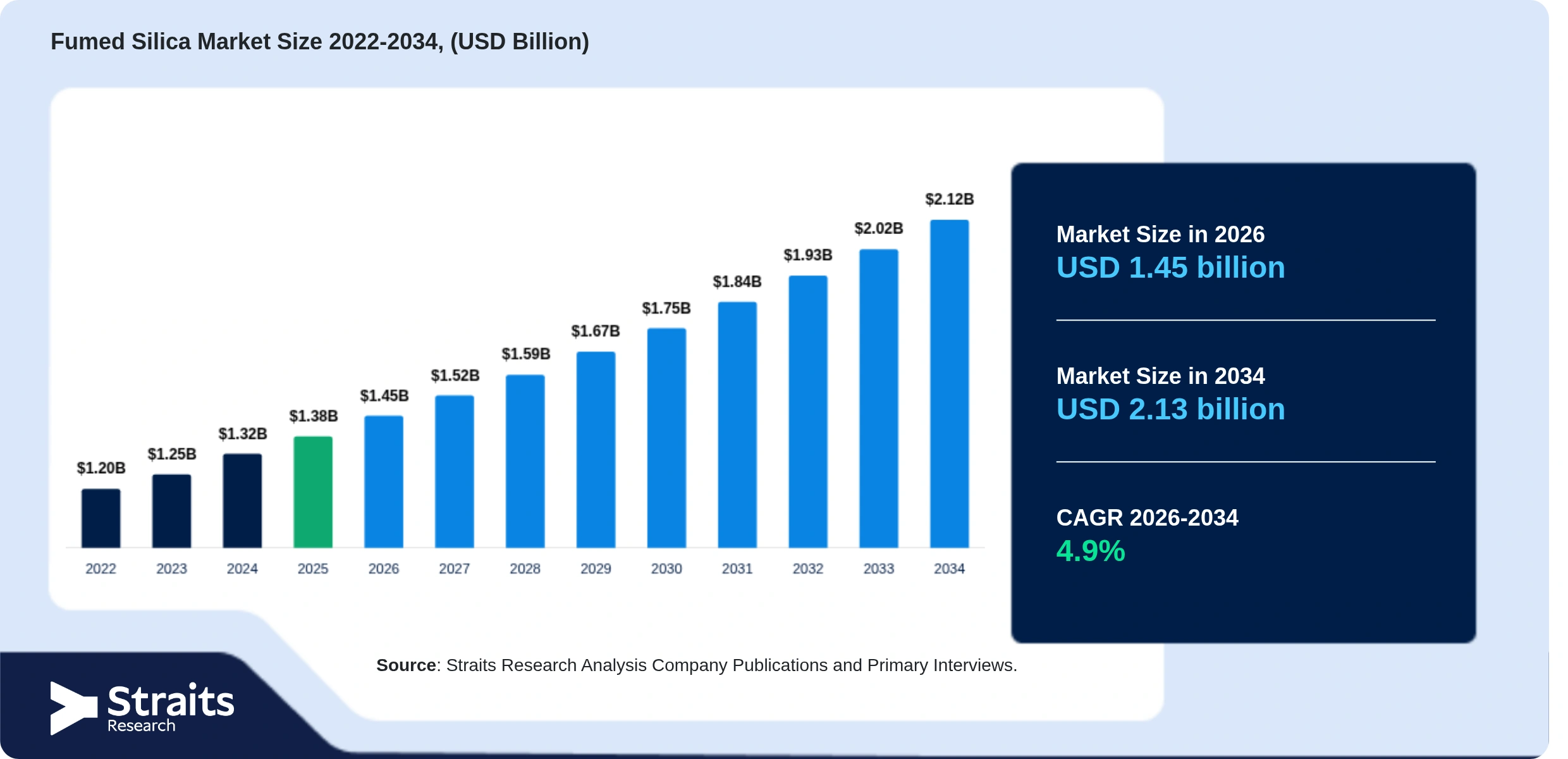
The global fumed silica market size was valued at USD 1.38 billion in 2025. The market is projected to grow from USD 1.45 billion in 2026 to USD 2.12 billion by 2034, registering a CAGR of 4.9% during the forecast period from 2026 to 2034. Asia Pacific dominated the global market in 2025, accounting for a share of 42.3%.
Market expansion is supported by demand from silicone rubber manufacturing, pharmaceutical and personal care formulations, paints and coatings, adhesives and sealants, and composite materials. The growing need for specialized silica grades in electronic materials and battery applications is also creating additional avenues for manufacturers.
Market Drivers
Expansion of Silicone Rubber Manufacturing
The expansion of silicone rubber manufacturing is supporting demand for fumed silica as a reinforcing filler. Its ability to improve mechanical strength, tear resistance, and durability makes it an important component in silicone rubber products used across automotive, electrical, medical, and industrial applications. Automotive seals and gaskets, for example, use fumed silica to improve strength and resistance to mechanical stress. Greater production of these components supports procurement from fumed silica suppliers.
Growth in Pharmaceutical and Personal Care Formulations
Pharmaceutical and personal care manufacturers use fumed silica as a flow agent, thickener, and anti-caking additive. Its formulation properties help improve powder flow, product consistency, and stability during manufacturing and storage. Applications include pharmaceutical powder formulations, tablets, face powders, creams, and gels. The need for consistent processing and product texture supports demand for suitable fumed silica grades across these industries.
Demand for High-Performance Adhesives and Sealants
Construction, automotive, and industrial manufacturers require adhesives and sealants with controlled viscosity, sag resistance, and bonding stability. Fumed silica provides thickening and rheology control, helping formulations maintain their properties during application. These requirements support consumption among adhesive and sealant producers and encourage specialty additive suppliers to develop application-specific products.
Expansion of Paints and Coatings Applications
Fumed silica acts as a rheology modifier that helps prevent pigment settling and controls coating flow. Its use supports storage stability, application control, and resistance to settling in architectural, industrial, and protective coatings. Demand from manufacturers serving buildings, vehicles, industrial equipment, and infrastructure contributes to its consumption in paints and coatings.
Growth in Composite Materials Manufacturing
Composite manufacturers use fumed silica to improve reinforcement, dispersion, and processing characteristics in resin systems. Its viscosity-control properties help maintain filler distribution in applications such as wind turbine components, automotive parts, and construction materials. These requirements create demand from manufacturers seeking consistent processing and performance in composite formulations.
Market Challenges
The fumed silica market faces competitive pressure from manufacturers with expanding production capacity and established supply networks. Findings published by India's Directorate General of Trade Remedies indicate that China's fumed silica production capacity is expected to expand by approximately 137.8 kilotonnes annually before 2027. The identified underutilized capacity also points to potential growth in export supply, which may intensify competition in international markets.
Product customization and quality requirements present another challenge for manufacturers serving specialized applications. High-purity electronic materials and surface-modified grades require controlled particle characteristics, low impurity levels, and application-specific performance. Manufacturers must therefore compete through product purity, particle size consistency, surface treatment capabilities, technical expertise, and reliable supply arrangements.
Market Opportunities
High-Purity Materials for Electronics
The demand for reliable insulation, thermal management, and contamination control in electronic components is creating opportunities for high-purity fumed silica. Controlled particle characteristics and low impurity levels make these grades suitable for specialty encapsulants, electronic adhesives, and advanced semiconductor-related formulations. Semiconductor investment initiatives in Japan, the U.K., Germany, and the U.S. may support further demand for specialty materials used in electronics manufacturing.
Specialized Grades for Batteries and Energy Storage
The growing use of fumed silica in gel batteries and other energy-related applications creates opportunities for manufacturers. In gel batteries, fumed silica helps stabilize gel electrolytes through electrolyte immobilization. Its insulating and rheology-control properties also support specialized formulations used in batteries, electronic components, and energy storage systems.
Surface-Modified Formulations
Hydrophobic surface treatments improve compatibility with non-polar resins, silicone systems, and moisture-sensitive formulations. Tailored surface properties also support dispersion and thickening performance. These characteristics create opportunities for specialized fumed silica grades used in adhesives, sealants, coatings, and silicone-based materials.
Market Segmentation
The fumed silica market is segmented by type, application, and end-use industry.
By Type
The hydrophilic segment held the leading position, accounting for 61.4% of the market share in 2025. Its effectiveness as a thickening, anti-settling, and reinforcing agent supports its use in paints, adhesives, pharmaceutical products, and personal care formulations.
The hydrophobic segment is projected to grow at a CAGR of 6.34% during the forecast period. Its moisture-repellent properties and compatibility with non-polar formulations support applications in silicone rubber, sealants, coatings, and moisture-sensitive products.
By Application
The paints and coatings segment dominated the market with a share of 27.4% in 2025. Fumed silica functions as a rheology modifier, anti-sagging agent, and anti-settling additive, helping improve coating stability and application properties.
The gel batteries segment is projected to register the highest CAGR of 6.82%. Its growth is supported by the use of fumed silica to stabilize gel electrolytes, immobilize electrolyte materials, and support battery performance in backup power and energy storage applications.
By End-Use Industry
The construction segment accounted for the largest market share of 24.5% in 2025. Fumed silica is used in construction sealants, adhesives, coatings, and construction chemicals, where its thickening, reinforcement, and anti-sagging properties improve formulation stability and application performance.
The electronics and energy segment is projected to grow at the highest CAGR of 6.73%. Demand for advanced materials in batteries, electronic components, and energy storage systems supports this growth, with fumed silica contributing insulating and rheology-control properties to specialized formulations.
Regional Analysis
Asia Pacific
Asia Pacific dominated the global fumed silica market with a share of 42.3% in 2025. The region benefits from its established chemical manufacturing base and demand across industrial applications.
Japan's Ministry of Economy, Trade and Industry aims to increase domestic semiconductor-related sales to more than JPY 15 trillion by 2030. The government also plans to encourage over JPY 50 trillion in public and private semiconductor and AI investments over ten years, potentially creating opportunities for fumed silica used in semiconductor polishing applications.
China's fumed silica production capacity is expected to expand by approximately 137.8 kilotonnes annually before 2027, according to findings published by India's Directorate General of Trade Remedies. Existing underutilized capacity may also support additional export supply and increase competitive pressure in international markets.
In India, NITI Aayog projects domestic chemicals market consumption to reach USD 290–310 billion by 2030. Inorganic chemicals account for approximately 9% of the domestic chemicals industry, providing a relevant industrial demand base for materials such as fumed silica.
Europe
Europe is projected to be the fastest-growing regional market, registering a CAGR of 6.65% from 2026 to 2034. Semiconductor investment initiatives in the region may support demand for specialty materials used in electronic and precision applications.
The U.K. government plans to invest up to GBP 1 billion in its semiconductor sector over the next decade, supporting domestic research, manufacturing infrastructure, and advanced packaging capabilities. Germany is expected to attract up to EUR 40 billion in public and private semiconductor investments by 2030, while its semiconductor industry is expected to record annual growth close to 10% through 2030.
North America
North America accounted for 21.4% of the global fumed silica market in 2025. Semiconductor manufacturing expansion and battery-related investments are creating potential demand opportunities for specialty materials.
In the U.S., semiconductor manufacturing capacity is projected to increase by 203% by 2032, while the country's share of global fabrication capacity is expected to rise from 10% to 14%. These developments may support demand for fumed silica used in semiconductor chemical-mechanical polishing applications.
In Canada, Volkswagen's PowerCo battery plant in Ontario, backed by an announced investment of CAD 7 billion, is expected to begin operations in 2028. Asahi Kasei's CAD 1.6 billion battery separator facility is expected to start operations in 2027, potentially supporting demand for specialty materials in battery-related applications.
Key Players
The fumed silica market is moderately consolidated, with established specialty chemical manufacturers, silica producers, advanced materials companies, and regional suppliers competing across major applications. The five leading companies—Evonik Industries AG, Wacker Chemie AG, Cabot Corporation, Tokuyama Corporation, and OCI Company Ltd.—collectively accounted for an estimated 38.7% of the global market share in 2025.
Key players in the fumed silica market include:
-
Evonik Industries AG
-
Wacker Chemie AG
-
Cabot Corporation
-
Tokuyama Corporation
-
OCI Company Ltd.
-
Air Liquide S.A.
-
Shandong Xinlong Group
-
GCL Technology Holdings Limited
Competition is based on product purity, particle size consistency, surface treatment capabilities, production capacity, quality standards, technical expertise, global distribution networks, and long-term customer relationships. Manufacturers are also focusing on specialized surface-modified grades, application-specific formulations, production technologies, and flexible supply arrangements.
Conclusion
The global fumed silica market is projected to expand from USD 1.45 billion in 2026 to USD 2.12 billion by 2034, registering a CAGR of 4.9%. Demand from silicone rubber, pharmaceuticals, personal care, paints and coatings, adhesives, construction, and composite materials continues to support market development. Meanwhile, high-purity electronic materials, gel batteries, and surface-modified formulations are creating additional opportunities for specialized product manufacturers.
Asia Pacific remains the largest regional market, while Europe is expected to record the fastest growth during the forecast period. Manufacturers focusing on product quality, customized formulations, and application-specific solutions are positioned to address evolving requirements across industrial and advanced material applications.
For detailed market segmentation, regional forecasts, competitive analysis, and customized research insights, request a sample of the report: http://straitsresearch.com/report/fumed-silica-market/request-sample

 English
 Arabic
 French
 Spanish
 Portuguese
 Deutsch
 Turkish
 Italiano
 Russian
 Romaian
 Portuguese (Brazil)
 Greek
