
Personalized Implants and Advanced Fixation Systems Reshape Craniofacial Surgery
Craniomaxillofacial Devices Market Size, Share, Growth Opportunities, and Industry Analysis (2026–2034)
Market Overview
The global craniomaxillofacial devices market is gaining momentum as specialized implants and surgical instruments play an important role in repairing, reconstructing, and stabilizing the bones and soft tissues of the skull, face, and jaw. These devices are used in trauma treatment, reconstructive procedures, and the correction of congenital deformities. The product landscape includes cranial flap fixation systems, CMF plates, screws, bone graft substitutes, distraction systems, and temporomandibular joint replacement devices.
The market is supported by demand for facial trauma reconstruction, corrective procedures for congenital craniofacial disorders, and specialized surgical treatments. Advancements in patient-specific 3D-printed implants and bioresorbable fixation systems are also shaping product development and clinical applications.
Request Sample: http://straitsresearch.com/report/craniomaxillofacial-devices-market/request-sample
Market Size and Forecast
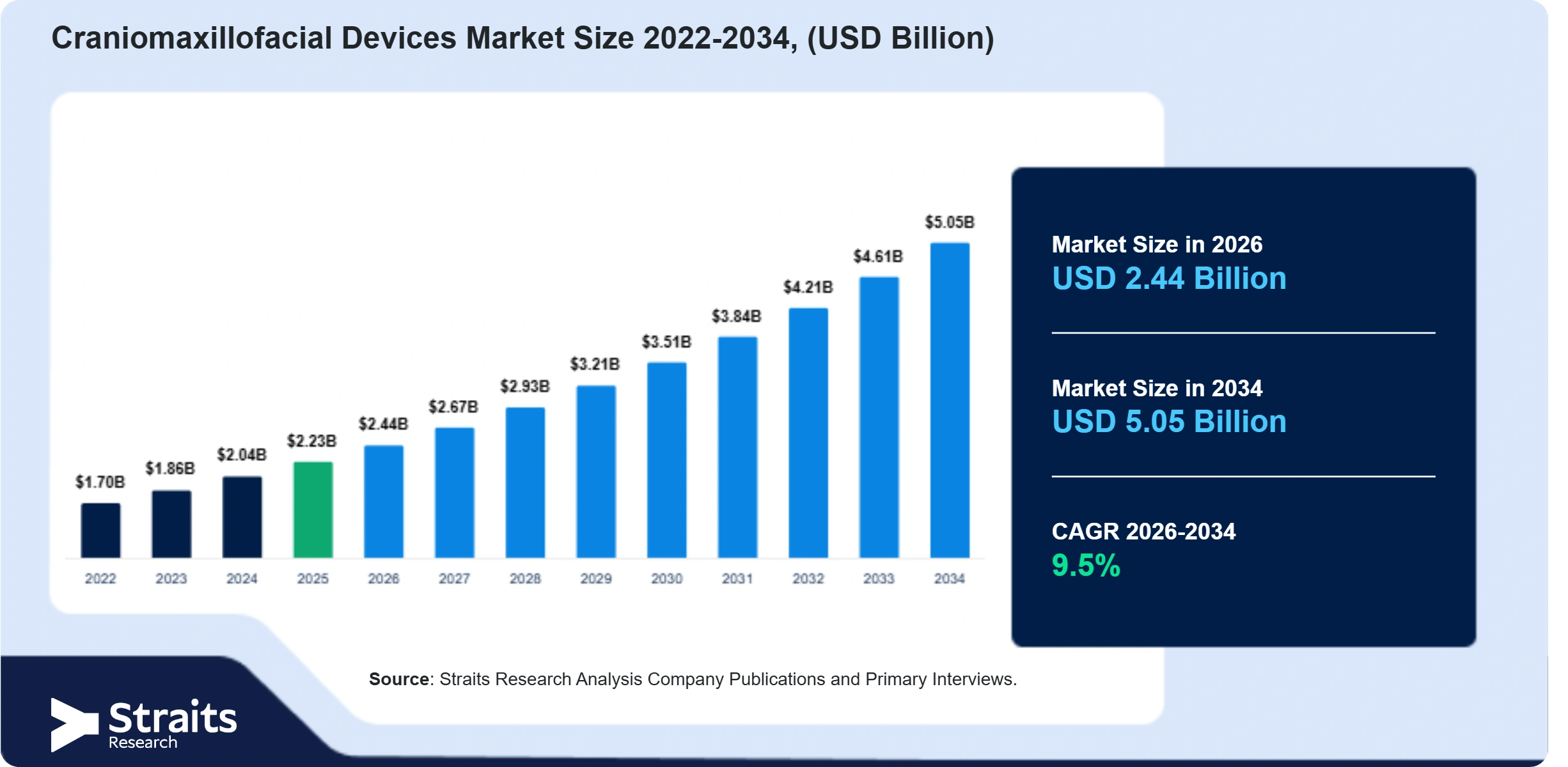
The global craniomaxillofacial devices market was valued at USD 2.23 billion in 2025. It is projected to increase from USD 2.44 billion in 2026 to USD 5.05 billion by 2034, registering a CAGR of 9.5% during the forecast period from 2026 to 2034.
The market outlook reflects the role of specialized fixation and reconstruction devices in complex cranial and facial procedures. North America held the leading regional position in 2025, accounting for 38.5% of the global market. Europe is projected to record the fastest regional growth, with a CAGR of 9.2% through 2034.
Market Drivers
Facial Trauma and Reconstructive Procedures
Road accidents, sports injuries, and workplace incidents can cause complex fractures involving the jaw, cheekbone, and eye socket. These injuries often require specialized plates, screws, and fixation systems to stabilize damaged facial bones and support reconstruction. For example, patients experiencing severe facial injuries in road accidents may require titanium plates to stabilize fractured structures. The need for effective trauma treatment supports demand for craniomaxillofacial devices across hospitals and trauma centers.
Congenital Craniofacial Disorders
Conditions such as cleft palate, cleft lip, and craniosynostosis create demand for corrective craniofacial surgeries. These procedures frequently involve specialized implants and fixation devices to support bone reconstruction and restore facial structure. Children undergoing corrective surgery for craniosynostosis, for instance, may require cranial fixation plates to maintain the reconstructed skull shape. The need for early intervention and reconstructive treatment contributes to market demand.
Specialized Surgical Infrastructure
Expansion of specialized trauma centers and reconstructive surgery departments improves access to complex procedures. Investments in surgical infrastructure support the availability of advanced fixation and reconstruction technologies. Demand for post-traumatic reconstruction and devices used in head and neck cancer surgeries further contributes to the adoption of cranial plates, meshes, and fixation systems.
Market Challenges
The supplied market report does not identify or quantify specific market restraints. However, its competitive landscape highlights several important product and commercial requirements. Manufacturers compete on implant quality, durability, material biocompatibility, clinical evidence, regulatory approvals, and technological expertise. Maintaining strong product portfolios, surgeon relationships, and distribution networks is also important for market participation.
These requirements create a competitive environment in which manufacturers need to demonstrate the performance and suitability of their devices across different craniofacial procedures.
Market Opportunities
Patient-Specific 3D-Printed Implants
Patient-specific 3D-printed implants present an opportunity for manufacturers to address complex cranial and facial reconstruction requirements. Computed tomography imaging and computer-aided design allow digital implant models to reflect individual bone contours, defect boundaries, and fixation requirements. Additive manufacturing can then produce customized components using titanium alloys and biocompatible polymers. These technologies support the development of patient-matched cranial plates, orbital floor implants, and facial reconstruction components.
Bioresorbable Fixation Technologies
Bioresorbable plates and screws offer opportunities in procedures where temporary fixation is suitable. Materials such as polylactic acid and polyglycolic acid gradually degrade as the healing bone gains stability, potentially eliminating the need for secondary hardware removal procedures. Their application in pediatric craniofacial surgery and selected facial fracture treatments supports further product development in this segment.
Market Segmentation
By Products
CMF plate held the largest share of the craniomaxillofacial devices market at 21.6% in 2025. Its use in facial fracture repair, reconstructive procedures, and bone stabilization supports its leading position. Temporomandibular joint replacement is projected to register the highest CAGR of 9.1%, supported by demand for advanced jaw joint reconstruction, improvements in implant design, and developments in surgical techniques.
By Material
Metal accounted for the largest market share at 63.7%, supported by its strength, durability, biocompatibility, and established use in cranial and facial fixation procedures. Bioresorbable material is projected to record the highest CAGR of 9.1% during 2026–2034. Its growth is supported by interest in implants that gradually dissolve in the body and can reduce the need for secondary removal surgeries.
By Applications
Neurosurgery and ENT represented the leading application segment, accounting for 42.6% of the market in 2025. The extensive use of fixation and reconstruction devices in cranial procedures, trauma treatment, and complex head and neck surgeries supports its position. Orthognathic and dental surgery is projected to register the highest CAGR of 8.5%, driven by demand for corrective jaw procedures, facial reconstruction, and advancements in surgical planning and implant technologies.
Regional Analysis
North America
North America dominated the craniomaxillofacial devices market with a 38.5% share in 2025. In the U.S., federal funding for advanced reconstructive treatments includes a USD 12 million allocation by the Department of Defense to its Reconstructive Transplant Research Program. Specialist maxillofacial restoration centers also support the development of complex reconstructive care.
In Canada, a projected shortage of oral and maxillofacial surgeons through 2033 highlights the need to strengthen specialist surgical capacity. British Columbia plans to add 15 operating rooms and upgrade one hybrid operating room at Vancouver General Hospital by 2029, supporting capacity for complex surgical procedures.
Europe
Europe is projected to be the fastest-growing regional market, registering a CAGR of 9.2% during 2026–2034. In the U.K., the healthcare system targets at least 92% of elective treatments within 18 weeks by 2028–2029. Planned NHS capital investment of GBP 15 billion in 2029–2030 is also expected to support healthcare infrastructure and surgical capacity.
Germany's hospital modernization program includes a EUR 50 billion transformation fund for healthcare infrastructure and hospital restructuring. These investments could strengthen surgical facilities and access to specialized reconstructive treatments.
Asia Pacific
Asia Pacific accounted for 22.6% of the global market in 2025. Japan aims to expand global sales of domestically developed medical devices from JPY 10 trillion to JPY 28 trillion by 2040. It also targets an increase in annual medical device industry investment from JPY 1.9 trillion to JPY 4.2 trillion, supporting domestic manufacturing and innovation.
China's target of achieving 95% domestic procurement of high-end medical devices by county-level hospitals by 2030 is expected to encourage local product development and manufacturing. In India, the Production Linked Incentive scheme for medical devices has been extended through 2035–2036, with an allocation of approximately INR 2,700 crore. The program supports domestic manufacturing capabilities and investment in medical device production.
Key Players
The craniomaxillofacial devices market is moderately consolidated, with participation from established medical device manufacturers, specialized orthopedic and trauma implant companies, and regional suppliers. Stryker Corporation, Medtronic, KLS Martin, Medartis AG, and Johnson & Johnson are among the leading participants. These five companies are estimated to collectively account for approximately 55–60% of the global market.
Key companies operating in the market include:
-
Stryker Corporation (U.S.)
-
Medtronic plc (Ireland)
-
KLS Martin Group (Germany)
-
Medartis AG (Switzerland)
-
Johnson & Johnson (U.S.)
-
W. L. Gore & Associates, Inc. (U.S.)
-
Integra LifeSciences Corporation (U.S.)
-
OsteoMed LLC (U.S.)
Competition is shaped by implant durability, material biocompatibility, clinical evidence, regulatory approvals, product portfolios, and surgeon relationships. Emerging competitive approaches include patient-specific 3D-printed devices, customized surgical solutions, advanced biomaterials, and products designed for compatibility with minimally invasive surgical techniques.
Conclusion
The craniomaxillofacial devices market is projected to expand from USD 2.44 billion in 2026 to USD 5.05 billion by 2034, at a CAGR of 9.5%. Demand for facial trauma reconstruction, corrective craniofacial procedures, and specialized surgical treatments supports the market outlook. Patient-specific implants and bioresorbable fixation technologies also present opportunities for product innovation.
North America currently leads the market, while Europe is projected to register the fastest regional growth. CMF plates and neurosurgery and ENT remain important market segments, while bioresorbable materials and orthognathic and dental surgery represent key growth areas.
Report: http://straitsresearch.com/report/craniomaxillofacial-devices-market

 English
 Arabic
 French
 Spanish
 Portuguese
 Deutsch
 Turkish
 Italiano
 Russian
 Romaian
 Portuguese (Brazil)
 Greek
