
Why Sensitive Onboarding Workflows Need More Than Email and Secure Document Collection
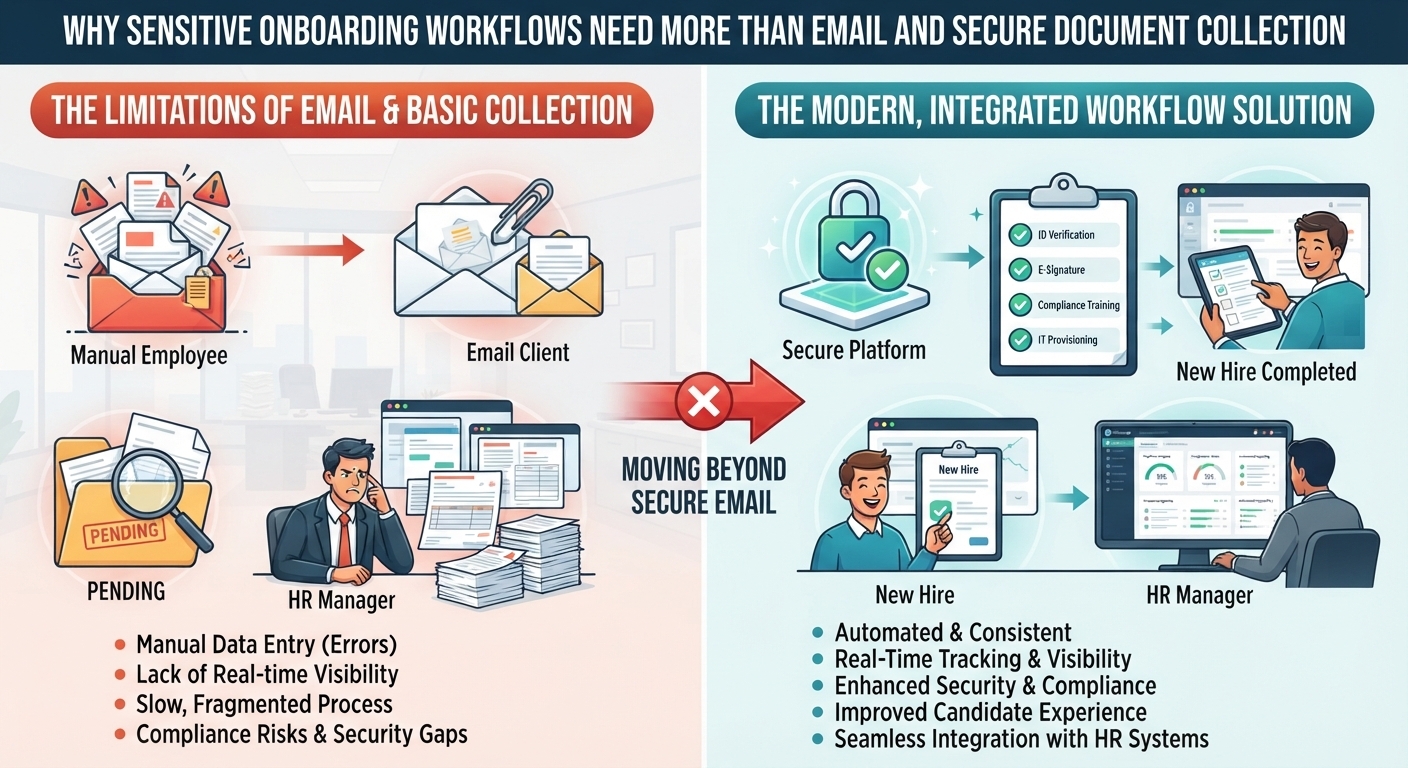
Onboarding often begins with a simple request: send us your identification, signed forms, banking details, certificates, contracts, or other supporting documents. The problem is that many organizations still collect this information through ordinary email, shared inboxes, public upload links, or loosely controlled file-sharing tools. That may be convenient, but convenience alone does not make a workflow secure. Sensitive onboarding documents often contain exactly the type of information organizations should protect most carefully, including personal identifiers, financial information, signatures, employment records, customer data, and regulated documents. Secure Document Collection provides a stronger foundation because it treats document intake as a controlled business process rather than a series of attachments moving between inboxes. The real objective is not simply receiving a file. It is receiving the correct information from the right person, protecting it during transfer, validating what was submitted, controlling access, preserving useful metadata, and moving the record into the next workflow without creating unnecessary copies or security gaps.
Email Was Never Designed to Be a Controlled Intake System
Email remains one of the most familiar business tools, which is precisely why organizations continue using it for sensitive document exchange. A customer, employee, supplier, or applicant already knows how to attach a file and press send. From an operational perspective, however, familiarity can hide significant weaknesses.
Once a sensitive document enters email, control becomes difficult. The sender may use the wrong address. A recipient may forward the attachment to another employee. Multiple copies can appear across inboxes, local downloads, mobile devices, backups, and shared folders. Employees may save attachments under inconsistent names or upload them manually into other systems. When the process is complete, nobody may know how many copies still exist.
The issue is therefore larger than encryption in transit. A secure onboarding process must consider the entire lifecycle of the document after submission.
Email is a communication channel. Sensitive intake requires a governed workflow.
The First Security Question Should Be Who Is Submitting the Document
Organizations often focus on protecting files after receipt, but secure onboarding begins earlier.
Who is actually sending the information?
A document arriving from an email address does not necessarily provide strong assurance that the intended customer, employee, or supplier submitted it. Email accounts can be compromised, addresses mistyped, messages forwarded, and attachments sent by unauthorized intermediaries.
The appropriate level of identity assurance depends on the risk associated with the workflow, but organizations should think deliberately about how a submission is connected to the correct person or case.
A controlled document collection process can connect upload requests to a specific recipient, transaction, application, or onboarding record. This reduces ambiguity and makes it easier to understand why each document entered the organization.
For sensitive workflows, that relationship between sender, request, and record can be as important as protecting the file itself.
Secure Collection Should Minimize Exposure Before Upload
One of the strongest security principles in document intake is simple: collect only what is actually required.
Onboarding processes often become bloated over time. Teams add document requests for unusual cases, then apply the same checklist to everyone. Customers may submit more information than necessary because instructions are unclear. Employees may request entire documents when only one specific piece of evidence is needed.
Every additional piece of sensitive information creates another asset that must be protected, governed, retained, and eventually deleted.
A well-designed collection workflow should make document requirements explicit. The user should understand what is needed, why it is needed, and which format is acceptable.
This does more than improve usability. It supports data minimization by preventing unnecessary information from entering the organization's environment in the first place.
Good security begins before the file is uploaded.
Encryption Is Important, but It Is Only One Layer
A secure transfer channel is essential when collecting sensitive documents, but encryption alone does not make an onboarding workflow secure.
Organizations also need to consider where files are stored immediately after submission, how keys are managed, who can access the records, whether employees can download copies, how long temporary files remain available, and what happens when the onboarding process finishes.
A technically encrypted upload can still create risk if every employee has broad access to the destination folder.
Likewise, strong storage encryption does little to prevent an authorized user from downloading sensitive documents to an unmanaged laptop.
Security therefore needs to be layered.
Secure Document Collection should operate within a wider control model that considers transport security, storage protection, authentication, authorization, auditability, retention, and downstream processing.
The strength of the workflow is determined by the entire chain, not by one security feature.
Access Should Follow Business Need, Not Inbox Visibility
Shared inboxes often create an unintended access problem.
A single onboarding mailbox may be visible to several employees because that arrangement makes coverage easier. But every employee with access may also be able to open every identity document, financial statement, contract, or customer record sent to that inbox.
This violates a basic governance principle: access should be limited according to legitimate business need.
A controlled collection environment can route different document types to different users or systems. HR records can remain restricted to authorized HR personnel. Financial documentation can follow a separate path. Compliance evidence can be routed to reviewers responsible for verification.
This reduces unnecessary exposure.
It also makes access easier to manage when employees change roles or leave the organization. Permissions can follow defined responsibilities rather than remaining tied to membership in an overly broad shared mailbox.
Auditability Matters When Something Goes Wrong
Sensitive onboarding processes eventually produce difficult questions.
Did the customer actually submit this document?
When was it received?
Who viewed it?
Was it downloaded?
Was another version later uploaded?
Who approved it?
Was the record transferred to another system?
These questions become important during disputes, security incidents, compliance reviews, internal investigations, or customer complaints.
Email is poor at answering them consistently because document history can become fragmented across multiple inboxes and systems.
A structured intake workflow can create a clearer audit trail. Important events can be recorded as the document moves through collection, review, validation, approval, storage, and eventual disposition.
The goal is not to log every meaningless technical action. It is to maintain enough evidence to reconstruct significant events when necessary.
Auditability turns document intake from an informal exchange into a defensible business process.
Validation Should Begin at the Point of Submission
Many onboarding delays are caused by incomplete or incorrect documents.
A user uploads the wrong file. A required page is missing. An image is unreadable. A certificate has expired. A document type does not match what was requested. A mandatory field has been left blank.
When these problems are discovered days later, employees must contact the user, reopen the case, request another file, and repeat part of the process.
A more structured collection workflow can reduce this rework by validating submissions earlier.
The system can require certain document types, restrict file formats, check whether mandatory fields are present, or flag submissions that require manual review.
Not every validation decision should be automated. Some documents require human judgment.
The objective is to prevent obvious errors from moving deeper into the workflow.
Earlier validation improves both security and efficiency because employees spend less time handling unnecessary, incomplete, or duplicate files.
Metadata Makes Sensitive Documents Easier to Govern
A file without context quickly becomes difficult to manage.
Consider a document called passport_scan.pdf. The filename tells the organization almost nothing about why the document exists, which onboarding process it belongs to, who submitted it, how long it should be retained, or who should be allowed to access it.
A controlled intake process can capture relevant metadata at the point of collection.
That metadata may include a customer or employee identifier, case number, document type, submission date, jurisdiction, workflow status, retention category, or relationship with other records.
This context allows the organization to manage the record more intelligently later.
Search becomes easier. Routing becomes more accurate. Retention rules can be applied more consistently. Duplicate documents are easier to identify. Archived records remain understandable even after the original onboarding team has changed.
For information governance, metadata is not decoration. It is part of the record.
Secure Collection Should Connect Directly With Downstream Workflows
A common mistake is to secure the upload process while leaving everything that happens afterward manual.
A document may arrive safely through an encrypted portal, only for an employee to download it, rename it, email it to another department, and upload it again into a CRM, HR system, archive, or case-management platform.
At that point, much of the original control has been lost.
The stronger model is integration.
Once the document has been collected and validated, it should move into the appropriate business system with as little unnecessary handling as possible.
For example, an identity document collected during onboarding might be associated automatically with the correct customer record. A signed agreement could move into contract management. Compliance documentation could enter a review queue. Completed records could be transferred into an archive according to retention requirements.
Reducing manual handoffs limits duplicate copies and makes the workflow easier to monitor.
Retention Should Be Decided Before Documents Begin Accumulating
Sensitive onboarding information should not remain available indefinitely simply because nobody created a deletion process.
Retention should be designed into the workflow.
Different document types may require different retention periods. Some records may need to remain available after a relationship ends. Others may only be required until verification is complete. Certain records may become subject to legal holds or regulatory requirements.
Without clear rules, organizations tend to retain too much.
That increases the amount of sensitive information exposed during a security incident and creates unnecessary privacy risk.
A stronger collection process connects incoming documents to retention categories early. This gives the organization a clearer basis for determining how long records should remain and when they can be disposed of responsibly.
Secure collection is therefore connected directly to information lifecycle management.
User Experience Is Part of Security
Security and usability are often treated as competing objectives, but poor user experience can actively weaken security.
If an upload process is confusing, customers may send documents through email instead. If a portal repeatedly fails, employees may create unofficial workarounds. If instructions are unclear, users may submit unnecessary personal information.
The secure route needs to be the easiest obvious route.
A good collection experience should explain what is required, allow users to upload documents without unnecessary complexity, show submission status clearly, and make correction straightforward when something is missing.
Organizations should also avoid demanding account creation or excessive authentication when the risk does not justify it.
Security controls should match the sensitivity of the workflow.
The goal is not to create friction. It is to make the controlled process easier than the uncontrolled alternatives.
Human Review Still Matters
Automation can improve onboarding significantly, but sensitive workflows should not assume every decision can be made by software.
Documents can be unusual, manipulated, incomplete, ambiguous, or inconsistent with other information in the case. Some situations require judgment, escalation, or additional verification.
The strongest model combines automated controls with human review.
Routine tasks such as routing, format validation, metadata capture, and completeness checks can reduce repetitive work. Employees can then focus on submissions that require interpretation.
This creates a more efficient exception-based process.
Instead of manually handling every document from beginning to end, teams concentrate their attention where human reasoning is actually valuable.
Secure Document Collection Is Ultimately About Control
The biggest difference between email-based onboarding and a structured collection process is not simply security technology. It is control.
Organizations gain greater control over who is asked for information, what is requested, how documents are submitted, who can access them, what metadata accompanies them, how they are validated, where they move next, how long they remain, and when they should be removed.
That control improves more than security. It can reduce onboarding delays, support compliance, improve auditability, lower manual effort, and create more consistent records.
This is why Secure Document Collection should be viewed as an operational capability rather than an upload feature.
The upload itself may take only a few seconds. The governance consequences can last for years.
Conclusion
Sensitive onboarding workflows cannot rely on the assumption that email is safe simply because it is familiar. The real challenge begins once valuable documents start moving through people, inboxes, shared folders, applications, archives, and retention processes.
Secure Document Collection creates a controlled point of entry where organizations can connect submissions to the right person and process, minimize unnecessary data, validate information earlier, restrict access, capture useful metadata, maintain auditability, and route records into downstream systems without creating uncontrolled copies.
For organizations handling sensitive onboarding information, the goal should not be to make document submission merely convenient. It should be to make the entire intake process secure, traceable, governed, and operationally useful from the first upload to final disposition.

 English
 French
 Spanish
 Portuguese
 Deutsch
 Turkish
 Dutch
Dutch
 Italiano
 Russian
 Romaian
 Portuguese (Brazil)
 Greek
Greek
