
How Digital Preservation Protects Files From Format Obsolescence and Technology Change
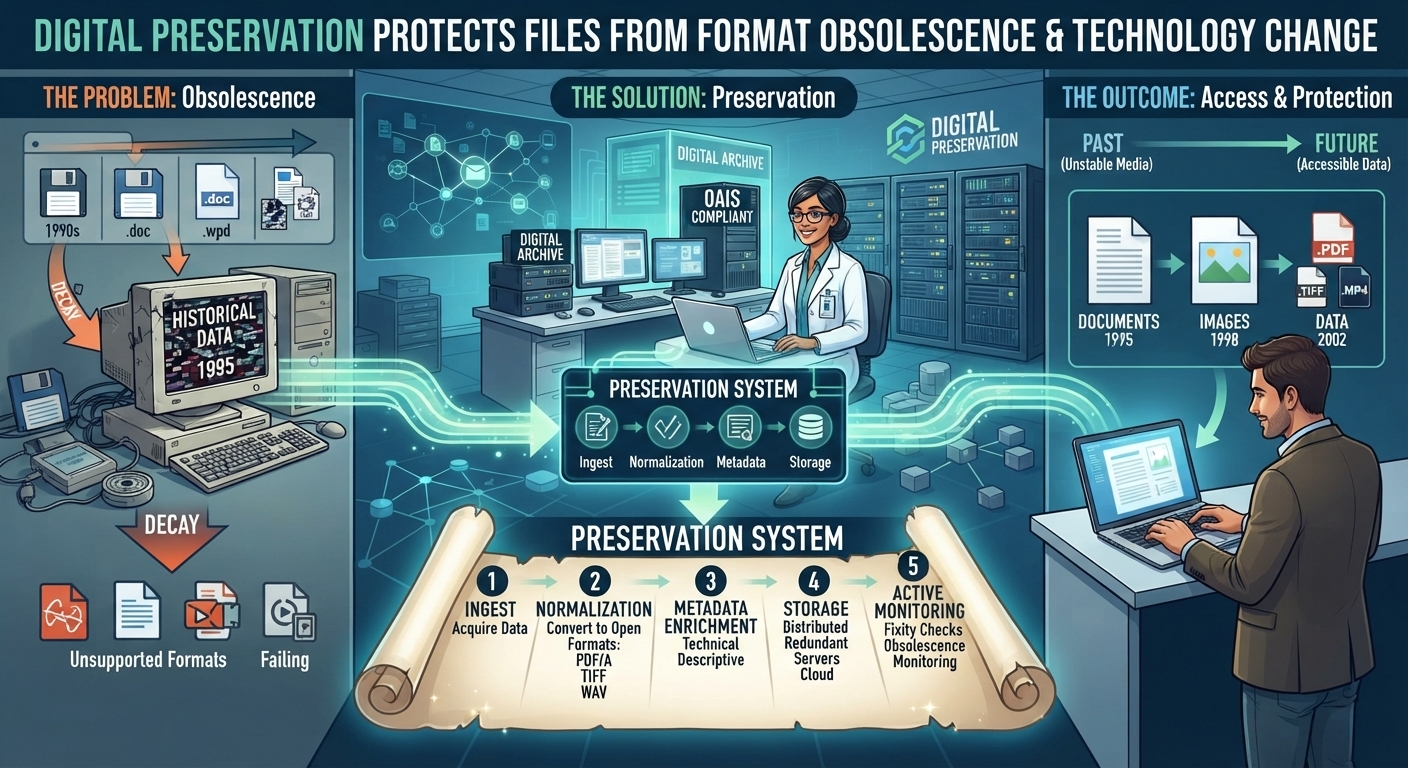
A digital file can survive perfectly and still become unusable. The bytes may remain intact, the storage system may report no corruption, and the organization may still possess every original file, yet users can struggle to open, interpret, or verify the information because the software, file format, operating system, or technical environment that once supported it has changed. This is one of the central problems Digital Preservation is designed to address. Long-term preservation is not simply about preventing deletion or keeping additional copies.
It is about maintaining the usability, meaning, integrity, and context of digital information as technology evolves. For organizations retaining contracts, regulated records, financial data, engineering files, signed documents, historical databases, or other long-lived information, format obsolescence can turn technically preserved data into practically inaccessible records unless the risk is managed deliberately.
Digital Files Depend on More Technology Than They Appear To
A paper document can often be read decades later with little more than adequate preservation and human eyesight. Digital records are different because they depend on layers of technology. A file requires software capable of understanding its format, hardware and operating systems that can run that software, storage capable of retaining the data, and sometimes external services, databases, plugins, encryption keys, or proprietary components.
This dependency is easy to ignore while systems are current. A spreadsheet created today opens instantly because the appropriate software is widely available. A specialized engineering file can be viewed because the application that created it is installed. An archived database can be queried because the required platform is still supported.
Years later, those assumptions may no longer hold.
Vendors stop supporting old products, operating systems change, file specifications evolve, and specialist applications disappear. Digital Preservation addresses this dependency by planning for the record to survive even when the original technical environment does not.
Format Obsolescence Often Happens Gradually
File formats rarely become unusable overnight. The process is usually gradual. A format may first stop receiving updates, then lose compatibility with newer software, become dependent on legacy plugins, and eventually require specialist tools to open correctly.
This gradual decline makes the problem easy to postpone.
As long as someone can still access the file, preservation work may appear unnecessary. But waiting until a format becomes difficult to read creates a much more complicated migration problem.
At that point, organizations may have thousands or millions of files requiring conversion. The original software may be unavailable, vendor expertise may have disappeared, and employees may no longer know how the files were intended to behave.
Early preservation planning allows organizations to identify format risks while they still have multiple options.
Preservation Starts With Knowing Which Formats Exist
An organization cannot manage format obsolescence if it does not know what file types are stored across its environment.
This sounds straightforward, but large organizations often accumulate decades of heterogeneous information. Archives may contain PDFs, spreadsheets, emails, image files, multimedia records, proprietary databases, CAD files, scanned documents, XML records, office documents, compressed packages, and application-specific formats.
Some formats may be relatively durable, while others depend heavily on specific software.
A Digital Preservation program therefore begins with visibility. Teams need to identify the formats they hold, understand which records have long-term value, and assess how dependent those formats are on particular applications or technologies.
The objective is not to convert everything immediately. It is to understand where future accessibility risk exists before that risk becomes an emergency.
Open and Well-Documented Formats Can Reduce Dependency
One way organizations reduce format risk is by favoring formats that are widely supported, well documented, and less dependent on a single vendor.
This does not mean proprietary formats are automatically unsuitable. Many business systems generate proprietary files for legitimate operational reasons. The problem arises when long-term access depends entirely on keeping one specific application alive indefinitely.
For records that must remain accessible for years or decades, organizations may create preservation copies or normalized representations in formats that are more likely to remain usable across different software environments.
The original file may still be preserved where authenticity, functionality, or evidentiary requirements make that necessary.
The key is avoiding a situation where the organization has only one fragile path to accessing important information.
Migration Is One of the Main Preservation Strategies
Format migration involves moving information from an aging format into a newer or more sustainable one while attempting to preserve the important characteristics of the original record.
This can sound simple, but preservation-quality migration requires careful decisions.
A document contains more than text. It may include fonts, layout, embedded objects, comments, formulas, interactive elements, metadata, digital signatures, hyperlinks, or other features. A conversion that preserves the visible page while removing critical functionality may not be an acceptable preservation result.
Organizations therefore need to define what characteristics must survive.
For some records, visual appearance may be the priority. For others, searchable text, calculations, structured data, metadata, or authenticity may matter more.
Digital Preservation treats migration as a controlled transformation rather than a basic file conversion exercise.
The Original File May Still Need to Be Preserved
Creating a newer representation does not always mean the original should be discarded.
The source file may contain evidence, metadata, functionality, or technical characteristics that are not fully represented in the migrated version.
For this reason, preservation strategies often distinguish between the original object and one or more accessible representations.
The original can provide historical or evidentiary continuity, while the newer representation supports practical access using current technology.
This approach can be especially valuable for complex records where no conversion perfectly reproduces every characteristic.
Maintaining the relationship between those versions is critical. Future users should be able to understand which file is the original, which representation was created later, when the transformation occurred, and why it was necessary.
Integrity Checks Protect Records During Technology Change
Migration introduces risk because information is being transformed or transferred.
Organizations need to know whether files were altered unintentionally, corrupted during movement, or lost during the process.
Integrity mechanisms such as checksums or cryptographic hashes can help verify that files remain unchanged when no transformation is expected. When transformation is deliberate, organizations can document the relationship between the source and resulting preservation copy.
This creates a more defensible migration history.
The objective is not to pretend that nothing ever changes. Technology change often requires preservation actions. The goal is to make those actions controlled, measurable, and traceable.
A future user should be able to understand what happened to the record rather than encountering a converted file with no explanation of its history.
Metadata Becomes Essential When Formats Change
When information moves between formats, metadata helps preserve continuity.
A file may need information about its original format, creation date, source system, migration date, conversion tool, record type, owner, retention category, or relationship with other files.
Without this context, future users may see only the newest representation and have no way to understand how it relates to the original record.
Metadata also supports future preservation decisions.
If an organization knows which format a record currently uses and what previous transformations occurred, teams can assess whether another migration is required later.
This turns preservation into a managed lifecycle rather than a series of isolated conversion projects.
Some Digital Records Cannot Be Preserved as Simple Documents
Not all digital information behaves like a PDF or image.
Databases, interactive applications, websites, software-generated reports, dynamic dashboards, and complex engineering records may depend on functionality as much as content.
In these cases, simply exporting a screenshot or static file can remove important meaning.
A database, for example, may depend on relationships between tables. An interactive record may rely on calculations or application logic. A website may contain links, multimedia, scripts, and changing content.
Digital Preservation therefore needs to identify what makes the record meaningful.
Sometimes that means preserving data together with structure and documentation. In other cases, organizations may preserve a rendered representation, an export, or sufficient technical information to reconstruct the original behavior.
The preservation method should follow the characteristics of the record rather than assuming every digital object can be treated the same way.
Emulation Can Preserve Access to Complex Legacy Formats
Migration is not always the best answer.
Some digital objects depend so heavily on their original environment that converting them would remove important functionality or meaning.
In these situations, emulation can be considered.
Emulation recreates aspects of an older technical environment so that legacy software or files can still operate on newer hardware.
This approach can preserve functionality that would be difficult to reproduce through conversion alone.
However, emulation also introduces complexity. Organizations may need to preserve software, documentation, configuration information, and technical dependencies alongside the record.
For many ordinary business documents, migration is simpler. For specialized or highly interactive digital objects, preserving the environment may be more appropriate.
Application Retirement Creates a Major Format Risk
Organizations often discover format problems when retiring legacy systems.
An application may contain years of records stored in proprietary formats or internal database structures. While the system remains operational, those records appear accessible because the application knows how to interpret them.
Once the platform is scheduled for retirement, the dependency becomes obvious.
Teams need to determine which information must survive, which formats can be preserved directly, which records need conversion, and what metadata or relationships must be exported alongside them.
A rushed retirement project may extract visible documents while losing the context or structure required for long-term use.
Digital Preservation should therefore be part of application retirement planning from the beginning.
The organization needs a strategy for preserving information independently of the software that originally created it.
Digitally Signed Records Need Special Treatment
Signed records create an additional challenge because changing the file can affect the relationship between the document and its original digital signature.
A simple conversion may produce a readable copy while no longer preserving the original signature evidence in the same form.
Organizations therefore need to distinguish between preserving accessibility and preserving the original signed object.
The original signed record may need to remain intact together with relevant validation information, timestamps, certificates, or other evidence. Additional representations can then support future readability where appropriate.
This illustrates why preservation cannot be reduced to converting old files into newer formats.
Different records carry different evidentiary requirements, and preservation methods must reflect those differences.
Technology Change Also Affects Storage and Infrastructure
Format obsolescence is only one part of the problem.
Storage technology also changes. Organizations move from on-premises infrastructure to cloud environments, replace storage hardware, change providers, and migrate archives between platforms.
These transitions can happen several times during the lifecycle of a long-lived record.
Preservation therefore needs to protect information across infrastructure changes as well as format changes.
Files should remain accounted for, integrity should be checked, metadata should survive, and access controls should continue after migration.
A new storage platform may be technically superior while still creating preservation problems if metadata, relationships, permissions, or lifecycle information are lost during the move.
Technology modernization should preserve the record, not merely the file payload.
Preservation Requires Monitoring, Not One-Time Conversion
A major mistake is treating Digital Preservation as a project that ends after one migration.
Technology continues changing.
A format considered sustainable today may eventually become less suitable. A storage platform will eventually be replaced. New security requirements may emerge. Applications will continue to be retired.
Preservation therefore requires periodic review.
Organizations need to monitor whether important formats remain supported, whether integrity checks continue to pass, whether metadata remains usable, and whether technical dependencies are increasing.
This does not mean constantly converting every record.
It means maintaining enough awareness to act before access becomes difficult.
Preservation works best when intervention happens while the organization still has choices.
Future Users Should Not Need the Original Technology Team
The ultimate test of preservation is whether someone can understand and use the information years later without relying on the people and systems that originally created it.
A future employee may never have seen the software that generated a record. The vendor may no longer exist. The original IT team may have moved on. Internal terminology may have changed.
The preservation environment therefore needs to carry enough context forward.
Future users should be able to identify what the record represents, understand its format and history, retrieve an accessible representation, and determine how the organization preserved its integrity.
This is why technical documentation, metadata, provenance, and migration history matter so much.
Long-term accessibility cannot depend on institutional memory surviving forever.
Conclusion
Technology change is inevitable, but losing access to important digital records does not have to be. Files can become unusable even when storage remains reliable because formats age, software disappears, systems are retired, and technical dependencies change. Digital Preservation addresses this risk by managing information as a long-term lifecycle rather than a collection of static files.
Format inventories, migration planning, integrity verification, metadata preservation, sustainable representations, controlled application retirement, and ongoing monitoring all help records survive technological change without losing their meaning or trust. The goal is not to freeze technology in place. It is to ensure that important information can move forward as technology changes, so future users can still open it, understand it, and rely on it when the original technical environment is long gone.
 English
 Arabic
 French
 Spanish
 Portuguese
 Deutsch
 Turkish
 Dutch
Dutch
 Italiano
 Russian
 Romaian
 Portuguese (Brazil)
 Greek
Greek
