
Why Is RWA Tokenization Important? Key Benefits, Use Cases, and Challenges
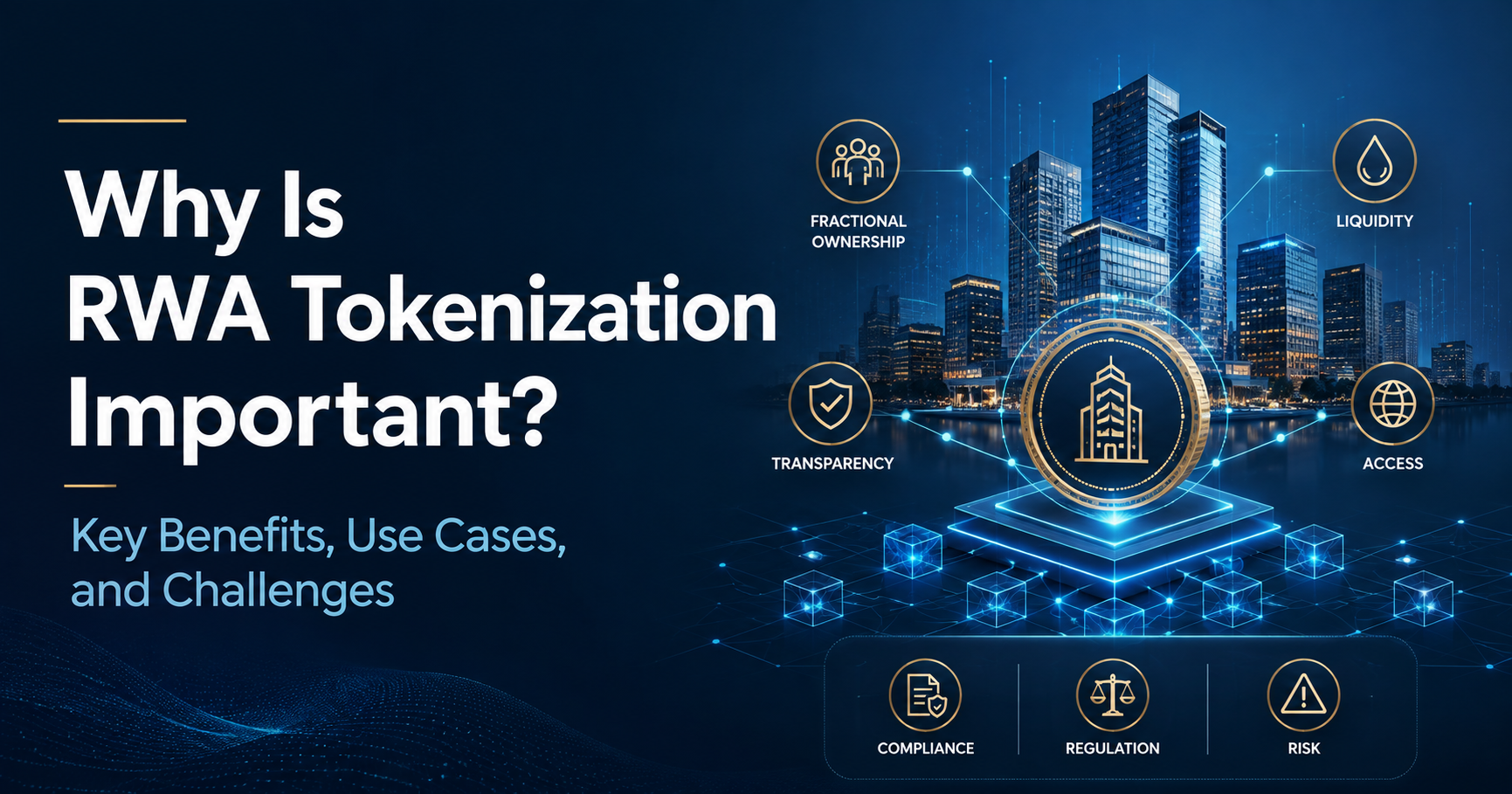
Real-world asset (RWA) tokenization is becoming one of the most important developments in blockchain-based finance. Instead of limiting blockchain applications to cryptocurrencies and digital-native assets, tokenization brings traditional assets such as real estate, government bonds, private credit, commodities, funds, and other financial instruments onto blockchain networks.
The idea is relatively straightforward: an asset or an ownership claim is represented digitally through blockchain-based tokens. These tokens can then be issued, transferred, managed, and, depending on the legal structure, traded through programmable infrastructure. What makes the concept significant is not simply putting an asset on a blockchain. The real opportunity lies in connecting traditional financial assets with programmable, transparent, and increasingly interoperable digital markets.
The market is already moving beyond experimentation. CoinGecko reported that tokenized RWAs excluding stablecoins reached approximately $19.3 billion by the end of Q1 2026, more than tripling from the beginning of 2025. Tokenized Treasuries remained the largest category, while commodities and tokenized equities also expanded.
What Is RWA Tokenization?
RWA tokenization is the process of creating blockchain-based digital representations of ownership, economic rights, or claims associated with real-world assets. Depending on the legal and technical structure, a token may represent direct ownership, a beneficial interest, debt exposure, shares in an entity holding an asset, or another contractual claim.
For example, consider a commercial property worth $10 million. Traditionally, ownership might be represented through legal documents and corporate records, while investment may require substantial capital and involvement from brokers, lawyers, custodians, banks, and other intermediaries. A properly structured tokenization model could divide economic interests in that property into smaller digital units, allowing eligible investors to acquire fractional exposure.
The blockchain does not automatically make the underlying property divisible or legally transferable. The legal framework, custody arrangements, investor rights, compliance procedures, and connection between the physical asset and digital token remain essential. This distinction is important because successful RWA tokenization is as much a legal and financial infrastructure project as it is a blockchain project.
Why Is RWA Tokenization Important?
The importance of RWA tokenization comes from its potential to modernize markets that have traditionally depended on fragmented systems, manual processes, and limited accessibility.
The Bank for International Settlements explains that tokenization can combine asset information, ownership records, and programmable rules on a common platform. This can enable automation, contingent transactions, and the combination of multiple financial activities through smart contracts.
Traditional asset markets often operate through multiple disconnected databases. An investor, broker, custodian, transfer agent, settlement institution, and regulator may each maintain different records. Reconciling these systems creates operational costs and opportunities for errors.
Blockchain-based infrastructure can provide a shared transaction environment where permitted participants interact with a common source of information. McKinsey identifies programmability, composability, transparency, liquidity, and operational efficiency among the major potential advantages of tokenization.
This does not mean blockchain automatically eliminates every intermediary. Instead, it can change what intermediaries do and reduce repetitive administrative functions.
Key Benefits of RWA Tokenization
1. Fractional Ownership and Greater Accessibility
One of the most frequently discussed benefits of tokenization is fractional ownership. High-value assets often require substantial capital, which limits participation to institutions or wealthy investors.
Tokenization can divide economic exposure into smaller units, potentially lowering the minimum investment size. Real estate provides a useful example. Instead of one investor purchasing an entire property, a compliant tokenized structure could allow multiple investors to hold interests connected to the asset.
However, fractionalization should not be confused with unrestricted public access. Securities laws, investor eligibility requirements, transfer restrictions, and jurisdiction-specific regulations can still apply.
2. Improved Liquidity
Many traditional assets are inherently illiquid. Private credit, commercial real estate, private equity, collectibles, and certain commodities can take weeks or months to transact.
Tokenization can introduce more flexible transfer mechanisms and potentially broaden the pool of eligible participants. If a compliant secondary market exists, token holders may have more opportunities to transfer their interests than they would under conventional private-market structures.
The important qualification is that tokenization does not automatically create liquidity. Liquidity requires buyers, sellers, appropriate market infrastructure, regulatory permission, and reliable pricing. In fact, research in 2026 has shown that a significant portion of tokenized asset value still experiences limited transfer activity, demonstrating that issuance alone does not guarantee an active market.
3. Faster and More Efficient Settlement
Traditional transactions may involve multiple stages of verification, reconciliation, clearing, and settlement. Tokenized markets can automate some of these processes through blockchain infrastructure and smart contracts.
This can enable faster settlement and reduce the need for repeated reconciliation between different databases. McKinsey notes that tokenization can support near-instant settlement, lower operational friction, and fewer reconciliation errors.
For institutions handling large transaction volumes, even small efficiency improvements can produce meaningful savings.
4. Greater Transparency and Traceability
Blockchain records can provide a transparent history of token movements and transactions. Depending on whether the network is public, private, or permissioned, different participants may have different levels of visibility.
This can improve auditability and make ownership transfers easier to track. For regulated financial products, programmable compliance rules can also be incorporated into the infrastructure, such as restricting transfers to approved wallets.
Transparency, however, is not the same as truth. If inaccurate information is entered into the system, blockchain technology does not automatically correct it. Reliable oracles, custodians, auditors, legal documentation, and asset verification remain essential.
5. Programmability and Automation
Programmability may ultimately be one of tokenization's most important advantages.
A tokenized asset can interact with smart contracts that automate predefined processes. For example, a tokenized bond could potentially distribute interest according to programmed rules. A tokenized fund could automate certain subscription and redemption processes. Tokenized collateral could interact with lending protocols where permitted.
The BIS describes this combination of tokenization and smart contracts as enabling new forms of automated and composable transactions.
This creates possibilities that are difficult to reproduce using disconnected legacy systems.
Major Use Cases of RWA Tokenization
Real Estate
Real estate is one of the most obvious candidates because properties are expensive, geographically concentrated, and often difficult to trade. Tokenization can support fractional investment, digital ownership records, automated distributions, and potentially secondary-market transfers.
For developers and asset managers, the model could also provide new ways to raise capital from qualified investors while maintaining clearer digital records.
Government Bonds and Treasury Products
Tokenized government securities have become one of the strongest real-world examples of institutional RWA adoption. RWA.xyz currently tracks more than $10 billion in tokenized U.S. Treasuries, demonstrating that tokenization is increasingly being applied to traditional fixed-income products.
BlackRock's BUIDL, Ondo's products, Franklin Templeton's Benji, and other initiatives demonstrate how established financial institutions are experimenting with blockchain-based fund and Treasury structures.
Private Credit
Private credit is another significant use case because loans involve complex documentation, servicing, collateral, and cash-flow management.
Tokenization can provide a standardized digital representation of loan interests while enabling automated reporting, transfers, and payment processes. It may also make private credit more compatible with digital financial infrastructure.
Commodities
Gold and other commodities are increasingly being represented through blockchain tokens. Tokenized commodities can provide digital exposure while connecting tokens to underlying physical assets through custodial arrangements.
The growth of tokenized gold has been particularly notable. CoinGecko reported that tokenized commodities reached $5.5 billion by the end of Q1 2026, with gold-backed tokens accounting for most of that growth.
Funds and Financial Securities
Asset managers are exploring tokenized money-market funds, bonds, equities, and alternative investment products. The attraction is particularly strong for institutions because tokenized funds can connect conventional investment products with blockchain-based settlement and distribution infrastructure.
Real-World Example: The Growth of Tokenized Treasuries
Tokenized U.S. Treasuries provide a useful case study because they demonstrate where tokenization currently has strong economic logic.
Treasury securities already have standardized structures, established demand, and relatively strong liquidity. Putting them onto blockchain infrastructure can provide investors with digital access while adding features such as programmable transfers, faster settlement, and integration with other on-chain financial applications.
According to RWA.xyz data, tokenized Treasury value has continued expanding rapidly, surpassing $10 billion in early 2026.
This illustrates an important principle: the strongest tokenization opportunities are not necessarily the assets that sound most innovative. They are often assets where blockchain can solve a specific problem in settlement, distribution, collateral management, or operational efficiency.
Challenges and Risks of RWA Tokenization
Despite its potential, RWA tokenization is not a simple process.
Regulatory Complexity
The biggest challenge is often regulation. A token representing an asset may be classified differently depending on the jurisdiction, underlying asset, investor rights, and structure.
Projects may need to address securities regulations, KYC and AML requirements, investor eligibility, taxation, custody, reporting, transfer restrictions, and licensing.
Connecting Blockchain to the Physical Asset
A blockchain can record ownership of a token, but it cannot independently verify whether a building, bond, gold reserve, or loan actually exists.
This creates an important “oracle” or asset-verification problem. Reliable legal agreements, custodians, auditors, administrators, and data providers are necessary to connect on-chain records with off-chain reality.
Security and Smart Contract Risks
Smart contracts introduce another layer of risk. Coding errors, vulnerabilities, access-control failures, oracle manipulation, and compromised administrative keys can potentially cause significant losses.
Professional smart contract audits, secure architecture, monitoring, and controlled upgrade mechanisms are therefore essential components of institutional-grade tokenization.
Fragmented Infrastructure
Different blockchain networks, token standards, custodians, wallets, compliance systems, and marketplaces may not work seamlessly together. Interoperability remains a major issue.
The BIS notes that the benefits of tokenization must be considered alongside economic, legal, and technical challenges, describing this as a “tokenisation continuum.”
Liquidity Does Not Come Automatically
Creating a token is comparatively easy. Creating a sustainable market around that token is much harder.
An asset needs demand, market makers or counterparties, compliant trading venues, transparent pricing, and investor confidence. This is why tokenization projects should be designed around a complete ecosystem rather than simply token creation.
What Is the Future of RWA Tokenization?
The long-term outlook is significant, but adoption is likely to happen gradually rather than all at once. McKinsey estimates that tokenized financial assets could reach approximately $2 trillion by 2030 in its base scenario, with a broader range of roughly $1 trillion to $4 trillion depending on adoption conditions.
BCG has presented a substantially more aggressive projection for tokenized real-world assets, estimating growth from around $0.6 trillion in 2025 to $18.9 trillion by 2033 in its midpoint scenario.
The difference between forecasts highlights the uncertainty surrounding the sector. What is clearer is the direction: financial institutions are increasingly testing blockchain not merely as a speculative technology but as infrastructure for issuance, settlement, custody, distribution, and asset management.
For businesses considering RWA tokenization, the priority should therefore be identifying an asset class where tokenization solves a measurable business problem. Regulatory structure, investor demand, liquidity strategy, custody, compliance, smart contract security, and interoperability should be designed together.
Conclusion
RWA tokenization is important because it has the potential to connect traditional assets with programmable digital financial infrastructure, improving accessibility, operational efficiency, transparency, settlement, and financial product innovation. However, successful tokenization requires more than launching a blockchain token; it requires legally sound asset structures, regulatory compliance, secure smart contracts, reliable custody, and a realistic liquidity strategy. Businesses looking to enter this market can work with experienced providers offering RWA tokenization development services and RWA tokenization services to build secure, scalable, and compliance-focused solutions. Blockchain App Factory provides best RWA tokenization services, helping businesses explore blockchain-based asset digitization and develop solutions aligned with their specific business requirements.

 English
 French
 Spanish
 Portuguese
 Deutsch
 Turkish
 Dutch
Dutch
 Italiano
 Russian
 Romaian
 Portuguese (Brazil)
 Greek
Greek
